
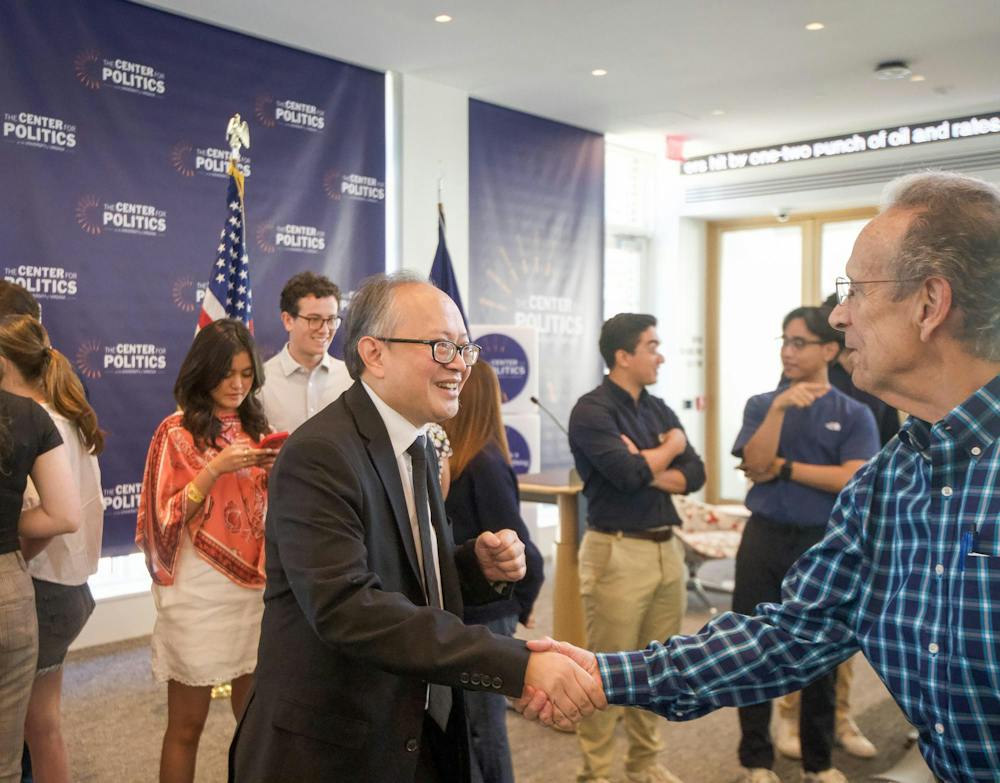
Ambassador of Thailand to the U.S. Suriya Chindawongse spoke Wednesday at the Center for Politics, discussing the Thailand-U.S. relationship. Chindawongse spoke about his home country’s history with the U.S., relations with other nations in Southeast Asia and Thailand’s economy and social progress. The Center for Politics at U.Va.'s Global Perspectives on Democracy program hosted the event in partnership with the Nelson Fund at the East Asia Center.
Chindawongse spoke on the history of the relationship between the U.S. and Thailand. Thailand — which was known as the Kingdom of Siam until 1939 — was the first country in Asia to form a treaty with the U.S. in 1833 with the Treaty of Amity and Commerce. The ambassador said that the U.S. is Thailand’s second largest trading partner and biggest export market.
Countries in Southeast Asia range from monarchies to republics and follow religions including Buddhism, Christianity, Islam and others, the ambassador explained. Chindawongse also spoke on the formation of the Association of Southeast Asian Nations — an intergovernmental organization that seeks to promote economic and security cooperation across Southeast Asia. Chindawongse said that Thailand brought Indonesia, Malaysia, the Philippines and Singapore together to form ASEAN in 1967 and since then, ASEAN has grown to have 11 members across the region.
“Now, 11 countries [are] committed to a regional integration program whereby we share similar economic goals,” Chindawongse said. “We have to learn to live with each other and to try to develop some regional added value for the larger Asia-Pacific region. So that has been our challenge — how to get 11 diverse countries to work together.”
Despite efforts to work closely with its neighbors in Southeast Asia, a conflict broke out between Thailand and one of its neighboring countries, Cambodia, in July 2025. Chindawongse said that Thailand did not plan to initiate this conflict and shared that Thailand is committed to cooperation, stability and peace. Fighting between the nations has concluded following a ceasefire last December, and the nations are currently undergoing a U.N.-backed conciliation regarding a different dispute on maritime borders.
“As a country that really thrives on trade, we don't want to have these conflicts with anyone, let alone our neighbor Cambodia,” Chindawongse said.
Chindawongse also spoke about Thailand’s domestic priorities. He said that Prime Minister of Thailand Anutin Charnvirakul is business-oriented, and the country is beginning to invest more in technology manufacturing and research and development.
Chindawongse said that Thailand is in a unique spot as an investment location — it is characterized as a stable country in Southeast Asia, provides key facilities to the U.S. military, is part of the Chinese-led Belt and Road Initiative and is located at the crossroads for many trade and transportation routes. The ambassador said that businesses from the U.S., China, Europe and Japan invest in Thailand.
“We are a safe haven — some say even a neutral haven — for investments from all over the world,” Chindawongse said. “With the problems that are happening in the Gulf right now in the Middle East, a lot of investors are looking at new safe havens for investment [in] Southeast Asia, including Thailand.”
Thailand’s investment into the technology sector comes at a time when tourism in the country has dropped 3 percent since the start of the year. Some domestic academics have called the Thai economy overly dependent on tourism and recommended that the nation adopt an economic diversification strategy. When asked about the decrease in tourism traffic in Thailand, Chindawongse said it was due to the baht — the official currency of Thailand — becoming stronger. This means each dollar buys less baht, making tourism more expensive for foreign visitors, and he said more generally that there are other options for tourists in Southeast Asia.
Chindawongse also spoke on Thailand's social progress. In 2024, Thailand became the third country in Asia to legalize same-sex marriage, after Taiwan and Nepal. In 2015, Thailand’s Gender Equality Act went into effect, preventing discrimination on the basis of gender and making the country “inclusive of lesbians, gay, bisexual and transgender people.” He also said that Thailand has been home to almost a million refugees since the end of World War II, and the country offers universal healthcare to everyone, regardless of immigration status.
Charlottesville resident James Nix came to the event to learn more about the country, having visited it prior. He said he came into the event not knowing much about the ties between the U.S. and Thailand, and he was surprised to learn that Thailand was the third country in Asia to legalize same-sex marriage.
“I didn't realize, even having been there, what an open and culturally liberal country Thailand is,” Nix said. “I was surprised to find out about the [legality of] same-sex marriage … It's a very forward-looking country.”
Chindawongse also answered an audience question regarding his experience as a diplomat, and he said that diplomacy is not something that can be learned in school, but is based on experiences. He shared a story of when a high-stakes ASEAN conference became heated, and he called in a birthday cake to diffuse the situation, bringing the diplomats to a consensus.
In an interview with The Cavalier Daily, Fiona Bailey, third-year College student and intern for the Center for Politics, said that she attended the event because of her interest in diplomacy. She said she was surprised by the breadth of information the ambassador had about both countries, and she appreciated the advice from Chindawongse on the qualities of a good diplomat.
“I was surprised at just the depth of knowledge that the ambassador had … It was really cool to see how much he knew about his country and the relationship [with the U.S.],” Bailey said. “I thought it was interesting that he spoke about how there's not one guidebook or tactic that works in diplomacy. You have to read the room.”

Edward Christopher is a staff writer on the news desk as well as a member of the advertising team for The Cavalier Daily. He is a second-year Commerce student from Northern Virginia. Edward enjoys covering state politics and University developments.
Read More

Buildings and Grounds Committee approves a U.Va. Health hospital renovation
By Grace Little | 1 hours agoThe Board of Visitors’ Buildings and Grounds Committee convened Thursday afternoon to approve the U.Va. Health Transitional Care Hospital renovation and the namings of 13 exterior spaces at Aggarwall Hall.

Supreme Court Justice Amy Coney Barrett discusses legal doctrines, emergency docket
By Edward Christopher | 2 hours agoShe reflected on how the role of the Supreme Court Justice has evolved since she clerked for former Supreme Court Justice Antonin Scalia and how she approaches legal issues.

Honor Committee continues discussion of changing appeals process
By Isabela Delgado | YesterdayThe proposed change would allow the Committee to better determine whether a sanctioned student's appeal is legitimate and would establish new qualifications that an appeal would need to meet to be allowed to continue through the appeal process.


