
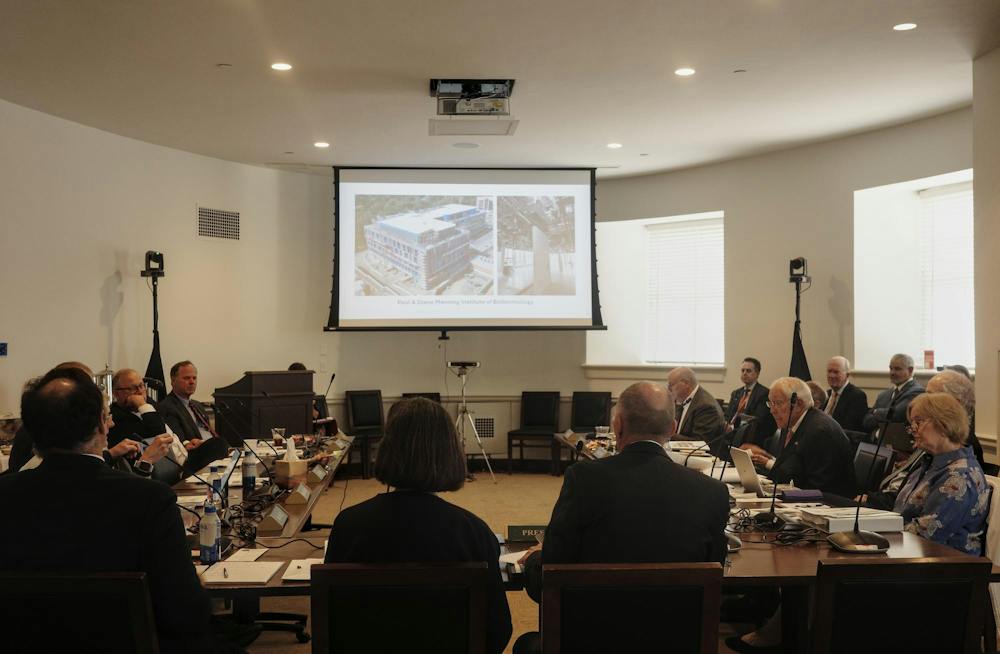
The Board of Visitors’ Buildings and Grounds Committee convened Thursday afternoon to approve the U.Va. Health Transitional Care Hospital renovation and the namings of 13 exterior spaces at Aggarwall Hall. University Architect Alice Raucher also centered the Committee with a presentation of the architectural design goals for buildings on Grounds, and Raucher walked Committee members through a schematic design review of the Darden Hall renovation for the College at Wise.
The Buildings and Grounds Committee oversees all the maintenance, design and construction of buildings and land belonging to the University. As many Committee members are new, Raucher provided the context for the University’s architectural goals that permeate the Committee’s work. She harkened its work back to Thomas Jefferson’s intentions when he built the University using precedents from ancient Rome and modern France.
“[Jefferson] was interested in establishing a certain worldliness in the architecture of his new college,” Raucher said. “U.Va. buildings strive to be worldly, addressing both local and international audiences. U.Va. buildings articulate their role in their educational mission through science, scale and design. Whether in brick, stone, concrete or steel, U.Va. buildings manifest solidity.”
Raucher clarified in her presentation that the closer a building is to the Lawn, the more “traditional” in style it tends to be to original architectural designs, whereas as one moves further from the center of Grounds, the buildings become more contemporary while retaining their unique, University character. Within the confines of the UNESCO World Heritage Site on Grounds, however, all buildings “must be designed consistently with the architectural expression of the [Academical] Village.”
Though the timing is off-cycle for additions to the Major Capital Plan — projects are typically approved in the summer — Lois Stanley, senior vice president for operations, presented to the Board the addition of the U.Va. Health renovation, which passed unanimously. According to Stanley, the project will address increased patient needs.
“This project is critical in supporting the much-needed expansion of inpatient beds on Grounds, and also for the Medical Center to meet the increasing demand for more comprehensive psychiatric care for both our region and our community,” Stanley said.
In the context of Raucher’s centering presentation, Board member Robert Byron mentioned a letter received by all committee members from Madison Spencer, principal of Madison Spencer Architects, over the summer denouncing recent architectural choices by the University's architectural team. In response, Byron said there will always be people displeased with certain architectural decisions due to architecture’s subjective nature. Board member David Webb confirmed that in his time on the Board, he has experienced several University stakeholders sending letters to the Board to voice their opinion. Byron reflected on the importance of being responsive to feedback, while also recognizing the robust process that goes into bringing each design to fruition.
Regarding other recent architectural controversies directed at the Board, John Nau, Board member and chair of Buildings and Grounds, clarified that private student housing developments — such as The Mark and Blume on Ivy — are not the work of the University.
Moving on the next action item of Aggarwal Hall — the new home of the U.Va. Alumni Association on Emmet Street — the Board unanimously approved the naming of all exterior spaces, including walkways, terraces, overlooks and archways. Jennifer Wagner Davis, executive vice president and chief operating officer, clarified that the U.Va. Alumni Association operates as a separate 501(c)(3) from the University, meaning it has been responsible for the planning and funding of the project. The names are for various donors, as well as the Honor Committee and Young Alumni Council, and the namings passed unanimously.
Moving off of Charlottesville Grounds to the College at Wise, Raucher presented to the Committee a schematic design review on the proposed Darden Hall renovation. The renovation will address outdated building systems and create ample collaboration spaces, according to Raucher.
“The goal of the project is to create a vibrant academic hub and study destination with collaboration spaces … [and] state-of-the-art classrooms and computer labs … update building systems and create an identifiable sense of arrival,” Raucher said. “Moving inside the building for a moment, this first floor collaboration space … provides dramatic views through the building to the western landscape.”
According to Wise Chancellor Donna Price Henry, the old, current building was constructed in a “70s style” with concrete. She said the faculty are excited about a “warmer building” with “gorgeous” views.
Nau followed up on the Darden presentation, noting that housing is another priority Wise could address following the Darden Hall project. Henry agreed, explaining how the housing needs of Wise students are currently met, but as enrollment continues to increase with each incoming class, housing will become an important focus.
Following the Wise portion, Andrea Trimble, director of the University Office for Sustainability, presented alongside two student employees for the Office on the University’s sustainability efforts.
“U.Va.'s leadership in sustainability has reduced operating costs, strengthened the resilience of our infrastructure, advanced student leadership opportunities and career development and has helped position U.Va. as a national leader for making national progress,” Trimble said.
According to Trimble’s presentation, the University has reduced its carbon emissions by 45 percent and its waste by 32 percent since 2010. In response to a question from Byron, Trimble said the Office employs 21 full-time staff and at least 20 part-time students, in addition to many student volunteers.
Board members Byron and C. Evans Poston suggested reaping the benefits of the infrastructure developed by the Office’s team by selling the sustainability infrastructure to other universities who could incorporate similar measures. Davis agreed this is a challenge the Sustainability office could take on. For the future, Trimble also noted that many of the Medical buildings are still left to tackle in terms of implementing sustainability measures to become energy efficient.
Two of the sustainability student employees — Anika Rekulapelli, fourth-year Engineering and College student, and third-year Engineering student Kate Balwinski — presented to the Committee sustainability skills they have learned that translate to career readiness.
Rekulapelli focused on her work in reducing food waste across Grounds. According to Rekulapelli, the sustainability team diverted over 130,000 pounds of food waste from fall 2025 football games, and the Free Food Alert App and U.Va. Dine to-go containers continue to save leftover food.
“In this work, I can actually see the difference we are making,” Rekulapelli said. “It's empowering to know that we as students can help divert hundreds of thousands of pounds of material from landfills. Being part of this work has made me feel more connected to Grounds and more confident in my ability to lead environmental progress.”
Balwinski informed the Committee about Corner cleanups and workdays in the Student Garden near Observatory Hill Dining Hall, which the Office of Sustainability organized.
“Being part of these programs has helped me see that sustainability isn't only about the environmental impact,” Balwinski said. “It’s about building relationships, supporting our community and seeing the difference we can make together. These programs have given me a place to contribute, to learn and to feel a part of something that is bigger than myself.”
Following the students’ presentations, Mark Stanis, director of capital construction and renovations of facilities management, gave updates on ongoing construction projects. Stanis said Darden student housing will be complete in April, and the student housing in the Ivy Corridor — set for completion in July — will include dining and student spaces with improved connectivity to Central Grounds. Additionally, Stanis said the Karsh Institute of Democracy should be completed this winter with the exception of the auditorium, which will be completed in April.
Stanis explained that the Paul and Diane Manning Institute of Biotechnology is currently having work done on its interior, and Stanis also touched on the construction of the North Grounds parking garage. Nau asked that this garage have University branding, and Davis clarified the garage would primarily serve commuters, long-term student parking and parking for events due to its close proximity to athletics facilities.
Stanis also mentioned the East Lawn repairs and maintenance and the infrastructure renewal of Memorial Gymnasium. According to Stanis, although students may walk into a similarly-looking building as before the renovations, the extensive work done included new air conditioning, plumbing and electrical systems and accessible restrooms. The gym will be fully open in Spring 2027, Stanis said.
Board member Peter Grant inquired about pedestrian connectivity as construction projects span across Grounds, and Raucher replied that the University has already made “great strides” in this field. For example, Raucher mentioned widened sidewalks and University President Scott Beardsley’s Staying Connected Across Grounds initiative.
Last, Stanley presented to the Committee on deferred maintenance, which usually accrues due to lack of funding, time or a data-driven approach. Stanley said the University has been relatively good about staying on top of deferred maintenance, although buildings such as Fitzhugh Housing and the West Complex will require substantial attention in the coming years.
The Committee adjourned its meeting at 2:55 p.m., and it is next scheduled to convene at the next meeting of the Board Dec. 2-4.

Grace Little is a news editor for the 137th term. She is a third-year student from Dallas majoring in neuroscience and the interdisciplinary major in public policy, politics and media studies. She enjoys writing about the shifting landscape of higher education, and you can reach her at g.little@cavalierdaily.com.
Read More
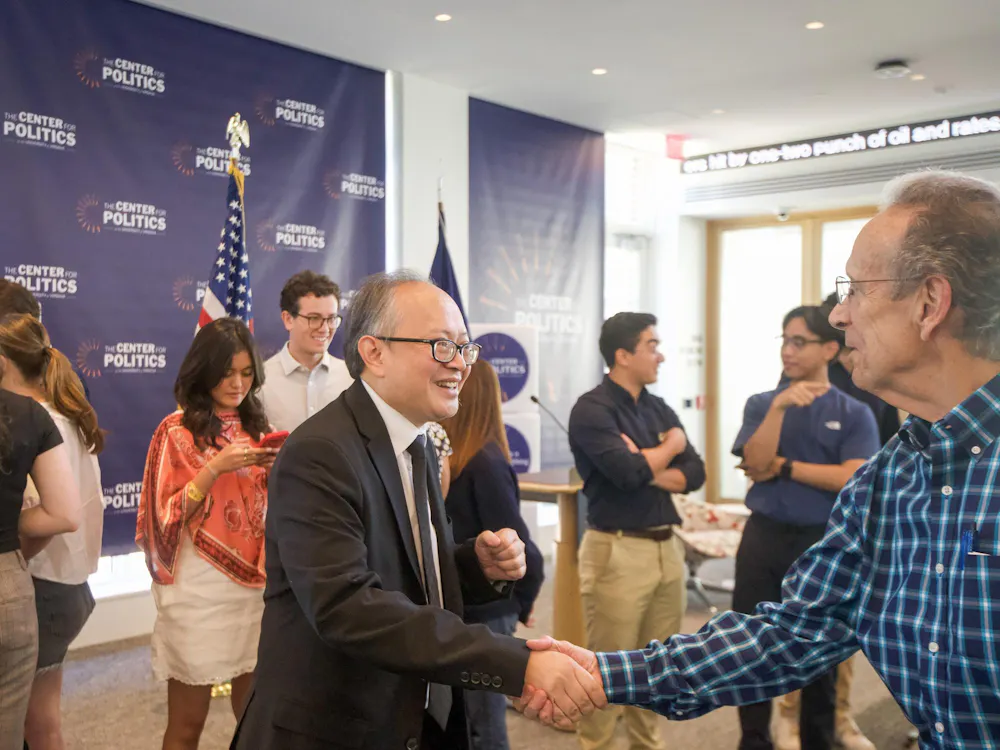
Ambassador of Thailand to the US speaks on Thai economy, conflict with Cambodia
By Edward Christopher | 4 hours agoChindawongse spoke about his home country’s history with the U.S., relations with other nations in Southeast Asia and Thailand’s economy and social progress.

Supreme Court Justice Amy Coney Barrett discusses legal doctrines, emergency docket
By Edward Christopher | 5 hours agoShe reflected on how the role of the Supreme Court Justice has evolved since she clerked for former Supreme Court Justice Antonin Scalia and how she approaches legal issues.

Honor Committee continues discussion of changing appeals process
By Isabela Delgado | YesterdayThe proposed change would allow the Committee to better determine whether a sanctioned student's appeal is legitimate and would establish new qualifications that an appeal would need to meet to be allowed to continue through the appeal process.


