
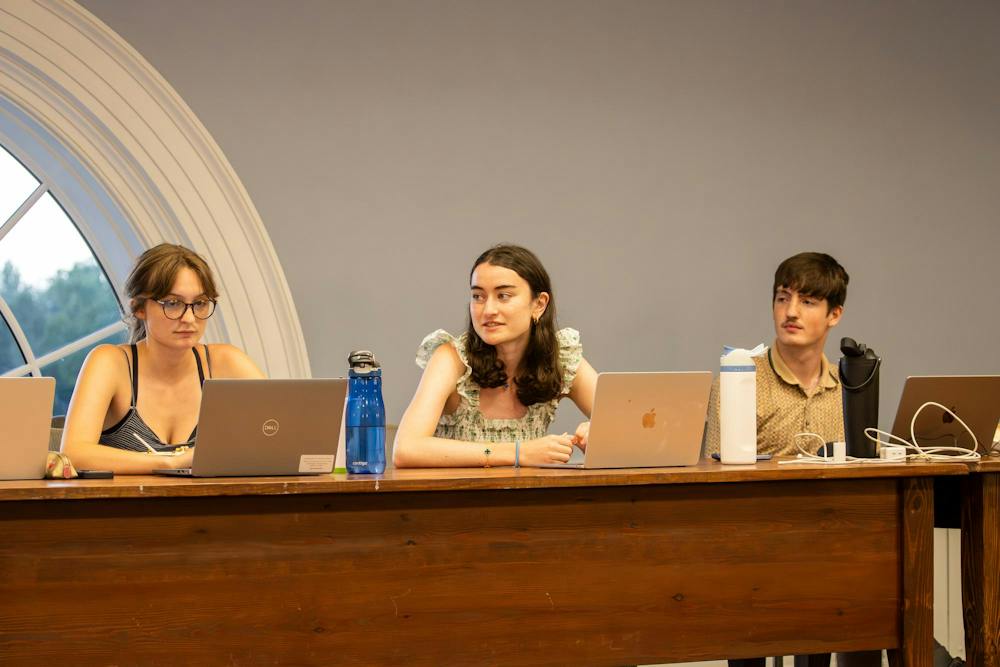
At its weekly meeting Sunday, the Honor Committee continued its discussion of amending the appeals process for students. The proposed change would allow the Committee to better determine whether a sanctioned student's appeal is legitimate and would establish new qualifications that an appeal would need to meet to be allowed to continue through the appeal process.
Sunday’s discussion was a continuation of the Committee’s first meeting of the semester, where it announced a proposed bylaw change that would alter requirements for students wishing to appeal an honor sanctioning decision following their trial decision. The newly proposed requirements would include submitting a detailed list of claims within the appeal brief that would then have to be evaluated against nine criteria.
The nine criteria include filing the appeal only following the conclusion of the sanctioning procedures, filing the appeal within the correct time frame as explained in the Committee’s bylaws, failure to cite a reasonable outcome of the appeal, failure to state an appealable claim, lack of prejudice, non-conclusory allegations, a prior waiver of a student’s rights, attempting to appeal a requested procedure and insufficient new evidence.
Two criteria from the previous proposal presented Sept. 2 were removed — lack of evidence of infringement of a student’s rights and lack of evidence of infringement of a patient’s rights. Additionally, the insufficient new evidence criteria was added since the first iteration.
According to Walter Blessing, Policies and Procedures subcommittee member and fourth-year College representative, the language used in the proposed criteria and in the proposed bylaws is still subject to change and will not be officially implemented until the Committee decides to vote on the bylaw and it is passed into effect.
The proposal was originally introduced Aug. 30 by Blessing, where he explained that the initial need for an appeal, as defined in the Committee’s bylaws, is to help students when the Committee makes a mistake and needs to correct an issue. He further explained that students have been using the appeal to alter the outcome of their sanctioning process, which is what prompted the proposal.
“The [Honor sanctioning] process can be very stressful for students and when they get sanctions that they’re unhappy with, they want something to change,” Blessing said. “So, [students have] been using the appeals process as sort of a way to go ‘through’ [the process].”
According to Blessing, the current appeals process begins with a student submitting an appeal on the grounds of either new evidence or good cause, where good cause includes factors such as a trial's fairness or timeliness.
Under the current bylaws, if the appeal brief is considered complete based on the aforementioned requirements, an appeal investigator is appointed to begin conducting an investigation. After the investigation is complete, an Appeal Review Panel can then vote on whether to dismiss the appeal, dismiss the Honor charges, alter the sanctions or grant students the right to a new investigative panel or panel of sanction.
In the new proposal, Blessing explained that the standing Committee chair would work alongside an appeals coordinator — a selected Committee member that is not associated with the case — in the Appeal Validity Conference. The Appeal Validity Conference is the meeting between the standing Committee chair and the appeals coordinator to evaluate each claim made in the appeal brief to determine whether an appeal is considered both “complete” and “valid.” The new proposal would also require students to provide an enumerated list of the alleged claims that warrant an appeal within their appeal brief prior to submitting for review during the Appeal Validity Conference.
The Committee chair and the appeals coordinator would then weigh each of the claims against the nine new criteria outlined in the proposal to determine the validity of the appeal in the Appeal Validity Conference.
The establishment of the Appeal Validity Conference would make it such that an appeal investigator is not appointed and an investigation is not started until after the appeal has been approved. Under the current bylaws, an appeal investigator and investigation are started following the appeal brief’s filing with the vice chair for hearings considering the appeal is complete per the Committee’s bylaw requirements.
Along with the proposed changes to its appeals process, the Committee also discussed its recent wave of applications with the Selections and Recruitment subcommittee.
Cody Scarce, vice chair of the undergraduate community, Selections and Recruitment Committee member and fourth-year College representative, shared that the Committee completed reviewing applications and started conducting interviews Tuesday and will continue conducting interviews throughout the duration of the week.
“We have a lot of really great applicants that are ready to get interviewed,” Scarce said. “We did really well this year with [Selections and Recruitment] and we exceeded my expectations, for sure.”
The Committee will reconvene for its weekly meeting Sunday in Newcomb 480 at 7 p.m. Meetings are open to the public and if a student requests to join a meeting via Zoom, the link must be requested from the Committee chair.

Isabela Delgado is a staff writer on the news desk who enjoys writing long-form pieces. Most of her work is focused on U.Va. Health and the Honor Committee, although she enjoys writing about many subjects. Outside of writing, Isabela is also a member of the photo desk. Isabela is from New Jersey and currently plans to major in government.
Read More

Professors say rise in AI-use has pushed redevelopment of courses
By Komal Reddymachu | 1 hours agoProfessors in three University departments described their experience with AI use in their own classrooms where large language models pushed them to rewrite assignments, restructure exams and in some cases, rebuild entire courses.

The Board will convene Sept. 16-18 — here is a preview of its meeting agendas
By Grace Little | YesterdayThe full University Board of Visitors will convene Wednesday through Friday to discuss artificial intelligence strategy, updates regarding the provost and dean searches as well as the buildings, finances and compliance of the University.

At first Council meeting since Free Bridge clearing, residents’ and City officials’ accounts differ
By Luca Bailey | YesterdayThe Charlottesville City Council convened for a regular meeting Sept. 8, where residents and City officials presented accounts of the clearing and subsequent early operations at the emergency shelter.


