
The City of Charlottesville cleared an encampment of unhoused residents along the Rivanna Trail Sept. 1, marking the final stage in a controversial facilitated transition process that saw the opening of an emergency homeless shelter at 2000 Holiday Drive for many displaced residents.
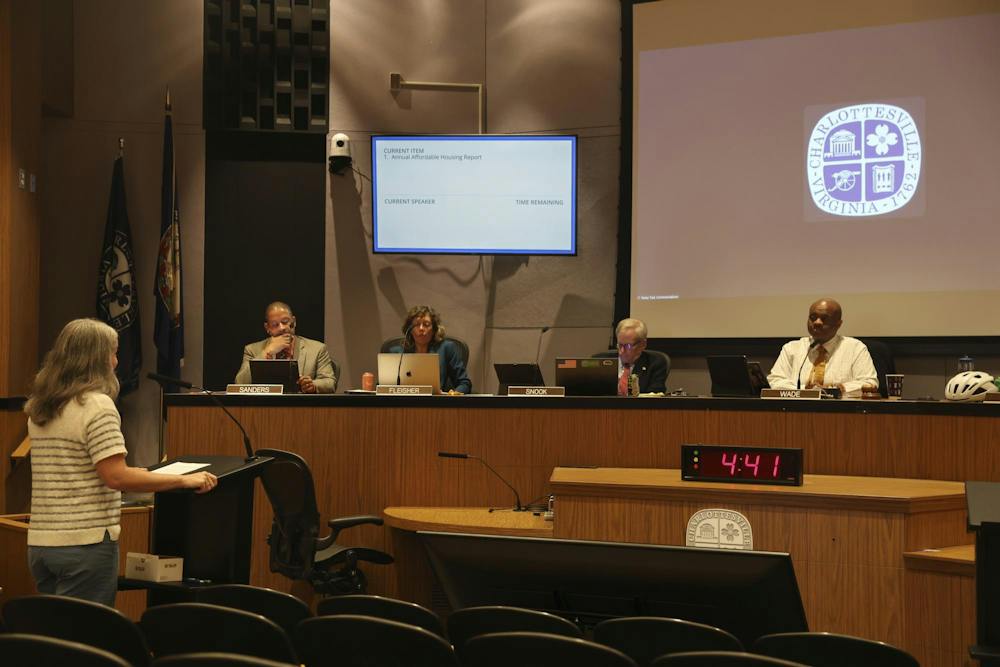
Seven days later, the Charlottesville City Council convened for a regular meeting Sept. 8, where residents and City officials presented accounts of the clearing and subsequent early operations at the emergency shelter that diverged considerably.
City officials had previously condemned the encampment at Free Bridge — the site of fires, two reported sexual assaults and one recent death — as an imminent risk of danger to the public. Aside from opening the shelter, the City utilized “multidisciplinary outreach teams” made up of City officials and community partners to connect residents with available services and resources throughout the summer. According to Charlottesville Tomorrow, 25 to 30 unhoused residents remained at the encampment Sept. 1 as the final volunteers and City officials arrived to help them relocate from the site.
Some City residents have disagreed with this approach, and have asserted that a facilitated transition disrupts the lives of unhoused residents without addressing the root causes of homelessness. During the “Community Matters” segment of the Sept. 8 meeting — the public portion in which up to 16 members of the public can address Council members for three minutes each — a number of speakers expressed dissatisfaction with the realization of the City’s plans and argued that the clearing itself was executed poorly.
Isis Neumann is a local advocate who volunteers with the “Charlottesville Care Bears” — an organization that seeks to serve the needs of the City’s unhoused population, whose volunteers were present Sept. 1. Neumann alleged that volunteers did “all the labor” to help residents move, while City staff stayed for just a few hours and largely got in volunteers’ way. Neumann said she saw residents having mental breakdowns and arrests taking place. She also criticized how tents were “going up in flames,” in reference to fires which an unidentified suspect lit Sept. 2, destroying a large number of unretrieved items that some encampment residents intended to return for.
Residents also assailed the heavy increase in police “surveillance” in the weeks leading up to the clearing, and asserted the process of connecting unhoused residents with outside help was carried out in bad faith. Neumann said there had been an increase in arrests and forced hospitalizations at the encampment in the weeks prior to the clearing. She noted one example where police officers allegedly “slammed” a resident to the ground, handcuffed her and forcibly transported her to a nearby hospital for care.
“When the City says that things went smoothly and without incident … clearly you mean without incident to yourselves,” Neumann said. “You were not hurt, so therefore it was incident free … You probably don’t understand why I am so infuriated at your actions because you do not truly see the people you are oppressing as fellow people … These people mean nothing to you, but they mean everything to me.”
Regarding the Holiday Drive shelter itself, speakers had similarly negative feedback. Donnas Chambers, a former encampment resident who now lives at Holiday Drive, expressed disapproval with the fact that some of the shelter’s 60 beds were given to unhoused residents not from the encampment, despite the fact that the City advertised the shelter as being for Free Bridge residents. Chambers said that by Sept. 2, the City had allowed a number of non-encampment residents to occupy beds, resulting in former residents of Free Bridge being turned away.
Chambers also alleged that during his time at the shelter, he had seen at least three instances of men threatening women and trying to make their way inside of the women's gender-segregated areas. He also told Council members that there are no working locks on the women’s restroom doors, which he believes is the product of an improperly rushed process.
“We told you before [that] this shelter was a bad idea,” Chambers said. “Y’all just threw a shelter together … and said ‘go there’ … How about y’all come there and live and y’all can see the incidents … You can see how it feels to walk outside at nighttime to try and go use the bathroom and worry about somebody coming in there to attack you.”
Another point residents took issue with was the cost of the shelter. Laura Sirgany, program coordinator for mentoring and community engagement at the University’s Maxine Platzer Lynn Women’s Center, questioned why the City would foot the bill for the shelter’s $3 million annual operating costs — an average of roughly $50,000 per resident — instead of investing in helping those residents rent “a decent living situation” in the City. Sirgany estimated that helping unhoused residents rent homes would total to less than half the cost of the shelter. According to Apartments.com, the average cost of 12 months of rent in Charlottesville totals roughly $20,628.
“You’ve built a soft-option prison camp instead of firm housing solutions for the same reasons you prioritize an arbitrary deadline over people’s well-being,” Sirgany said. “This is no way to serve our community.”
City staff asserted that the residents’ recollections of events were misleading. During what City Manager Samuel Sanders called the final regular update on the City’s efforts to clear the encampment, Assistant City Manager Samuel Roman addressed some of the residents’ points of concern directly. He reported that City staff and community partners both worked “late into the evening” Sept. 1, disagreeing with the assessment that they did not provide meaningful help to the remaining residents or outside volunteers.
Both Sanders and Roman noted that, ultimately, no Free Bridge resident was arrested for trespassing in the area on or after Sept. 1. Sanders clarified that the one resident arrested at Free Bridge that day was not arrested for trespassing at the encampment. The arrested resident had an outstanding warrant in Albemarle County, according to Charlottesville Tomorrow.
In response to the allegation that City police tackled a resident to the ground and forced her to receive medical care, Roman said that this did not happen. Roman and Sanders also clarified that there were a total of two police officers at Free Bridge Sept. 1, neither of whom were wearing their uniforms and both of whom had been at the site previously to “[establish] trust” with the people living there. Roman did note at the Council’s Aug. 3 meeting, however, that the City had increased the police presence in the weeks leading up to Sept. 1 following a reported rape at the encampment July 27.
At the shelter, although a number of unhoused residents were given beds, Roman said Free Bridge residents were ultimately given priority. He also said that Chambers’ concerns over possible harassment had not been raised directly with Central Arizona Shelter Services, the outside firm which the City hired to operate the emergency shelter in July. Still, he said that both entities would discuss the matter further after Chambers brought it up at the meeting. Roman asserted that the women’s showers and bathroom stalls at Holiday Drive have working locks.
The evening before the Holiday Drive shelter was set to open, the building failed an inspection by Chief Building Official Chuck Miller, who indicated that the shelter still had a number of remaining violations, including a lack of exterior locks at the building’s entrance and on the women’s emergency exit. These violations, however, did not include any mentions of missing locks on the women’s restroom doors, and all issues were subsequently fixed the next day, according to a subsequent review by Miller, who issued a building permit for the site Sept. 1.
Regardless of the specifics, Roman indicated that the City was committed to mitigating “the reality or perception” of the many concerns residents raised Sept. 8.
Council member Jen Fleisher, who volunteered to work a night shift at Holiday Drive Sept. 5, also gave her own recollections of what she saw during her time there. Fleisher said that she had “very positive” interactions with the shelter’s residents. One had just gotten a new job, while others were in the process of going through the proper channels to find one, according to Fleisher. She also said she noticed a number of couples at the shelter who seemed to be “taking rest” for the first time “in a while.”
Fleisher said that residents were “well accommodated” by staff, and that a QR code to report complaints and grievances was plastered prominently on the wall. Fleisher has said she believes the facilitated transition went “smoothly.”
“Like any business opening [in] its first week, there will be some things that they’ll want to refine,” Fleisher said. “But for something that opened in five weeks in particular … [I think] the CASS team and the community teams that support them — and our teams — have really delivered.”
The shelter is currently in the process of hiring a volunteer coordinator who will compile a more comprehensive list of the shelter’s immediate needs in terms of donations and volunteer work, Fleisher said. Still, she noted the shelter has received a “generous outpouring of items and clothing,” and said those wishing to help further can donate to the Charlottesville Area Community Foundation.
In response to a question from Council Member Michael Payne about increasing the number of beds at the new shelter, Roman said the “capacity for more is there,” but that the City would work collaboratively with existing residents to ensure that a more utilized layout would remain comfortable without becoming too crammed. The City estimates the building’s maximum capacity is around 120 beds.
Michael Payne reiterated that he believed the facilitated transition was a net good for the community and for unhoused residents, noting that the fullness of the shelter clearly indicates that it is meeting a “significant need.” Payne stressed the need for residents forming an opinion on the issue to ensure they have their facts and figures straight.
“I think people can agree with the City’s approach, disagree with our approach or have mixed feelings about it,” Payne said. “All of that’s fine, but it is very important to be able to have an accurate basis of facts of what has actually happened … I firmly believe that [the transition] is a far more compassionate and humane approach than saying that people can die by the encampment with no intervention by the City.”
Sanders explained that he was irritated by what he perceived as a lack of fairness from certain commentators on the issue.
“For those that are hearing me and [think that] I might sound a bit angry … It’s just passion,” Sanders said. “It's irritation [from] when things are not being communicated fairly and accurately. It’s important for us to make sure that people understand that we made a real difference by opening that facility — and we’re not done.”
The Council’s regular meeting schedule can be found on the City’s website. The next regular, biweekly meeting will take place Monday.

Luca Bailey is a third-year College student majoring in politics from Free Union, Va. As a staffer on the news and video desks, he has covered topics ranging from the General Assembly and state elections to local politics and University governance. He is also The Cavalier Daily’s beat writer for the Charlottesville City Council.
Read More

The Board will convene Sept. 16-18 — here is a preview of its meeting agendas
By Grace Little | 10 minutes agoThe full University Board of Visitors will convene Wednesday through Friday to discuss artificial intelligence strategy, updates regarding the provost and dean searches as well as the buildings, finances and compliance of the University.

BOV College at Wise Committee discusses Chancellor’s Report, first-year experience
By Solomon Ross-Milligan | YesterdayCollege at Wise Chancellor Donna Henry began the meeting by presenting Board members with a five-year comparison of its fall enrollment statistics.
Dr. Sarah Flowers discusses pathology and genetic risk in Alzheimer’s disease
By Charlotte Gabriel | YesterdayThe “U Ask, U.Va. Answers” speaker series is hosted by the Office of the Vice President for Research with the goal of presenting University research to the Charlottesville community and sparking curiosity in the public.


