Editor’s note: This article makes reference to disordered eating habits.
“If I get one more GLP-1 weight loss ad,” said fitness influencer Allison Martens, venting to the camera in a TikTok video posted April 21. She followed up by rhetorically asking, “Have we ever tried working out? Have we ever tried moving our body? Have we ever tried eating less?”
Martens’ clip is merely one example of countless content with messages condemning the use of Glucagon-like peptide-1 agonist therapy. However, her oppositional stance is not unanimous among social media creators.
“It’s interesting to me that people love to hate on people taking GLP-1 when the reality is we’ve already tried everything else. Whatever worked for you, we’ve already tried it. And we tried 14 other things too,” said lifestyle influencer Kelsey Martinez in a TikTok posted in July 2025.
Martinez, too, joins thousands of others posting positive first-hand experiences with GLP-1 treatment. With so much representation both supporting and condemning GLP-1 medication, much of the general public is left struggling to understand it fully.
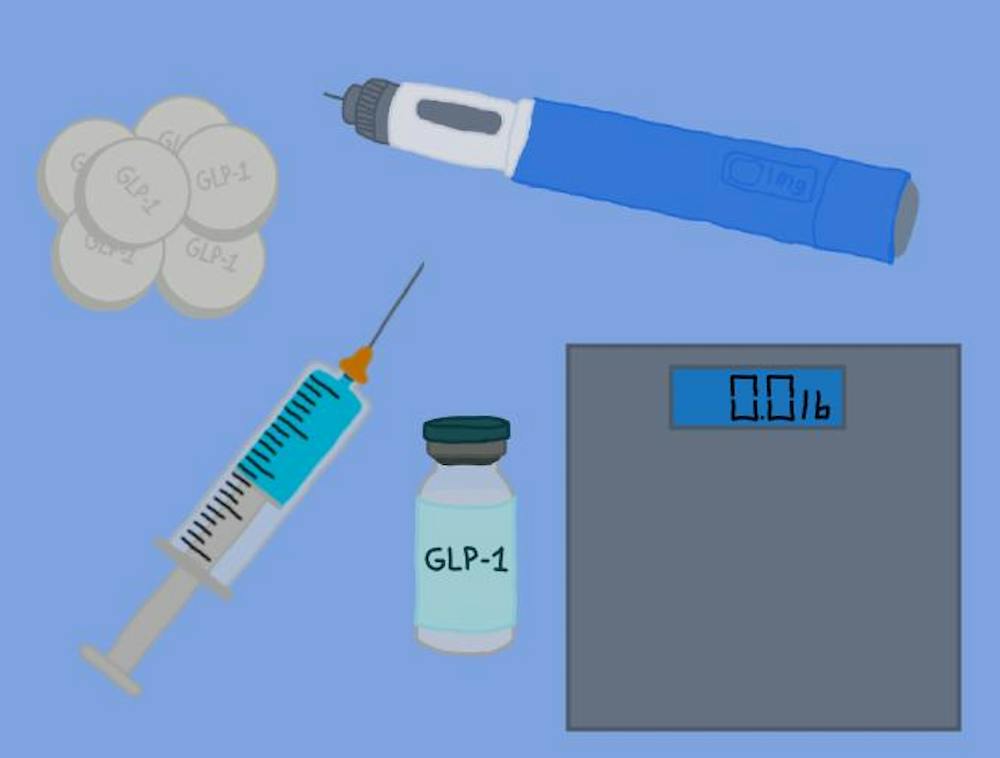
GLP-1 agonist therapy is a treatment designed to mimic naturally-occurring GLP-1 — a hormone produced by the small intestine that helps regulate blood glucose levels. Often, it is prescribed to patients with type 2 diabetes to help regulate their blood sugar and signal to the pancreas to release insulin and produce less glucagon.
Also often, it is prescribed to stimulate weight loss in patients with obesity by slowing digestion and amplifying fullness cues. Since the Food and Drug Administration’s approval of the medication to treat type 2 diabetes and obesity in 2005, it has grown exponentially in accessibility, and consequently, in public discourse.
According to Forbes, one in eight Americans are currently on some form of GLP-1, and by 2030, it is likely that upwards of 30 million will be using it. But with the spectrum of opinions spanning from intense villainization to celebrity-endorsed pedestals, the rise of GLP-1 use has generated confusion and apprehension about the drug itself. Many have taken to the media-driven slang term “Ozempidemic,” and charge the drug’s recent popularity with the resurgence of diet culture.
To strain the surplus of information about GLP-1 medication circulating on social media, The Cavalier Daily spoke to those on the frontlines of the phenomenon — University medical professionals and a student prescribed GLP-1 — to uncover what this development actually looks like for the future of weight management, diabetes treatment and American healthcare as a whole.
According to Dr. Catherine Varney, Obesity Medicine Director at U.Va. Health, the development of GLP-1 medication represents a momentous breakthrough, not only for patients, but for the broader narrative of obesity in the medical profession.
“[Obesity] is finally being recognized as [the] chronic disease that it is,” Varney said. “For decades, well, for all of history, obesity has been viewed as a lack of willpower, a moral failing upon people.”
For many of Varney’s patients, she said that the development of GLP-1 treatment symbolizes hope for sustainable long-term weight management they spent years trying to achieve naturally, and the prospect of finally being on a “level playing field” with peers who can maintain thinness without intervention. According to Varney, GLP-1s are chipping away at the stigma often attached to obesity and redefining it to what it actually is — a medical condition resulting from genetics, epigenetics and physiological resistance to weight loss.
Unfortunately, Varney shared that this breakthrough in narrative arrives with its own host of misconceptions, beginning with the tendency of many folks to refer to all GLP-1 treatments under the blanket term “Ozempic.” As Dartmouth Health states, “Like Kleenex is for tissues, Ozempic is the most recognized brand and essentially a catch-all name for this category of drugs.” However, Varney clarified that versions of the same medication must be branded differently based on their intended use.
Ozempic and Mounjaro are GLP-1 brands used exclusively to treat diabetic patients, while Wegovy and Zepbound are specifically prescribed to support weight loss. This distinction, she said, is primarily necessary for insurance companies — most are willing to cover GLP-1 treatment for type 2 diabetes but not obesity, a standard she believes is misinformed.
Varney also shared that misinformation circulating on the internet indicates gaps in the general public’s understanding of these medications. She said that there is still much judgment surrounding the treatment and that she hopes its growing commonality will help it to be regarded simply as standard medical support. When asked about the largest misconception surrounding GLP-1 treatments, Varney’s answer was immediate.
“That they're the easy way out,” Varney said. “If I was on blood pressure medications … nobody would look at me for taking a blood pressure medicine and say, ‘Hmm, that's the easy way out, to take the blood pressure pill,’ right?”
Enter fourth-year Education student Elise Bowen, who began taking Ozempic just three weeks ago as a tool to help manage her type 1 diabetes. Though the drug is currently only FDA-approved to treat type 2 diabetes, Bowen’s doctor had success prescribing it for previous type 1 cases.
In her first 14 days on the treatment, Bowen’s Glucose Management Indicator — which she said is recommended to be below 7.0 — dropped from a 7.6 to a 7.2 after 90 days of stagnancy. Bowen noted feeling “so much more reactive” to the insulin she takes, and that the medication has changed how she can manage her diabetes on the day-to-day.
Still, while she has seen exceptional results, Bowen identified concerns with GLP-1 use being normalized for extreme cosmetic weight loss, represented particularly by celebrities and social media users.
“I think where the real issue [is, is] seeing celebrities taking [GLP-1] and becoming these stick-thin versions of themselves, because then it loses the meaning of Ozempic, which is to become a healthier version of yourself and focus on wellness in your life,” Bowen said.
This issue, Bowen feels, could cheapen the narrative around the breakthrough medication to just another perpetrator of an unattainable aesthetic standard.
“When you shift the curve of beauty standards so that no longer is ‘skinny’ the goal, but now we're going for ‘ultra-skinny,’ that means that people are just going to abuse medication more, because there's a new beauty standard to reach for,” Bowen said.
Dr. Zhenqi Liu, James M. Moss Professor of Diabetes and former chief of the Division of Endocrinology and Metabolism at U.Va Health, echoed some of Bowen’s apprehensions about the medication. While he acknowledges that the development of GLP-1 treatment has great potential, he sees the need for a more comprehensive evaluation of general health beyond a patient’s perceived thinness.
“The concern is that these medications could reinforce the idea that thinness equals health and shift the conversation from treating obesity and metabolic disease toward pursuing an arbitrary body size,” Liu said. “That would be an unfortunate direction for medicine.”
Bowen, who noted that women in the type 1 diabetes community can be susceptible to disordered eating habits, also believes that would be an unfortunate direction for medicine.
“I think a lot of women end up in really terrible cycles of eating disorders throughout their lives with type 1 diabetes, because they're so focused on management. And so I think it's important to factor that in when you're talking about [GLP-1 treatment] … because yes, it is going to be a really great drug for those who need it, but there is also that element of, ‘How are we creating healthy eating habits for people, and is it sustainable to eat this little in the long term?’”
In Varney’s sector of medicine, the answer to whether GLP-1 use at large creates healthy, sustainable habits, is yes. In her role primarily treating patients with obesity, Varney shared that disordered eating correlated with GLP-1 use is a prospect she rarely encounters.
“I've seen thousands of patients, and so I would say I could count on one-to-two hands how many times that's been an issue … I don't think [GLP-1 medication] is driving an increase [in] eating disorders,” Varney said.
What is of Varney’s concern, however, is the potential of nutrient deficiency in patients taking the medication. While they may be eating a healthy, balanced diet, they may not be consuming enough in quantity to meet their nutritional needs. For this, Varney said she advises a daily multivitamin.
With their varying perspectives and areas of expertise, what Varney, Bowen and Liu consistently agree on is that the biggest dilemma associated with GLP-1 medication is the ambiguous narrative surrounding it. Varney and Liu see this play out online and within their own profession, while for Bowen, it is something she has had to address within herself as GLP-1 treatment has changed from a pop culture figment to a part of her daily life.
“I posted something … a year ago where I was like, ‘Hot take of the day — everybody needs to stop taking GLP-1s, they look entirely too thin,’” Bowen said. “But it really is different when you see the effects of how it's affecting your daily lifestyle. And so maybe it's also a narrative that I've had to shift for myself.”
As Liu continues to research GLP-1 medications and investigate the lingering unknowns — for example, he finds that experts still need “considerably more research” to fully understand exercise alongside GLP-1 use — he maintains the call for a culture shift relative to the general understanding of fitness.
Like most phenomena, he regards most facets of the “Ozempidemic” with nuance. Promising, yes. Life-changing for many, yes. But what should be kept at the root of all healthcare, Liu emphasized, is function.
“Ultimately, I think the field needs to move from a weight-centric paradigm to a health- and function-centric paradigm,” Liu said. “GLP-1 receptor agonist therapy is an important therapeutic advance, but it should be integrated with nutrition and exercise rather than viewed as a replacement for them."
Read More

One poke bowl, endless possibilities
By Astrid Cheng | 2 days agoThough this version is my personal favorite, this recipe is meant as a starting point, not a rulebook.

Learning from the land at the University’s Morven Sustainability Lab
By Kendra Mickle | 3 days agoSpread across nearly 3,000 acres of rolling hills, luscious forests and farm lands, the property has become a hub for sustainability education and experiential learning for the University community.

Notes from a shared address
By Summer Hoffman | 4 days agoAfter one year of living with my partner, I can safely say that our living room is the best classroom I have ever sat in.