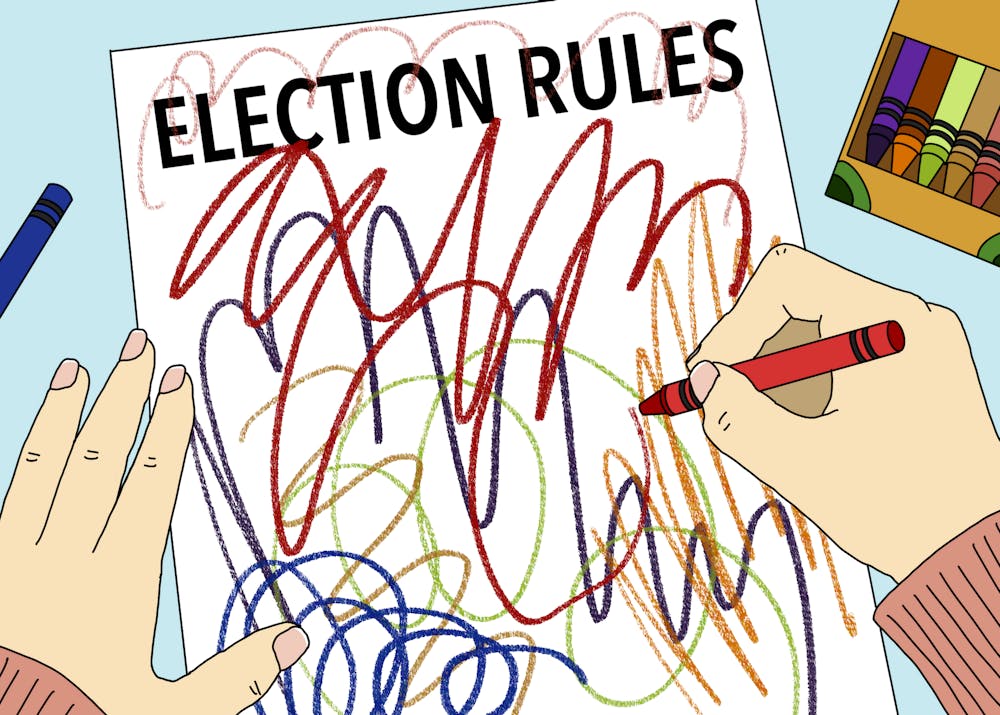
As a student at the University, I feel a deep connection and sense of reverence for student self-governance present on Grounds. Whether it be student-directed discipline for honor violations or the administration of programs utilizing tens of thousands of dollars, students have time and again demonstrated they can be trusted with some of the weightiest matters of University governance. Yet, there is one student self-governance group that, over the past two years, has dropped the ball on its delegated mission — the University Board of Elections. From failing to properly conduct elections to issuing disastrous reports, UBE has not shown it can competently administer the University’s elections. With the recently proposed draft of its election rules for the 2026-27 school year, UBE seeks to rid itself of the responsibilities it failed to fulfill last semester. Clearly, this trend of incompetence is here to stay.
My main criticism of UBE stems from its handling of allegations surrounding last semester’s Student Council presidential election. Micah Andrews, former Student Council presidential candidate and fourth-year College student, raised serious concerns about rule violations in the Student Council presidential election, providing evidence of potentially improper endorsement procedures. Suffice it to say, UBE handled the situation atrociously. It released a decision March 12 that failed to account for multiple pieces of evidence Andrews provided. Its decision was so egregious that the chair of the Judicial Review Board, the body responsible for overseeing student self-governance groups, remanded the case back to UBE — in other words, telling UBE it needed to do better. UBE eventually ruled for Michael Mitchell, Student Council president and fourth-year Commerce student, again, though abstaining from releasing its full decision publicly under advice from the University Counsel.
UBE’s first innovation in its rules this year is to introduce a new threshold by which individuals have to file complaints after voting ends. To be sure, thresholds for filing complaints are not inherently problematic — they prevent a flurry of complaints extending way past the stated end of an election. But UBE’s arbitrary threshold of just 24 hours — as opposed to no limit before — will make it nearly impossible for candidates alleging serious wrongdoing to gather evidence and submit a complaint to UBE before being time-barred altogether. Evidence that is hidden in, say, a fraternity GroupMe, might take time to unearth, and individuals should not be precluded from alleging serious wrongdoing because they do not have ready access to incriminating evidence. To be sure, the real reason for this arbitrary time limit is an effort to avoid any uncomfortable, drawn-out litigation of the kind experienced last spring. Resolving that litigation is part of UBE’s job, of course — but recent history shows that when it comes to doing its job correctly, UBE prefers to take a more lackadaisical approach.
Should a concerned member of the community wish to observe UBE’s process for handling allegations of election misconduct, they will find themselves out of luck. UBE has now mandated that all hearings on rule violations be closed to the public and that participants are barred from speaking about the proceedings until they have concluded. This ostensibly stems from the argument that its proceedings are protected by the Family Educational Rights and Privacy Act, which prevents university bodies from releasing disciplinary records of students. If FERPA is UBE’s main concern, however, then it remains unclear why UBE released a public report — complete with student names — on the Spring 2026 election disputes in March. Given that the report has since been removed from the website, it seems likely that UBE originally released the report in error. Clearly, UBE’s handling of material it says is confidential is haphazard at best.
UBE’s mishandling of information extends beyond its most contentious hearing to the management of its most mundane responsibilities. The reality is that for those with any modicum of interest in the free and fair election of student leaders, they will have to sit quietly until UBE deigns to release anything to the public. This silence might not be an issue if UBE were timely in issuing its other reports, such as candidates’ and organizations’ expenditure reports. But these reports that UBE is required to make “freely available to the public” are nowhere to be found. One should not trust UBE to proactively release information on much more contentious topics like election contestation when it cannot even provide the most basic electoral information.
Perhaps the most egregious proposed rule is that the decisions of UBE cannot be appealed to the JRB. Yet, even this attempt to avoid criticism of its decisions is incoherent. UBE’s constitution, the body’s governing document above and beyond its yearly election rules, provides that “appeals from enforcement actions … shall be taken to the University Judicial Review Board.” Nowhere does the constitution permit UBE to eliminate a path to JRB review wholesale. Indeed, to do that, UBE would need to amend its constitution, which would require a vote of the whole student body to ratify the amendment. It is bad enough that UBE thinks it appropriate to insulate itself from competent review, but to try and do so through unconstitutional means — whether intentionally or ignorantly — is beyond the pale even for a body as incompetent as UBE.
As I said at the beginning, student self-governance is one of the hallmarks of this University. But that same hallmark requires that those entrusted with its care acquit themselves admirably. This requirement is no less serious for the gatekeepers of student self-governance, those who run its elections — UBE. There is still time to avert its current course — extend the time limit for submitting post-election complaints, open hearings to the public and honor the JRB's avenue of review. These are commonsense reforms and rules, and I implore those who care about this University’s elections to leave the appropriate feedback on UBE’s own form. I wrote last semester that it remains unclear if UBE has the motivation to heal its self-inflicted wounds. Now, the proposed rule changes would be the perfect opportunity to demonstrate just that motivation. Yet, given that these rules are being proposed in the first place after one of UBE’s most contentious election seasons, I would not hold my breath for any meaningful reform coming soon.
Michael King is the Opinion Editor of The Cavalier Daily. He can be reached at opinion@cavalierdaily.com.
The opinions expressed in this column are not necessarily those of The Cavalier Daily. Columns represent the views of the author alone.
Read More

EDITORIAL: The hidden price of McIntire’s admissions timeline
By Editorial Board | 39 minutes agoThe compressed application timeline changes the way students approach the classroom.

LOPEZ: Breaking the chains of the two-party system — America needs real solutions
51 minutes agoThat is why I decided that if I was going to run for Congress, I would not simply tell people what is wrong. I would put actual proposals on the table.

EDITORIAL: The Virginia General Assembly must step up for western Virginia
By Editorial Board | 2 days agoThis reality is only set to get worse after newly-effective Trump administration cuts to Medicaid and Medicare reimbursement rates.