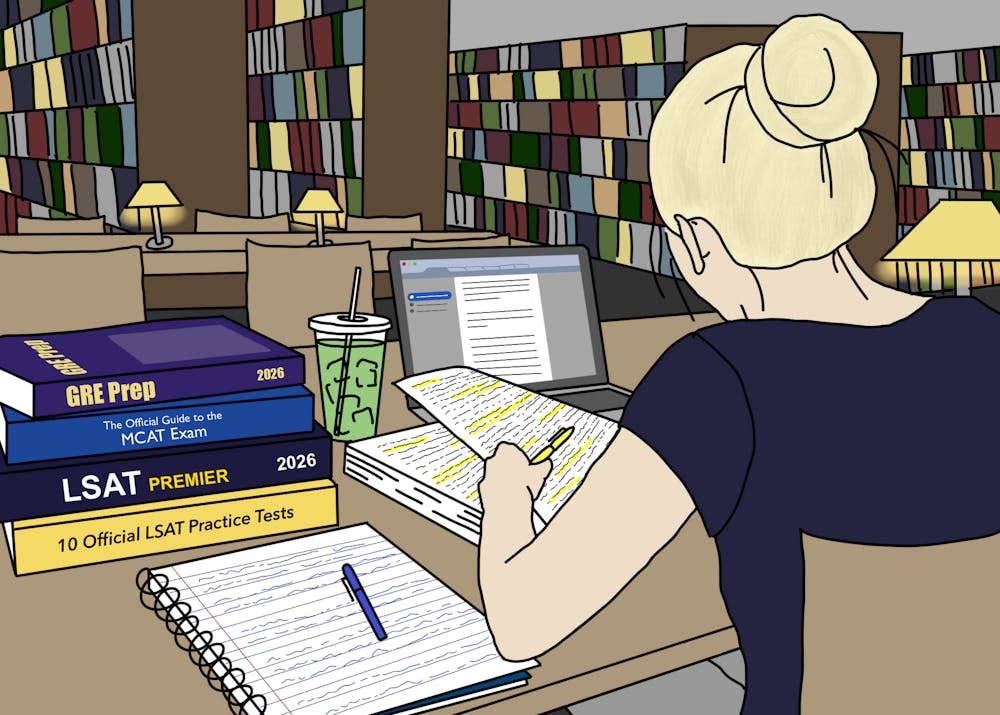
Just when University students think they have left the prep-work perils and score obsessions of standardized testing back in high school, entrance exams for graduate program applications ring in round two. These exam scores can punch a ticket to a dream university or rule out candidacy for elite institutions, raising the pressure to perform well. Consequently, those looking to take their education beyond bachelor’s degrees must balance exam preparation with classes, extracurriculars and other undergraduate experiences, straining University students’ already busy schedules.
The LSAT, MCAT and GRE are three of the most common exams required by graduate school programs. Faced with a tough job market, a rise in the inflation rate post-pandemic and the uncertainty of artificial intelligence’s impact on the workforce, more and more students are pursuing graduate degrees — a trend captured by the New York Times’ article titled “The Master’s as the New Bachelor’s.” For test-takers, this spike in demand has translated to rising exam registrations and score medians, further encouraging students to study hard.
Along with the psychological burden of impending exams, test-takers face a sizable financial barrier. The MCAT, LSAT and GRE cost $355, $253 and $220, respectively — for exam registration alone. Preparation services add to this total, often reaching into the thousands as students strive for a perfect score.
Fourth-year College student Kristin Tidey will graduate from the University in 2027 and hopes to begin law school the following fall. With increasingly competitive admissions cycles in mind, she began studying for the LSAT in September 2025. Tidey said the preparation process was unlike her past exam-taking experiences.
“It's more time-intensive and harder than the ACT,” Tidey said. “If it was the ACT … I would have studied for a month and been fine, but … it's not as easy as the standardized tests that we've done [before]. You need to dedicate a lot of time.”
The LSAT consists of two types of sections — Logical Reasoning and Reading Comprehension — as well as an unscored argumentative writing part at the end. Logical Reasoning questions challenge exam-takers to analyze brief arguments, testing their ability to recognize flaws, make provable inferences and apply abstract principles to unfamiliar ideas. The Reading Comprehension portion makes exam-takers read longer passages and answer corresponding content questions. Despite their differing structures, both sections require a quick understanding of complex material, which Tidey highlighted as a key challenge.
“The timing is definitely [difficult]. I've never had an issue with timing for standardized tests before,” Tidey said. “The questions are just a lot harder. You have to train your brain to work in a certain way that you don't have to train your brain to work in for other standardized tests.”
Similarly, fourth-year Education student Riley Kane aims to earn a Doctor of Physical Therapy degree, Kane must take the GRE to apply to most programs in the field. The GRE requires students to demonstrate mastery in a wide variety of subjects through three sections of Analytical Writing, Verbal Reasoning and Quantitative Reasoning sections. Additionally, the GRE offers subject-specific tests in psychology, mathematics and physics.
Unlike the LSAT or MCAT, GRE questions differ depending on test-takers’ answers, challenging students to adapt to a potentially unfamiliar exam style that Kane said she has not encountered since middle school.
“The questions will change depending on what answers you give,” Kane said. “If you get the answer correct, it will take you one path, but if you get it wrong, it will bump you back down … I’m going to try to prepare by learning the best way to tackle the format.”
So far, Kane has approached GRE studying similarly to how she prepares for University course exams — by exploring online resources, such as recorded video lessons or even TikToks, to fill in any gaps in understanding.
“In college, if I'm really confused on topics, I can find someone on YouTube or online who can explain it better,” Kane said. “Especially with a test like this where it’s so generalized and so broad, if I can get any tips from [a source] that's free, like YouTube, that would be great.”
Kane said she learns best through active recall, which involves writing or talking out answers to cement them into her memory. This strategy has served her well in the University’s kinesiology program, but Kane voiced slight concern about its applicability to GRE content.
“It will be an adjustment because I've been doing so many of my major-related courses, whereas now I'm going to be doing [topics like] grammar,” Kane said.
While Kane’s approach to studying is mainly self-directed, Tidey has opted for formal LSAT preparation services. She utilized 7Sage, an online LSAT course before taking the exam for the first time this past April. However, Tidey said the program’s generalized teaching style did not always resonate with her. In the hopes of boosting her score on the August LSAT, she switched to Blueprint, which offers live classes, recorded lessons, homework practices and office hours.
While the Blueprint program charges a lofty $1999 price for these luxury study services, it comes with a caveat — if Tidey does not score a 170 on the August LSAT, which would place her in the 95th percentile, she gets all of her money back.
“The explanations [on 7Sage] weren’t great … It just didn’t make that much sense to me,” Tidey said. “Being able to ask my own questions and understand things myself, I feel like it's a lot better [for] my learning style … [Blueprint is] definitely more focused on one-on-one learning and supporting each individual.”
Fourth-year College student Catherine Goldstein took the MCAT this month to broaden her clinical career opportunities after graduation. Unlike the LSAT, the MCAT contains content questions, meaning that exam-takers must memorize specific facts that will not be present within passages on the test. Over its four sections, students must show mastery and in-depth knowledge of biological, chemical and psychological phenomena. Fortunately for Goldstein and her fellow pre-med students, University courses shoulder some of the significant study burden.
“A lot of the classes I'm taking … have overlapping content with [the MCAT], so that has been really helpful,” Goldstein said. “Learning that [information] for exams is honestly like [MCAT] studying in itself.”
In addition to its weight in admissions, the MCAT matters as an indicator of how well-prepared an exam-taker is to tackle the demanding environment of medical school. Goldstein said it is critical to emerge from undergrad with a strong science background, and the MCAT helps gauge what content from University courses really stuck with her.
“At its most basic level, it is a key part in your medical school application,” Goldstein said. “It kind of combines everything I've ever learned in science since getting to college, so it will be interesting to see how well I can remember and synthesize information.”
To give herself enough time to learn, practice and memorize content, Goldstein did the bulk of her MCAT studying over the summer. She said balancing full-length practice tests — which take roughly 7.5 hours — with full-time studying and University classes would be very difficult.
Kane is in a similar boat — she was balancing GRE summer studying with both outpatient sports medicine physical therapy shadowing and a job at a restaurant in her hometown of Newport News, Va. Tidey, on the other hand, began studying for the LSAT during the school year. She dedicated several hours a day to studying throughout both semesters of her third year, layering exam preparation onto a busy academic calendar.
“I definitely didn't go out or hang out with my friends as much, but I definitely did still [have] balance,” Tidey said. “I still went to the gym every day, I still had time for homework … and I went to all my friends’ birthdays and stuff. I think it's definitely doable, but you do have to prepare for not having any free time.”
Despite differing experiences, one common thread among graduate school exam-takers interviewed by The Cavalier Daily emerged — a general lack of guidance from advisors and career-centered staff. Tidey said she navigated the study process largely on her own, leading her to constantly wonder if she was on track.
“I thought that I was ahead when I was studying over the school year, and then I learned that people have already taken [the LSAT],” Tidey said. “The last time to take it, if you want to go straight through [to law school], is August … Nobody really tells you what the timeline is or when you need to get stuff done.”
Goldstein shared a less critical opinion, noting that her professors and teaching assistants sometimes take the time in class to draw students’ attention to content that they encountered on the MCAT. However, she still noted several preparation areas where the University’s curriculum could improve.
“A decent amount of the questions on the MCAT are scientific paper-based,” Goldstein said. “Learning how to analyze scientific papers [more in class would be helpful] because that's a skill that is super important.”
What is more debatable, though, is how accurately exams like the LSAT, MCAT and GRE can capture a student’s ability to succeed in a wide variety of degree programs. In Kane’s view, for instance, the GRE comes second to hands-on physical therapy education.
“I would equate it to probably the same as the SAT … it can show that someone could be really good at taking a test and that you could do very well … I wouldn’t say it’s a very accurate [predictor of PT school success],” Kane said.
Whether exam-takers bomb their first GRE, knock their LSAT out of the park or take the MCAT a few times for good measure, Tidey stressed that a test score is not the end-all-be-all of University students’ graduate program applications. It is simply one of many steps that students must take on their long, unique pathways to their professional careers.
“Trust the process. Either way, it will work out,” Tidey said. “Even if you end up not getting the score that you want, you’ll end up going to law school, grad school or med school … it's a process that takes time.”
Read More

No longer the new kids on the block
By Phoenix Banks | YesterdayAs second year begins, different pressures and stresses — from academic comebacks to harder classes — plague the Class of 2029.

After a year of tech, University students spend the summer offline
By Phoenix Banks | YesterdayThese students felt that analog hobbies — passions that are independent of technology — not only bring entertainment, but also help relieve tension from the prior academic year while passing time over the summer.

The Virginian — where Charlottesville comes to stay
By Sadie Adams | 4 days agoBut reducing The Virginian to just another restaurant or college bar misses exactly what has kept the establishment alive and well for over a century.