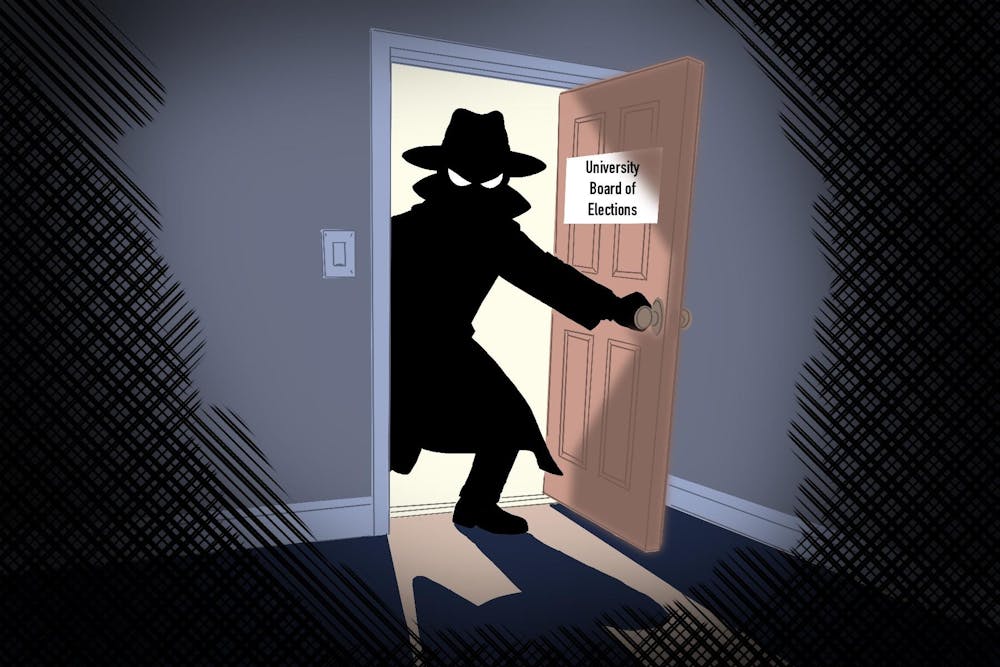
Of all the student self-governance groups on Grounds, readers might be the least familiar with the University Board of Elections. A Special Status Organization chartered by the University to run student elections, UBE acts as an agent of the University in managing the Spring General Elections and other incidental races throughout the year. Yet, to a degree unmatched by other student self-governance groups such as Student Council, the Honor Committee or the University Judiciary Committee, UBE has exercised faulty judgment in the performance of its vital duties, and it is not clear the body even understands what is required of it.
UBE’s most recent fiasco is its handling of a complaint from Micah Andrews, former Student Council presidential candidate and third-year College student, on potentially serious rule violations in the Student Council presidential election. Andrews provided a litany of evidence to suggest improper endorsement procedures between the Inter-Fraternity Council and Michael Mitchell, Student Council president-elect, Student Council vice president for organizations and third-year Commerce student. Andrews alleged that both Mitchell and the IFC committed numerous violations of UBE election rules that could have potentially affected the outcome of Mitchell’s election. The IFC is alleged to have broken numerous UBE regulations governing the conduct of endorsing organizations, and Mitchell faces notable allegations about the misuse of Student Council resources to advertise his campaign. These accusations deserve thoughtful attention and consideration by UBE. Yet, so far, UBE has made a fool of itself in handling the situation, suggesting the organization has no idea how serious its situation truly is.
It is helpful to take stock of UBE’s handling of the situation so far. To date, the body has unlawfully shut out members of the public and press from its hearing regarding Andrews’ election appeal, claiming its own bylaws somehow supersede Virginia public disclosure laws. Its March 12 decision on the merits of Andrews’ claim cites exhibits and documents that are nowhere to be found on its website, denying observers from examining the record presented in the hearing for themselves. That same March 12 decision failed to even consider or acknowledge multiple pieces of evidence in support of Andrews’ claims — instead, UBE hurriedly issued its decision in an attempt to wipe its hands clean of the matter. For the cherry on top, the University’s Judicial Review Board remanded Andrews’ case back to UBE, succinctly highlighting the numerous inadequacies in UBE’s decision.
The circumstances raise the question — do UBE leaders have a clue what they are doing? First, UBE hearings were supposedly allowed to be secret due to internal rules, yet a public report on the hearing, complete with identifiable student names, was released. In support of this contention that UBE can act behind closed doors, Abby Nickelson, UBE chair and fourth-year College student, stated that UBE is not required to host open meetings dealing with election violation allegations due to its own bylaws lacking such a requirement. It is unclear whether she understands that her body is subject to the same public disclosure laws that bind every agent of the University. Notwithstanding that bothersome legal obligation, Nickelson further claims that UBE is not a public body at all — but what else could it be? It is hard to see how UBE escapes the statutory definition for a public body as an “entity … of” the University “created to perform delegated functions of” the University.
To add insult to injury, UBE could not be bothered to provide readers the evidence used in the decision its closed hearing produced. UBE’s March 12 decision directs readers to documents that it nowhere provides. The decision also failed to address the allegedly contradictory statements of Alex Peskin, IFC president, co-chair of the Madison House Board of Directors and third-year Batten student, related to a phone call he had with Ben Lawrence, then-vice president for operations candidate and third-year Engineering student. In this call, Peskin claimed he only endorsed the position of Student Council President because “guys” reached out to him, a potential violation of UBE rules if true. However, in his written answers to UBE — the mysterious and missing “Peskin interrogatories” mentioned in the March 12 decision — Peskin reportedly denies all wrongdoing. UBE did not address this phone call in its March 12 decision, nor did it address Mitchell’s alleged abuse of his Student Council position by advertising his campaign to a listserv that would have allowed him to contact leaders of hundreds of organizations at the University.
The decision of Jill Rockwell, JRB chair and senior assistant dean of career advancement and alumni engagement in the Frank Batten School of Leadership and Public Policy, to remand Andrews’ case back to UBE was necessary. UBE’s original decision utterly failed to provide a satisfying conclusion to a serious challenge brought against an extremely close election. Hopefully, UBE will rise to the challenge in its review of the case, but its past conduct makes this doubtful.
The gatekeeper of student self-governance is not immune from criticism despite its necessary duty. When the body responsible for organizing student elections cannot maintain a basic sense of their legal and operational responsibilities, stakeholders understandably lose trust in the ability of students to self-govern. Much like the pitiful accusations of faculty and patronization by the Board of Visitors, UBE’s actions bring contempt upon the entire system of student self-governance. The worst part, however, is that these wounds are entirely self-inflicted. UBE need only look to itself to solve its problems, but it remains unclear whether or not it has the motivation to do so.
Michael King is the Opinion Editor of The Cavalier Daily. He can be reached at opinion@cavalierdaily.com.
The opinions expressed in this column are not necessarily those of The Cavalier Daily. Columns represent the views of the author alone.

Michael King is an opinion editor for the 137th term of The Cavalier Daily. He is a third-year College student, majoring in American politics. Michael is from Richmond, and he enjoys writing about the turbulent atmosphere of University administration and student self-governance. You can reach him at m.king@cavalierdaily.com.
Read More
ANDERSON: Why I am ‘dark woke’ — and you should be too
By Beckett Anderson | YesterdayArising from an internet meme, dark wokeism offers Democrats a youth-powered way out of the hole they find themselves in.

HASNAIN: The mental health taboo and its many adverse effects
By Zehra Hasnain | YesterdayYet, I write this not to propose some novel solution on finding inner peace and instead hope to push students to capitalize on existing reliable resources.
EDITORIAL: Prevent drug overdose tragedy from repeating itself
By Editorial Board | 3 days agoThe combination of these realities at Ole Miss — unsafe drug use leading to overdose and death, coupled with specious social media speculation — represents a microcosm that we must be cognizant of at our University, where drug use is common and drug education is not sufficiently provided.