Correction: A previous version of this article incorrectly stated that the Judicial Review Board is an affiliate of the University Judiciary Committee. The JRB is an independent body entirely separate from the UJC and housed within the Student Affairs Office. The UJC has no role in arbitrating disputes arising from the UBE election process. The article has been updated to reflect this change.
Correction: A previous version of this article incorrectly stated that the UBE reached out to Mitchell, Palazzotto and Peskin with interrogatory questions after the March 11 UBE Hearing Panel. UBE reached out to Mitchell, Palazzotto and Peskin with interrogatory questions prior to the Hearing Panel, and received responses from all three individuals prior to the Hearing Panel. The article has been updated to reflect the correct timeline.
Several evidence-backed irregularities in the endorsement process and lead-up to the Student Council presidential election occurred prior to the Feb. 24-26 voting period. Micah Andrews, former Student Council presidential candidate and third-year College student, brought these irregularities to light in an initial complaint submitted to the University Board of Elections Feb. 26 before voting closed.
Andrews’ allegations against Michael Mitchell, Student Council president-elect, Student Council vice president for organizations and third-year Commerce student, included evidence she deemed to constitute bribery, coercion and procedural violations of UBE’s endorsement protocols. UBE found no violation of protocol in response to her initial complaint — a decision Andrews appealed March 2 to pursue a Hearing Panel by the UBE. UBE again found that no violation occurred — a decision that Andrews appealed to the Judicial Review Board Thursday. The JRB, housed within the Student Affairs Office, is a committee that reviews appealed decisions to ensure fairness in student disciplinary proceedings, according to the Student Affairs’ website.
The Student Council presidential election was held Feb. 24-26, and Mitchell won the election against Andrews with 3,579 votes, while Andrews received 3,345. Materials referenced in this article — including Andrews’ submissions of evidence and decisions by the UBE — were obtained by The Cavalier Daily from an anonymous source.
Andrews’ Feb. 26 initial complaint
Andrews’ initial complaint, submitted the final day of voting Feb. 26, focused on a screenshot from a fraternity GroupMe chat. In the screenshot, a fraternity member wrote that the Inter-Fraternity Council would host a bar tab for fraternity chapters that achieved at least 80 percent voter turnout if Mitchell won the presidential election, which was allegedly an initiative proposed by Alex Peskin, IFC president, co-chair of the Madison House Board of Directors and third-year Batten student.
“If michael mitchell wins, ifc is gonna have a bar tab for chapters with 80% voting,” the GroupMe message reads. “So if you vote for no other reason please do it for the sake of that.”
She also alleged that Mitchell communicated with endorsing organizations prior to the official endorsement window in order to secure an endorsement. According to Article III Section 3 of UBE Rules and Regulations, no candidate may ask an organization to become an endorsing organization nor become involved in the organization’s endorsement process.
Specifically, Andrews alleged that Mitchell communicated with Peskin prior to the start of the endorsement process, constituting a violation. Andrews said her evidence for this was an alleged phone call between Peskin and Ben Lawrence, then-vice president for operations candidate and third-year Engineering student, in which Peskin said that Mitchell had received an endorsement from the IFC because he reached out prior to the endorsement period. Andrews did not provide video or transcript evidence of the call at this time.
Peskin emailed the IFC listserv Feb. 24 — the first day of voting — endorsing Mitchell for Student Council president. In his email, Peskin described Mitchell as “an advocate for Greek life” and encouraged fraternity members to vote for Mitchell. Peskin did not mention other IFC-affiliated candidates, including Lawrence.
“At a time where fraternities are under increased scrutiny, we need a Student Council president who will support and protect the Greek system — that person is Michael Mitchell,” Peskin wrote in the endorsement email. “A vote for Michael is a vote for Greek life, and it is crucial for the future of our community that Michael becomes the next Student Council president.”
UBE’s response to Andrews’ Feb. 26 complaint
Upon review of Andrews’ initial complaint against Mitchell’s alleged violations during the endorsement process, UBE determined Feb. 26 — less than two hours after the complaint was submitted — that the fraternity GroupMe message regarding the potential bar tab did not constitute a violation of UBE policy.
In UBE’s email response to Andrews’ original complaint, UBE stated that incentives encouraging students to vote are permitted, as outlined in UBE Rules and Regulations in Article II Section 1. UBE also noted that since neither Mitchell nor the IFC could have access to fraternity chapter voting data, verifying voter turnout for a particular candidate was impossible.
With regards to the IFC’s lack of an endorsement for Lawrence, UBE said the IFC chose to solely endorse for the position of Student Council president within the Student Council presidential ticket — a choice allowed by UBE rules — so the position Lawrence was running for made him ineligible for one of the IFC’s endorsements.
In response, Andrews appealed the decision March 2. According to UBE Rules and Regulations Article IV Section 1, if a rule violation is disputed — as it was with Andrews’ initial complaint — UBE will call a Hearing Panel to determine whether a violation occurred. The panel consists of three UBE members, including the chair or vice chair of UBE.
Andrews’ evidence in her appeal of the Feb. 26 decision
In her appeal issued March 2, Andrews referenced past communications from Ryan Phelan, former IFC president and fourth-year College student, highlighting emails Phelan sent during the Fall 2025 and Spring 2025 election cycles. Within those emails, Phelan encouraged fraternity members to support candidates affiliated with the Greek life community and emphasized the importance of IFC representation in student self-governance. Phelan also endorsed several candidates for other positions, including seats on the Honor Committee and the University Judiciary Committee.
The IFC and Madison House, both led by Peskin, solely endorsed for the positions of Student Council president and president of the Fourth Year Trustees — a position with a single candidate, third-year College student Jackson Sleadd, who is affiliated with a fraternity.
UBE guidelines mandate that endorsing organizations provide ample and sufficient slots for candidates to be interviewed for a potential endorsement. Three candidates — two for the Student Council presidential position and one for the Fourth Year Trustee position — were eligible for an endorsement from the IFC and Madison House. Each organization offered two interview slots. Both Andrews and Mitchell interviewed for an endorsement from Madison House, and only Mitchell interviewed for an endorsement from the IFC. Sleadd did not interview with either organization for an endorsement.
Within her appeal, Andrews took issue with endorsement interview time slots provided by the IFC and Madison House. She said that when endorsement interviews opened, the IFC and Madison House only provided two interview slots for three candidates running for the positions they were endorsing. Andrews argued that this conflicted with UBE rules requiring endorsing organizations to provide interview opportunities for all eligible candidates.
Andrews compared Phelan’s past emails from the Spring and Fall 2025 election cycles with emails sent by Peskin during the Spring 2026 election cycle in her appeal to UBE. She argued that while previous IFC endorsements promoted multiple candidates across races, Peskin’s endorsement highlighted only Mitchell in the Student Council presidential race. Andrews also claimed in her appeal that the endorsement email reached more than 1,700 students — male students affiliated with an IFC fraternity — and created a substantial group of voters among fraternity members that could have influenced turnout.
Under UBE Rules and Regulations Article II Section 2, endorsing organizations are permitted to send endorsement messages through their own internal message outlets — such as the IFC listserv — without violating election guidelines. Endorsing organizations are prohibited only from using another organization’s email or list. Under these guidelines, Peskin’s emails promoting Mitchell through IFC’s own listserv were permitted.
In her appeal, Andrews also submitted a video of a phone call between Lawrence — her running mate for vice president for organizations — and Peskin. When Lawrence, as a member of a fraternal organization, asked Peskin why the IFC was not endorsing for VPO — his position — despite doing so in years past, Peskin explained that candidates for Student Council president and president of the Fourth Year Trustees reached out to him directly, prompting the IFC’s endorsements for those positions. The IFC did not ultimately endorse for the president of the Fourth Year Trustees position.
Peskin further stated on the phone call that no candidates for VPO or vice president for administration contacted him in regards to an endorsement, and the IFC had not completed the formal process to register as an endorsing organization for those races. Peskin added in the call that he intended to send an email listing all fraternity members running but ultimately only endorsed Mitchell, who had reached out directly.
In an email statement to The Cavalier Daily, Phelan wrote that he could not speak for Peskin or the IFC leadership, but he suggested that the IFC’s endorsement for Student Council president reflected connections within Greek life.
“[I] can’t speak for Peskin or [the] new admin, but as far as I know, Michael is in Greek life and Micah isn’t. [It] seems intuitive that the IFC would endorse the ticket aligned with Greek life,” Phelan said in an email statement to The Cavalier Daily.
According to Andrews’ appeal, Mitchell had admitted to Andrews to meeting with both Peskin and Zachary Palazzotto, president of the Engineering Student Council and fourth-year Engineering student, prior to the endorsement period. Mitchell confirmed he met with both Peskin and Palazzotto prior to the endorsement period, but he denied asking their organizations to become endorsing organizations.
On Feb. 24 — the first date of voting — Palazzotto announced the Engineering Student Council’s endorsement of Mitchell for Student Council president, Benjamin Lawrence for VPO and third-year College student Saehee Perez for VPA. The Engineering Student Council provided ample and sufficient slots for all candidates to interview for an endorsement, and both Andrews and Mitchell signed up for an endorsement interview slot.
Andrews further argued in her appeal that the potential bar tab incentive by Peskin to the IFC constitutes a UBE violation. Andrews reemphasized points made in her initial complaint, in which she cited Article IV of UBE Rules and Regulations. The article states that major violations include behaviors that are “coercive, harassing or otherwise substantially undermine the integrity of the elections process” — including bribery.
“[The bar tab] was not meant to encourage voting in general, since a vote for me would make the tab less likely to occur. It was contingent on electing a specific candidate, which coerced votes for Michael,” Andrews wrote in her appeal. “While UBE does not explicitly define ‘bribery’ in its regulations, I believe that the bar tab meets the definition of offering something of value to influence another’s actions.”
Andrews wrote that a reward tied to a specific candidate’s victory could be considered coercive and may have influenced the election’s outcome, claiming that Mitchell won the race by only 101 votes.
Mitchell won the race by 234 votes in the first count using UBE’s Optional Preferential Alternative Vote scheme of Instant Runoff Voting, as outlined in Article III Section 7 of UBE Rules and Regulations. However, with this voting system, candidates do not technically win by a margin in the same manner as with plurality voting. Instead, Mitchell reached a quota to be elected in count one, which is when he had 234 more votes than Andrews. In count two, the system redistributes votes from candidates who were elected with surplus votes — some of Mitchell’s ballots were transferred to Andrews in this count. The margin of count two is 101 — the margin Andrews claimed to have lost by.
Andrews’ appeal asked UBE to reevaluate whether the potential IFC-sponsored bar tab rumor constituted bribery or coercion under Article IV of UBE Rules and Regulations and whether IFC and Madison House complied with proper endorsement procedures. She also called for UBE to establish clearer definitions of bribery and coercion and to implement stronger oversight of endorsement practices in future elections.
UBE’s collection of evidence pre-hearing
The UBE reached out to Peskin, Palazzotto and Mitchell for comments prior to the Hearing Panel. The questions asked focused on the details of the Madison House, IFC and ESC endorsement processes to determine whether a violation occurred. Mitchell was also asked about the bar tab incentive to determine whether the instance constituted a violation of policy on his part.
In his interrogatory response to UBE prior to the hearing, Mitchell denied any involvement in promoting or promising a bar tab incentive for students to vote. Mitchell said he only learned of the bar tab between Feb. 24-26 — the voting period — and at the time it was brought to his knowledge, he said he confirmed with Peskin that it was untrue.
He wrote that his conversations that occurred in the weeks before the endorsement period with Peskin and Palazzotto focused on gathering input relating to the needs of their organizations, not endorsements. He also said that he did not ask any member of IFC, Madison House or other organizations to become endorsing organizations prior to their official registration.
According to Mitchell, in reference to the phone call Andrews submitted as incriminating evidence, he consulted with Peskin on drafting a policy for a Fraternity and Sorority Life representative seat in Student Council and attended an IFC President’s Council meeting Feb. 19, where he spoke about his role as VPO. He also spoke with Palazzotto on drafting a policy for the Presidential Advisory Board and said that he did not discuss endorsements.
Article III Section 3 — “Endorsing Procedures” — of UBE Rule and Regulations does not detail any protocols about candidates speaking to endorsing organizations about policy matters prior to formal endorsements. The rules solely specify that “no candidate may request any organization to become an Endorsing Organization.”
“I was intentional about following UBE guidelines throughout this campaign process and reached out several times to UBE before doing anything new for my campaign,” Mitchell wrote in a statement to The Cavalier Daily Friday.
In Peskin’s interrogatory response to UBE’s questions, he wrote that he was not involved in the Madison House endorsement interview process and could not speak to how endorsement decisions were made. He added that the decisions for both IFC and Madison House were made internally by their respective leadership teams, not solely by him.
Palazzotto wrote in his interrogatory response that he chose to endorse Mitchell, Lawrence and Perez because the positions of president, VPO and VPA play key leadership roles within Student Council. According to Palazzotto, the Student Council president regularly collaborates with the ESC president on committees — such as scholarships and Lawn selections — while the VPO manages funding for nearly 60 Engineering Contracted Independent Organizations.
In an email statement to The Cavalier Daily, Palazzotto emphasized ESC’s commitment to a fair and transparent endorsement process.
“I can share that the Engineering Student Council conducted a structured endorsement process with standardized interviews and deliberation by the Executive Board,” Palazzotto wrote. “[The ESC] followed all [UBE] rules … [and] we respect the UBE appeal process and its role in ensuring fairness in student elections.”
The March 11 UBE Hearing Panel
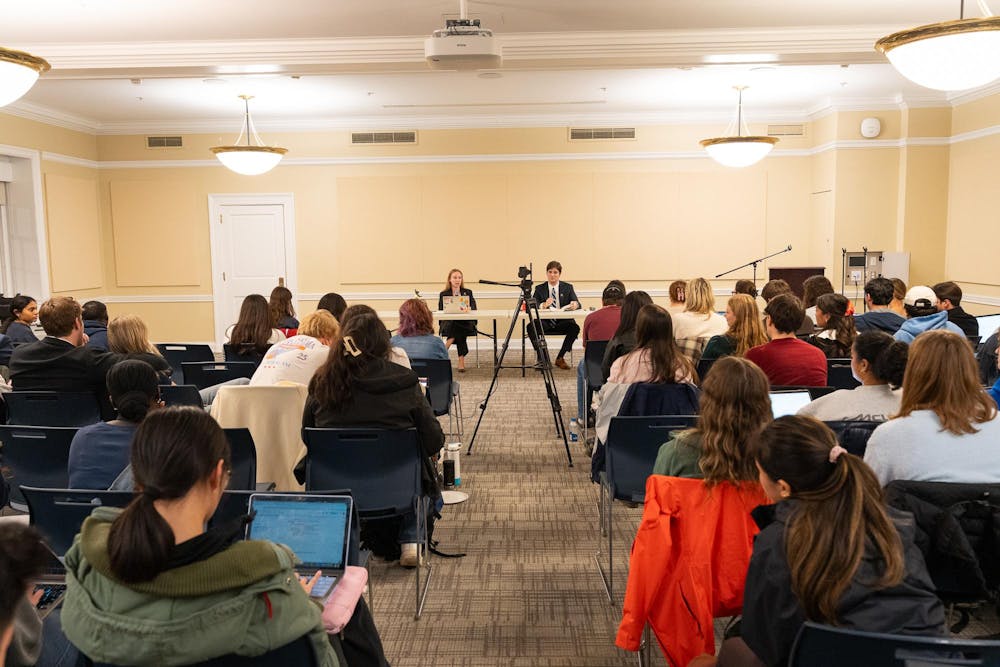
Andrews, Mitchell and three UBE members constituting the Hearing Panel met Wednesday evening to review Andrews’ appeal.
During the Hearing Panel, outside spectators were not permitted to sit in on the meeting. Abby Nickelson, UBE chair and fourth-year College student, wrote in an email statement to The Cavalier Daily that unlike other University student organizations such as Student Council, the UBE’s guidelines and bylaws do not possess a provision that requires meetings to be public and that meetings have historically been held privately. Nickelson also wrote that UBE does not constitute a “public body” under the Virginia Freedom of Information Act — which requires meetings of public bodies to be open to the public.
Nickelson noted that UBE releases a publicly available rules report on their website following each election detailing complaints and decisions that arose over the course of the election cycle. A report for the spring election is expected to be released by March 20.
In the hearing, Andrews presented the phone call in which Peskin told Lawrence that other candidates — including Mitchell — had reached out to him prior to the endorsement period, hence his decision to endorse those positions. Peskin communicated with the UBE through email questionnaires prior to the hearing, and his written responses said he did not “believe” any candidate had reached out inquiring about an endorsement prior to the organization’s official registration as an endorsing organization.
According to Peskin, the IFC determined internally which races it would endorse and which candidates would be interviewed. Peskin also claimed that the alleged bar tab referenced in the GroupMe message was not connected to Mitchell’s campaign, and the tab is instead a longstanding social tradition among fraternity chapter presidents and himself, as the incoming IFC president. Phelan confirmed with The Cavalier Daily that a bar tab is an annual tradition in the IFC.
“It's something that the IFC president does when the new group of chapter presidents turns over,” Phelan said. “We do [the bar tab] so they can get to know other presidents and the guys working on the IFC.”
It is unclear whether the traditional tab is connected with voter turnout rates, as it was submitted in the evidence by Andrews.
The Cavalier Daily reached out to Peskin for comment on the responses he provided before and during the hearing, and Peskin did not respond to requests for comment at the time of publication.
The outcome of the hearing
Following the Hearing Panel, UBE concluded Thursday evening — the day after the hearing — that the evidence presented by Andrews did not constitute a violation of election rules.
In a 3-0 decision, the UBE Hearing Panel sustained the Rules Committee’s earlier finding that Mitchell did not violate election rules and certified him as Student Council president-elect. The panel wrote that while the “bribery” incentive alleged by Andrews could have affected the outcome of the race by increasing vote turnout, there was insufficient evidence linking Mitchell to the alleged initiative. According to the UBE’s investigation, both Mitchell and Peskin denied that Mitchell promoted or was aware of a bar tab incentive.
The panel also found that while IFC initially provided two endorsement interview slots for three candidates — Mitchell, Andrews and Sleadd, constituting a violation of UBE guidelines under Article III Section 3 — Mitchell was not responsible for the scheduling issue. The decision concluded that there was insufficient evidence to find a rules violation by Mitchell or overturn the results.
“We agree with the appellant that her concerns raise important questions regarding the role of student organizations and financial incentives in elections which should be considered ahead of future cycles,” the Hearing Panel decision wrote. “However, this issue is separate from the question of whether sufficient evidence exists to warrant disqualification and overturn the outcome of a University-wide election decided by nearly seven thousand voters.”
If a UBE Hearing Panel convenes and denies the appeal, as was the case with Andrews’ hearing, candidates may submit an appeal to the JRB within 24 hours of the panel’s decision.
Next steps
In an email to The Cavalier Daily, Andrews wrote that she filed an appeal to the JRB housed within the Student Affairs Office, and she argued that the UBE decision overlooked several pieces of evidence. She wrote that the alleged IFC bar tab was not simply a rumor and said it was confirmed in Peskin’s interrogatory responses. She also added that the panel did not reference the phone call that she submitted as evidence in which Peskin discussed candidates contacting him before the endorsement process.
Peskin said in the call that she presented that “the only reason I did even [Student Council president] then Fourth Year Trustees was because guys reached out to me to let me know that I should sign up for their specific position.”
Andrews wrote that although Peskin later construed the phone calls to strictly consist of discussions about policy matters relating to the IFC, she believes it reveals that candidates contacted him before formal endorsements and said that the phone call raised questions about his credibility.
Andrews also cited UBE rules stating that they are “binding upon all student candidates, individuals working on their behalf, [and] Endorsing Organizations.” She argued that because the IFC was an endorsing organization and the bar tab was a planned event, the panel should have considered a remedy after acknowledging the alleged incentive could have affected the election outcome.
“The IFC is an endorsing organization working on Michael’s behalf — the bar tab is confirmed to have been a planned event, UBE acknowledged that it could have affected the outcome of the election and yet they did not provide any remedy,” Andrews wrote.
Peskin told The Cavalier Daily in a statement Monday that he believes the IFC has fully complied with all UBE processes and requests, and the IFC has confidence in UBE’s appeal process and findings.
The JRB consists of at least 15 members, at least five of whom are faculty or staff and at least five of whom are students. The JRB has not yet held a panel for the case.
The JRB’s Appellate Review Panel will be charged with making a decision on the case, and if it is unable to reach a decision based on its review of the Request for an Appeal, the case materials and the written submission of the parties, the panel may convene an Appellate hearing, according to the JRB Procedures.

Jaylynn Perez is a third-year College student from Chesapeake, Va., majoring in government and Public Policy and Leadership. She currently serves as a news senior writer and video staffer, after previously serving as senior associate editor for the news desk. She enjoys covering topics such as University governance and local politics.
Read More

How does the Honor Committee manage its endowment?
By Isabela Delgado | 11 hours agoThe Honor Committee manages an endowment upwards of $200,000, and for its 2026-27 academic term, it has budgeted $204,500 — just over its available endowment.

Provost search committee seeks Faculty Senate’s Executive Council input on qualities for next provost
By Jaylynn Perez and Cassidy Hazel | YesterdayBrie Gertler, interim executive vice president and provost, also provided updates on the University’s developing approach to artificial intelligence.

U.Va.’s Larry Sabato weighs in on midterms, issues warnings for Democrats ahead of 2028
By Luca Bailey | YesterdaySabato shared his insights into how the country’s 2026 midterm elections are unfolding heading into the final weeks of the campaign.