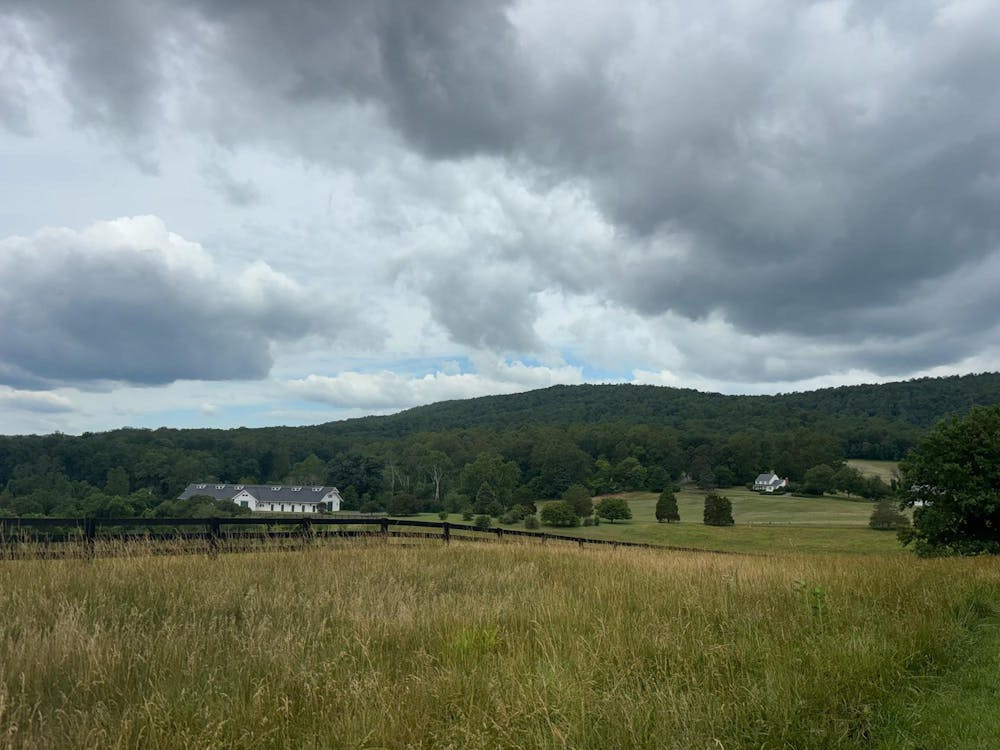
Located just 10 miles east of Grounds, the University’s Morven Sustainability Lab serves as a living classroom where students can study regenerative agriculture, conduct environmental research and reconnect with the natural world. Spread across nearly 3,000 acres of rolling hills, luscious forests and farm lands, the property has become a hub for sustainability education and experiential learning for the University community.
The property has belonged to the U.Va. Foundation — a non-profit organization providing real-estate and financial services to the University — since 2001, when it was donated by entrepreneur and philanthropist John W. Kluge.
Morven entered a new era in 2022 when former University President Jim Ryan designated it as the University’s Sustainability Lab. The shift transformed Morven from a site that hosted sustainability-related programming into a place where the property itself became the focus of teaching, research and experimentation.
According to Rebecca Deeds, program director of the Morven Sustainability Lab, the designation created new opportunities for students to apply what they learn in the classroom.
“The biggest opportunity and the biggest change for both Morven and the University is a land-centered program where students can really practice and experiment with what is being taught at the University,” Deeds said.
Deeds also noted that Morven’s proximity to Grounds sets it apart from the University's other research stations, such as the Mountain Lake Biological Station and Blandy Experimental Farm, which are both over 100 miles away from Grounds. Morven allows more students to engage with environmental research and sustainability initiatives.
“This new mission really activates this 3,000-acre historic property as a new research station for the Virginia Piedmont and it's only 10 miles from Grounds,” Deeds said. “Other research stations are hours away from the University, and we have the capacity, because of our location, to engage students more broadly and get more students involved in Morven.”
Morven also hosts events that encourage students to engage with the property outside of an academic setting. Through Student Days, open and free afternoons Morven holds every semester, students are invited to use Morven’s indoor and outdoor spaces to study and spend time in nature.
The events feature quiet study zones, access to Morven’s trails, refreshments and sustainable crafting activities. To make the experience accessible, a shuttle loop transports students from Grounds to Morven throughout the day. For the Fall 2026 semester, student days will be held on Sept. 19, Oct. 24 and Dec. 9.
Over the coming years, Morven plans to expand student engagement programming, building on initiatives such as Student Days to establish the property as a regular part of the student experience. One objective outlined in Morven’s 10-Year Strategic Action Plan is securing funding to connect the site to the University’s transit system, making transportation to the property easier for students.
Much of Morven’s infrastructure reflects the mission of student involvement. Deeds, for instance, explained that the Morven Food Lab, a classroom and gathering space that supports programming at the Morven Kitchen Garden, originated as a student capstone project.
Under the guidance of Professor of Architecture Phoebe Crisman, then-University students, Class of 2018 alumnae Gabby Levet and Elise Watt, developed both the concept and design for the building, and fundraising efforts later brought the project to life.
Despite the array of opportunities available at Morven, some courses struggle to attract enough student interest to meet enrollment requirements. Still, Assoc. Politics Prof. Paul Freedman, who teaches PLAP 3160, “Politics of Food” at Morven during the summer, said the property's educational value cannot be replicated in a traditional classroom setting.
“We have courses that we've had to cancel because not enough people signed up for it,” Freedman said. “And when you come out here, you're going to say, well, that's kind of a tragedy, because this is an amazing opportunity. It's the kind of place that people would pay a whole lot of money to come visit and take a course at.”
One student who took Freedman's Politics of Food course this past summer echoed his sentiment. Third-year College student Nina McGinnis said that Morven offers an experience unlike anything else available on grounds.
“It's hard to feel like, when you're at U.Va., [that you’re] out in nature, but Morven really has that feeling,” McGinnis said. “And so it just seems like such a relaxing place that students could go and just do their work.”
McGinnis visited Morven outside of her class for the Morven Spring Mixer to commemorate Earth Month this past April. For her, the natural beauty and built environment was the highlight of her visit. With her class, McGinnis was able to experience even more special events that Morven has to offer.
“[One] Tuesday there was a Virginia Farm Summit that just happened to be happening at Morven, and so we attended that for the day for class,” McGinnis said. “We got to meet real farmers and other people involved in the food system, we [had] an amazing lunch and learned about all that … [It] was just another amazing element to be there and experience that.”
Beyond academics, faculty members believe Morven can help students develop a deeper personal connection to sustainability. Elizabeth K. Meyer, faculty director of the Sustainability Lab, said that experiences at Morven may help students move beyond feelings of hopelessness associated with climate change.
“I think that’s what Morven's secret sauce could really be — particularly if every student just ends up going out there for an afternoon on a non-football weekend and just has a good time — that they'll start to care more, and then be curious about the things that they can change,” Meyer said.
At the center of Morven’s sustainability efforts is the Morven Kitchen Garden, a two-acre garden that grows vegetables, fruits and other crops using sustainable farming practices. The Garden was founded in 2011 by two University students, Michelle Rehme, Class of 2011 alumna, and Marie Schacht, Class of 2008 alumna, who wanted to engage with the local food system. The two students worked alongside Stewart Gamage, Morven’s first director of programs, as well as other students and volunteers to establish the garden.
According to Deeds, those same students helped establish gardens on Grounds that are now managed by U.Va. Office for Sustainability. Today, the Morven Kitchen Garden continues to serve as both an educational resource and a source of locally grown food.
The Morven Kitchen Garden also provides hands-on learning opportunities through internships and volunteer programs. This summer, the garden welcomed four farm crew interns and two coordinator interns who assisted with nearly every stage of crop-production, from planting and weeding to harvesting and distributing produce.
One way community members can engage with the Morven Kitchen Garden is through its Community Supported Agriculture Program, which allows participants to receive regular shares of produce grown at Morven. Students receive a 20 percent discount through the program and can sign up by filling out the CSA registration form on Morven's website.
Fiona Flynnmoore, manager of Morven Kitchen Garden, said she hopes volunteers, CSA members, interns and any other participants leave with a broader understanding of sustainability.
“Sometimes sustainability is very, very easy,” Flynnmoore said. “It's not really that hard to join a CSA program, and it might actually be somewhat joyful in that you actually find some community that you enjoy and that you have a little fun.”
In addition to serving students and the broader community, Morven is also working to deepen its relationship with the Monacan Nation, whose ancestors lived, hunted and cultivated the land long before European colonization. As part of this effort, Morven plans to collaborate with Monacan elders, scholars and community historians to co-curate the property’s landscape biography, interpret sites of cultural significance and pursue joint research initiatives.
One such initiative is a collaborative research partnership with the Monacan nation led by Meyer and Professor Manuel Lerdau, Morven’s research director and environmental sciences professor, who oversees the project's agriculture, forestry and ecological components.
“[The Monacan Nation] … [was] able to acquire a 1,500-acre property near their ancestral home, and it's surprisingly similar to Morven — [an] old farm with a combination of field and forest,” Lerdau said. “They're very interested in developing it sustainably and so I've been working with John Pierce [Monacan natural resources director] to try to identify projects that would be interesting and exciting to both Monacan for their goal, and for U.Va. students and faculty.”
The Sustainability Lab’s leadership views indigenous stewardship as an important guide for future management of the property. Deeds said that understanding the land’s history is essential to determining how it should be cared for.
“How we care for the property moving forward is a reflection of how it was stewarded in the early days by indigenous people. That's what we would really hope to do,” Deeds said.
Beyond becoming part of the University’s transit system, Morven’s 10-Year Strategic Action Plan also calls for expanding land-based research initiatives through agroforestry and regenerative farming projects, revitalizing the Morven Kitchen Garden and building partnerships with the University’s programs as well as local organizations.
As Morven continues to evolve, its leaders envision the property as a place where research, education and community engagement intersect. In doing so, they hope to expand opportunities for students and community members to engage with the land and the environmental challenges that shape it.
For Flynnmoore, these goals reflect a larger commitment to caring for the environment and helping others recognize their role in that effort.
“You know, I think of all the planets in the universe, and that we got to have Earth”, Flynnmoore said. “That is huge. And so every time you do something little, no matter how small it is, it does make a difference.”
Read More

Notes from a shared address
By Summer Hoffman | YesterdayAfter one year of living with my partner, I can safely say that our living room is the best classroom I have ever sat in.

CASH provides tax season assistance for the Charlottesville community
By Lily Notter | YesterdayWith the program’s primary goal being to benefit students and the Charlottesville community, they work to maximize refunds clients receive and minimize what they owe in annual taxes.
The graduate admissions exam grind
By Charley Thomas | 3 days agoJust when University students think they have left the prep-work perils and score obsessions of standardized testing back in high school, entrance exams for graduate program applications ring in round two.