
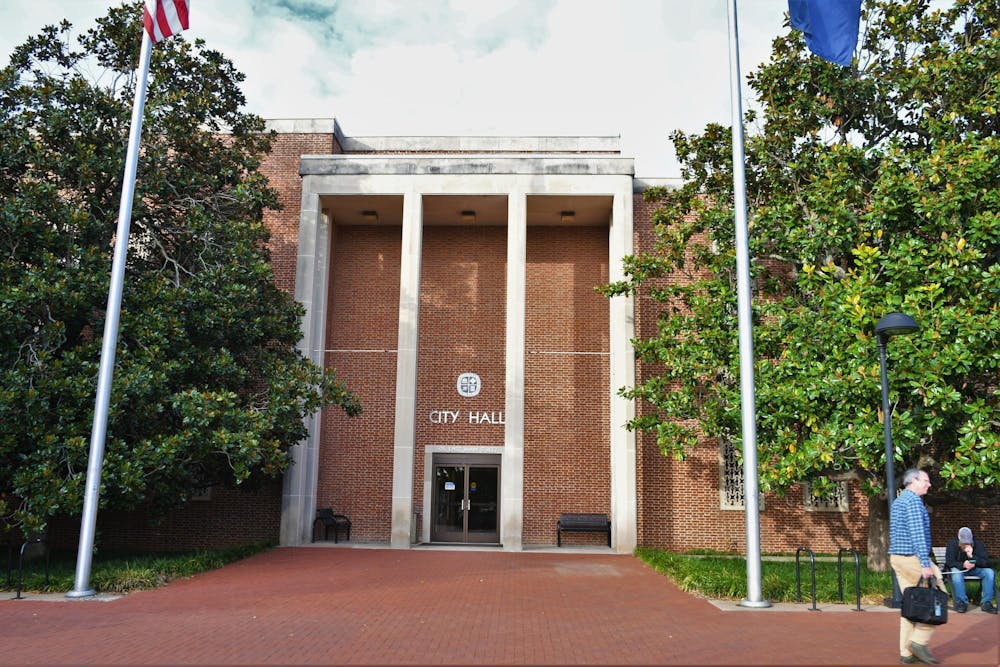
City Council’s May 4 vote to award “The Mark at Charlottesville” a necessary Certificate of Appropriateness for construction cannot be reversed, City Attorney John Maddux explained at the Council’s first regular meeting of the month July 20.
The planned, seven-story luxury apartment in the historically Black neighborhood of Fifeville has drawn condemnation from local residents, who claim the project would “loom over” the rest of the neighborhood and worsen local traffic problems. According to residents, it is also the latest in a series of disruptive luxury student housing projects that will raise living costs and transform their community into a “suburb” of the University.
The Council effectively greenlit The Mark at a regular meeting May 4 when it voted to award LCD Acquisitions — the developer based in Athens, Georgia — a “Certificate of Appropriateness” to construct the project next to two historic cottages. The Council’s vote overturned a prior decision by the Board of Architectural Review, which had ruled that The Mark would be impermissibly out of scale with the two small cottages as per the BAR’s established design guidelines.
Council members faced pushback for the decision at subsequent meetings and engagement sessions, including a developer presentation for residents June 24. Residents at this meeting reportedly demanded that Council Members — four of whom were in attendance — consider a revote on the issue, according to Charlottesville Tomorrow.
Shortly after the Council’s closed session ended July 20 at 6:30 p.m., Mayor Juandiego Wade asked Maddux to read a statement clarifying that such a re-vote would not be possible, as the city’s zoning code and state law clearly lay out Council’s limited role in Certificate of Appropriateness appeals.
“I know that many people feel strongly about this project [and] it’s not my intention to dismiss anybody’s concerns. Rather, I want to be clear about the legal question,” Maddux said. “The question is whether Council can now rescind its action or vote on that appeal again … The answer is no … Once [the] Council acted on the appeal, its role in that process was complete.”
In response to Maddux’s statement, Council Member Michael Payne said the conclusion of the certification process does not stop the Council from re-assessing its broader approach to student housing. The Council, Payne noted, can still implement more protections for concerned residents.
Payne said he would be interested in requiring a special exception permit for student housing projects subject to the Charlottesville Planning Commission’s approval. Currently, the City’s zoning code allows almost all development projects by right. This means that, except on narrow questions like the preservation of historic properties, development projects do not require the Council’s or another Board’s approval to proceed.
Payne further expressed support for expanding the protective “Core Neighborhood Overlay” zoning districts in the City. In these districts, building a seven-story project like The Mark would require a permit as part of an effort to limit development slightly in historic neighborhoods vulnerable to displacement.
“There are still policy mechanisms, there are still choices for Council to make,” Payne said.
Following the exchange, a packed hall of Fifeville residents and affordable housing advocates weighed in during the “Community Matters” segment of the meeting — the public portion in which up to 16 speakers can address Council members for three minutes each. A number of residents took issue with arguments Council members and LCD’s attorneys made at the May 4 and June 24 meetings.
School Board Member Zyahna Bryant spoke as a member of the public, condemning the “unhinged” development of the Mark and what she described as the limited system of accountability by-right development presents.
Bryant, who was present at the June 24 meeting, also indicated she spoke with a female member of the Council that day who supports the project. According to Bryant, this Council member was “convinced” that building housing of all types, including luxury housing, alleviates displacement pressures by creating new places for wealthy residents to live outside of working class neighborhoods.
At the May 4 meeting, Vice Mayor Natalie Oschrin said that the steady flow of University students coming to Charlottesville need somewhere to live, as well. She indicated she believes that housing them in new buildings like The Mark provide a number of benefits, such as helping to free up housing for other residents within the broader community, and raising the City’s tax revenue.
Bryant said July 20 that the University’s presence nearby changes the economics of the situation. More housing available in the City, Bryant said, directly increases the University’s enrollment capacity.
“The point that I made to her was that, actually, the more we allow developers to come in and have free reign over our City, [the more] we signal to the University that they can continue to enroll more people,” Bryant said. “They [can] continue to accept large donations that require more capacity, thus more units that are luxury and [that fit] the demographics of the students that they want to enroll.”
Asst. English Prof. Laura Goldblatt also disagreed with the assessment that the benefits of the Mark will trickle down to the rest of the community. Goldblatt provided Council members with an annotated bibliography of 13 sources that she said illustrates how the introduction of student housing in residential areas leads to “studentification” — a subsequent rise in living costs as the area evolves to cater to those students.
Goldblatt also noted a February article in The Atlantic magazine which found that a luxury housing project in Honolulu, Hawaii led to upward mobility in the community, but she highlighted that this trend only seemed to apply to residents at 100 percent of the Area Median Income level. Meanwhile, a report by Georgetown Law’s Center on Poverty and Inequality found that luxury housing decreased the supply for those at 50 percent AMI or lower, as cited by Goldblatt.
“Their findings contest the narrative of trickle down housing,” Goldblatt said. “They comprehensively show that increased housing supply does not trickle down to extremely low-income groups. Instead, those groups need housing specifically developed for them to mitigate displacement.”
Fifeville Resident Frank Bechter chided the system of by-right development for seeming out of step with the Charlottesville Comprehensive Plan — a guiding set of principles approved in 2021 which informs policymaking in the City. Bechter noted page 21 of the Comprehensive Plan, which states that residents should be made to feel “welcomed, valued and respected,” but he said community input has been “zoned entirely away by City Council.”
LCD’s attorneys also stressed May 4 that the developer would renovate the historic cottages — currently in “extreme disrepair” — at a cost of $2 million, noting this high-dollar investment as a major benefit that building The Mark will have for the surrounding areas. Bechter pointed out July 20, however, that none of the lawyers’ initial applications indicated that the two cottages LCD will renovate are at an “imminent risk of collapse.”
Bechter also said he believes LCD’s estimated price tag of $2 million was deceptive, and intended to make renovations seem more costly than they truly are. LCD claimed renovations would be so costly that no other entity could feasibly carry out renovations to salvage the properties as a standalone project.
“Council, you were lied to,” Bechter said. “I say this especially for the City Attorney to hear. … Landmark proposes to rehabilitate these structures at an estimated cost of about $2 million dollars [according to attorneys]. … But the developer himself told me when we walked the neighborhood in early June [the $2 million] includes the price of purchase.”
Zillow estimates value one of the cottages, located at 208 7th St SW, at $900,000. If the cottage next door at 204 7th St SW is valued at a similar price, LCD’s purchase of the properties would account for roughly 90 percent of its estimated expenses for carrying out renovations.
The Mark’s controversial designation as a “student housing” project under the city’s zoning code also came up at the July 20 meeting.
According to Don Gathers, a city resident and a member of the Charlottesville First Baptist Church, LCD’s representatives and lawyers repeatedly stated June 24 that they intend to lease the 737 beds to “anyone who could afford them,” as opposed to just students.
Gathers alluded to The Mark’s status as a “student housing” project under Charlottesville’s Affordable Dwelling Unit Monitoring and Procedures Manual. This designation means the project is located less than one half-mile from “Central Grounds” and leases beds on an individual basis. Barred from satisfying the traditional City requirement that it set aside 10 percent of units for affordable housing, LCD will pay an in-lieu fee into the City’s Affordable Housing Fund, and at a lower rate than non-student housing projects that opt to pay a fee.
LCD successfully fought off an appeal from Fifeville resident Paul Reeder in March, allowing it to maintain the “student housing” designation, and saving the project an estimated $5.6 million in in-lieu fees.
Gathers argued that if the project is not reserved for students, then its designation as a “student housing” project under the ADU manual should not be allowed to stand.
“They owe us 10 percent of those units that they’re putting in based on what they said at that meeting,” Gathers said. “I encourage and I urge you all to at least demand 70 beds of this property. That’s the very least that they could do — but they should do much more.”
The City’s ADU manual does not include a specific provision which states developers must lease units in projects classified as “student housing” specifically to students.
The City’s treatment of its unhoused population was another prominent issue at Community Matters July 20. The Council confirmed July 17 that it plans to clear an encampment at Free Bridge on the Rivanna Trail by Sept. 1, amid concerns of health violations, a sexual assault and a death at the encampment in recent weeks.
Several currently unhoused residents appeared July 20 to directly ask for relief. One unhoused resident, City Resident Donnes Chambers, said he applied for services for unhoused City residents — such as Region Ten for his then-five year old son with autism and at The Haven — both of which were denied. He asked Council members to focus their efforts on tackling the root causes of homelessness instead of clearing populations of unhoused residents.
“You say you don’t want homelessness, but you’re not fixing the problem that’s causing homelessness,” Chambers said. “All these programs that y’all have for people, [they] deny you, send you out the door and do nothing.”
The Council’s meeting schedule can be found on the City’s website. Its next regular, bi-weekly meeting will take place Monday.

Luca Bailey is a third-year Politics student from Free Union, Va. As a staffer on the news and video desks, he has covered topics ranging from the General Assembly and state elections to local politics and University governance. He is also The Cavalier Daily’s beat writer for the Charlottesville City Council.
Read More

English department considers AI’s place in the classroom
By Lily Kostro | 2 days agoFor the University’s English department, some professors have chosen assignments that utilize AI in writing, while others take the approach of completely eliminating students’ access to generative AI in their writing process.

The Cavalier Daily joins amicus brief supporting student press at University of Alabama
By Jaylynn Perez | 3 days agoThe Cavalier Daily joined 39 other collegiate news organizations and 15 student editors from across the country in signing an amicus brief Sept. 2.

Student Council considers creating an ad hoc committee to review UBE proceedings
By Lucia Gambacini | 3 days agoConsideration of the bill was postponed until the next general body meeting.


