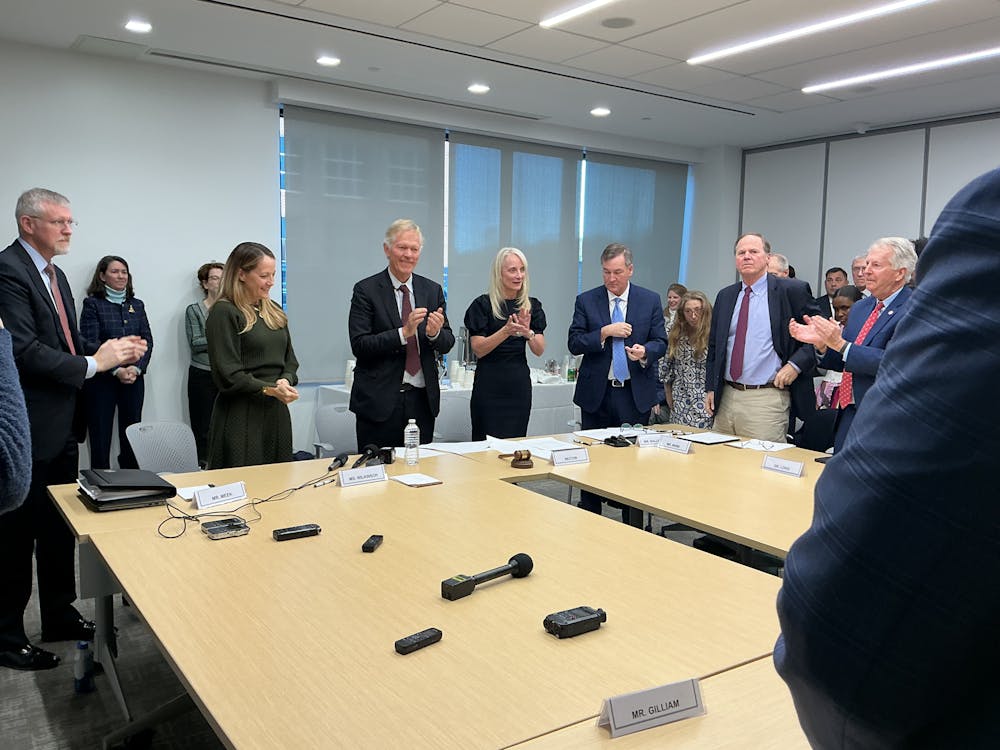
The appointment of Scott Beardsley, the current Dean of the Darden Business School, to be tenth president of the University Friday sparked conversation amongst University leaders. Putting aside Beardsley’s character and expectations for his work as president, many wished the Board had waited before finalizing the president-elect.
David Leblang, presidential search committee member and professor of public policy, objected to the Board’s actions Friday, and he said that the timing of the appointment on the last day of finals is setting Beardsley up to fight an uphill battle to win the University's trust.
“This is not about the appointment of Mr. Beardsley. This is about the timing of the appointment,” Leblang said. “Anybody who's appointed at this moment needs … to know that they're going to have to do an awful lot of work on Grounds and with the community in order to articulate why they thought it was so urgent to take the job now, as opposed to waiting until January.”
Leblang also said he thought the timing was intended to catch the University community as it was preparing for the holidays to avoid attention. Above all, Leblang said that the broad community wished for a president to be successful, but the nature of this search and following appointment has stilted Beardsley’s chances of success.
“The timing of this, especially in the face of the requests by deans, students, [the] Faculty Senate and the incoming governor [to stop the search] — I think all of that makes it very challenging for any new president to quickly gain the trust of the community,” Leblang said.
The University began the process for seeking the University’s tenth president in July with the appointment of the Presidential Search Committee, co-chaired by Board Rector Rachel Sheridan and Vice Rector Porter Wilkinson. Isaacson, Miller, an external search firm, was hired in August to assist with the search.
This fall, the Faculty Senate, Student Council, General Faculty Council, and nine of the 14 academic deans all called for the presidential search to be paused or suspended, citing concerns about how quickly the process was moving and broad distrust in the Board of Visitors. Gov.-elect Abigail Spanberger issued a similar call in November.
Faculty Senate Chair Jeri Seidman echoed LeBlang’s concerns, saying that she was primarily disappointed in the Board’s decision to appoint a new president despite these calls from stakeholders across Grounds.
“Disappointed — I think that about captures [my reaction to the appointment],” Seidman said.
Seidman said that having only eight days between the announcement of finalists and the appointment of a president amounted to a search process that “[nobody will] be proud of.” She said she found it insulting for the search committee’s process to be aborted after their time and energy dedicated to the search.
When asked for a comment on objections to the process, University Spokesperson Bethanie Glover directed The Cavalier Daily to a profile of Beardsley and a video of Beardsley introducing himself to the University community. In the video, Beardsley said he was proud and honored to be selected and will bring lessons he learned during his time at Darden to his new role.
“Together, we will advance scholarship, expand opportunity and strengthen our contributions beyond the Grounds,” Beardsley said in the video. “The path ahead is full of promise, and I look forward to the work we will do together.
In the University’s media release, William Goodwin, former rector of the Board and Darden alumnus, said in the University’s media release that Beardsley is a “visionary leader” and “tremendous choice.” Another former rector, George Keith Martin, said in the release that Beardsley is a “thoughtful leader” with a depth of experience that will serve as an asset to the University.
Some members of student leadership expressed similar concerns to Seidman and LeBlang. Keoni Vega, Class of 2026 president and fourth-year College student, said that although Beardsley probably has the capacity to be a “fine president of this University,” he shared other leaders’ concern regarding the appointment process. Keoni said that in order to be taken as a legitimate president, Beardsley should step down from his role.
“[Beardsley] should not accept the role, and [he should] ask for the search to be redone in the spring, once the Board is fully constituted, as has been asked by the governor, the Faculty Senate and repeated calls from students to do so,” Vega said. “[I am] incredibly disappointed in the Board of Visitors continuing to act in secrecy when the University community and students are not here.”
Certain stakeholders have argued that the Board does not currently meet legal guidelines and therefore should not be authorized to make lawful decisions. Virginia state law requires the Board to include at least 12 University alumni and 12 Virginia residents — the Board currently consists of nine Virginia residents and nine University alumni. The University has maintained that the Board is legally constituted.
Clay Dickerson, Student Council President and fourth-year College student, said that he did not know much about Beardsley himself, but he disapproved of the Board’s decision to appoint a president after the rushed process.
Dickerson said his initial reaction was shock, followed by anxiety about the implications of the politicized Board. In addition, Dickerson said he expects that Spanberger will have a “destructive response” that he feels is necessitated by the Board’s actions. According to Dickerson, the very nature of Beardsley’s appointment nullifies any future actions Beardsley may take to win the trust of the University.
“I don’t think there’s anything he can do to earn the trust of the University,” Dickerson said. “He was appointed by a Board that its constituents hold no confidence in.”
Not all stakeholders, however, were opposed to the process or the outcome. The Jefferson Council — a conservative group of University alumni — issued a statement Friday congratulating Beardsley on his appointment. The statement expressed enthusiasm for the University’s next chapter of leadership.
“We hope this transition marks a renewed focus on the core U.Va. principles that have been strained in recent years,” the statement reads. “Given President Beardsley’s deep experience within U.Va., we trust his understanding of this institution’s unique character will guide a renewed emphasis on creating a real level playing field for the free and civil exchange of ideas.”
Joel Gardner, president of The Jefferson Council, said he finds those who have critiqued the search process and appointment hypocritical. According to Gardner, previous Board leadership made an effort to keep the University in the hands of Democratic leadership prior to Youngkin’s term. He said that the search process was as open as it could be to allow for the committee to successfully identify finalists.
“[Opponents of the appointment] are all just politically motivated … [and] trying to find arguments to delegitimize the process,” Gardner said. “This is the broadest and most diverse search committee ever in the history of the university.”
Wahoos4UVA, a group of alumni, students and parents that emerged in support of Ryan prior to his resignation, echoed the discontent of faculty and student leaders in a statement Friday after the Board’s decision to appoint Beardsley amidst calls “from all corners of the U.Va. community” to pause the search until the Board is lawfully constituted.
“We are deeply disappointed by this decision and the rushed, opaque process that led to it” the statement read. “This is not who we are, or at least who we should be as an institution.”
Like Leblang, the Wahoos4UVA statement said that Beardsley and his candidacy aside, the process was illegitimate and degrades the trust of the University community.
“While we applaud Scott Beardsley's accomplishments at the Darden School, by accepting the position of U.Va. president under the current circumstances, he has regrettably eliminated the possibility of beginning a presidency with the trust and confidence of the U.Va. community that both a new president and the University deserve,” the statement reads.
Similarly, the American Association of University Professors issued a statement Friday after the appointment, calling it “rushed” and an "affront to the entire U.Va. community in a time of crisis.” The statement criticized the Board for being overtaken by politicization, maintaining secrecy throughout the search process and cutting off community input.
“Rather than heeding calls to pause the search until a fair and transparent process can be initiated, the Board regrettably chose to push through an appointment without a duly constituted membership,” the statement read. “This undermines the legitimacy of today’s appointment that will continue to be challenged in the coming months.”
Looking forward, Wahoos4UVA said that Governor-elect Abigail Spanberger will have the responsibility of repopulating the Board to ensure its lawful constitution and quality of members.
“Once the Board of Visitors is lawfully reconstituted, it can undertake the unfortunate but necessary work of nullifying a tainted presidential appointment, restoring integrity to the leadership of the University at this critical time, and guiding UVA forward out of this crisis,” the statement reads.
Similarly, LeBlang noted that Beardsley will have his work cut out for him given all the discontent and distrust surrounding this process.
“Trust is hard won and easily lost, and so I think he's going to have to work really hard to establish that trust.”

Grace Little is a news editor for the 137th term. She is a third-year student from Dallas majoring in neuroscience and the interdisciplinary major in public policy, politics and media studies. She enjoys writing about the shifting landscape of higher education, and you can reach her at g.little@cavalierdaily.com.
Read More

Student Technology Council aims to represent students on technological issues
By Solomon Ross-Milligan | 14 hours agoSTC is currently a 20-member council and includes students from across schools and organizations within the University.

Woodruff and Bouie discuss freedom of the press, emphasize need for nonpartisan news
By Robert Head | 14 hours agoAfter an introduction by Jane Kamensky, president and chief executive officer of Monticello, Woodruff answered Bouie’s prompts on topics such as modern threats to the press, the objectivity of the press and Americans’ declining trust in news outlets.
With midterm elections approaching, Miller Center experts share foresight
By Reilly Auld and Luca Bailey | YesterdayThese midterm Congressional elections are generally viewed as an opportunity for voters to evaluate the incumbent President’s performance in their first two years in office.