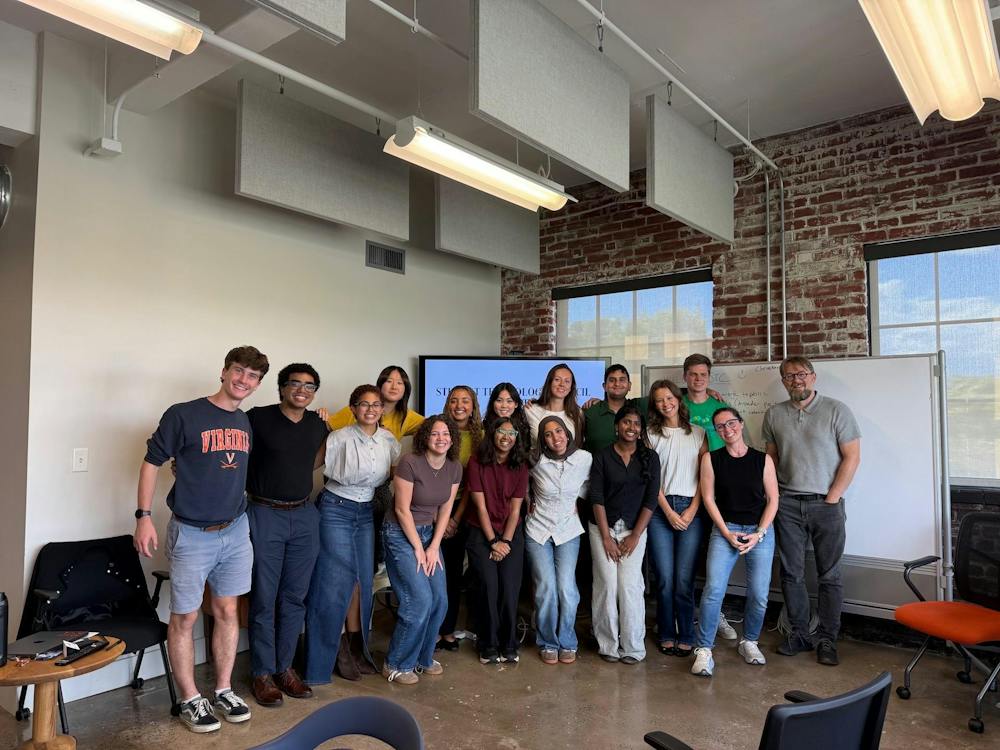
As technology becomes an increasingly important part of student life, the University and organizations across Grounds are finding ways to adapt. The Student Technology Council is one of these organizations, and fourth-year Data Science student Kayla Kim was named its inaugural chair at the beginning of the academic year.
STC is currently a 20-member council and includes students from across schools and organizations within the University. It was originally founded as a collaboration between the Sloane Lab, the Karsh Institute of Democracy and the Digital Technology for Democracy Lab. Its founding mission was to serve as a legislative body where students can elect fellow students to represent them in discussions surrounding technology on Grounds. Originally intended to be an individual Special Status Organization, Kim said it has since shifted its goals to incorporating with a larger overarching SSO, such as Student Council.
STC is divided into two teams, the Policy team and the Projects team, with each working together to best represent the student body, Kim said. The Policy team is headed by third-year Batten student Hafsah Zaman, who explained it as the “backend” part of STC, which works to provide recommendations and policy memos to University administrators based on student opinions.
“What we're trying to do going forward is [make] a standard for a lot of different tech policies [for] what we think should happen [at the University],” Zaman said. “That's taking student feedback, and also looking at what other schools are doing in terms of a bunch of different things like [artificial intelligence], data privacy concerns, things like that.”
On the other side, the Projects team is led by third-year College student Rishi Chandra, who said they provide more direct dialogue with administrators and University technology partners. Chandra said the team works closely with the Policy team’s recommendations to accurately represent the student body.
“We’re going to be coordinating with our administrative partners, making sure student voice is translated from the actual student body and then presented to the administrators,” Chandra said.
One of the main advantages STC has, Chandra and Zaman agreed, is its diverse nature. They said that not only do students represent many of the University’s different schools and majors, but they are also in many different extracurricular clubs and organizations. They explained this can further increase STC’s outreach efforts and bring a unique perspective to general body meetings concerning technological issues at the University.
“The cool thing about STC is all of the students were selected from many different departments and different fields. We have a lot of artistic students, and so we're trying to balance that idea of art and data with AI,” Chandra said.
Currently, STC’s focus has been on traditional issues such as AI and data protection. However, it is also using a sandboxing process, where new technologies such as apps and websites are tested to make sure of their usefulness. He said the two teams work closely together to make decisions on these issues, with Policy focusing more on research and Projects on front-end interactions with administrators and partners. However, he described this structure as fluid, with both teams taking note of what works and what does not for future cohorts of STC leadership.
Kim said her original interest in chairing STC stemmed from noticing a lack of student input when the University launches new technology products. Notably, many students expressed dissatisfaction with Wahoo Eats, which was an online food ordering application released in the fall of 2025 to replace Grubhub. The University has since switched back to Grubhub, but Kim said decisions like these are ones she hopes STC can be a part of before problems arise for students.
But first, Kim said, students need to know that STC exists in the first place. Zaman views this as one of the chief goals of the Policy team during her year as lead and said she has several ideas for the year on how to increase this outreach to the community. Some of these are traditional — such as student surveys and town halls — and some are more innovative — like creating a Substack to explain University-wide technological changes to students in a digestible format.
“Not creating what we think the issues are, but actually gauging what the students think the issues are … We actually will need to ask the students, ‘What do you guys think are problems in terms of technology at U.Va.?’” Zaman said.
Another goal of Kim’s during her year as chair is to integrate STC as a branch of Student Council, as she said she believes it could provide STC with immediate benefits.
Kim said that incorporating STC into Student Council would allow STC to report directly to students through Student Council general body assemblies, which would give students immediate access to STC and their current discussions as well as providing them with structural benefits such as the Student Council newsletter.
“The … branch idea … [is that] there will be public immediate access to what the STC is doing,” Kim said. “A set Technology Council representative at the [Student Council] general body meetings … would get our voice out there.”
STC operates as a hybrid organization, with the students working in tandem with University administrators and professors to develop recommendations and policy memos for technological decisions. One of these faculty advisors, Data Science Prof. Aaron Martin, said he believes STC can give students a voice when it comes to the technology the University uses.
“The idea that students can engage more closely on [technological] issues to provide their perspectives and student body perspective more broadly, I thought was something innovative and different,” Martin said.
Martin described his role as a support position, where he leverages his experience in technology policy to provide STC guidance on the most pressing technology-related issues facing American universities, and society more generally, today. Additionally, he explained that he counsels students on what is achievable within an institution such as the University when it comes to policy change and advocacy. Still, he said he wants to maintain the students’ independence when it comes to STC and not have it be something professors take over.
“I was keen to get involved, but also mindful that this is their thing, not mine. I’m happy to take a backseat role and … provide some steering, but I really want this to be something that they drive and take ownership of,” Martin said.
Kim also explained that the long-term goal for STC is still student self-governance despite this current hybrid model, which involves students, professors and administrators working together to provide recommendations to the University. One of the main challenges during her first term, Kim cited, will be demonstrating that despite this hybrid model, the STC does actually represent student voices.
“The hybrid model of our organization in its early infancy phase might seem like an issue to people, and I’m hoping to communicate with others that yes, we are hybrid right now. We're working with … other faculty,” Kim said. “I feel like people will push back on that, saying, ‘This is not student self-governance,’ but I want to remind them that … we're right now [just] starting out.”
Ultimately, Kim said that as technological decisions gain more importance in students’ lives, she said she hopes that the STC can continue to protect and prioritize student voices.
“I would like the students to see [themselves] as the … guardians of their technological rights … as their voice, their direct voice, with administrators on what they believe should be implemented around them,” Kim said.
Solomon Ross-Milligan is a staff writer on the news desk from Charlottesville. He is a second-year College student.
Read More

Woodruff and Bouie discuss freedom of the press, emphasize need for nonpartisan news
By Robert Head | 59 minutes agoAfter an introduction by Jane Kamensky, president and chief executive officer of Monticello, Woodruff answered Bouie’s prompts on topics such as modern threats to the press, the objectivity of the press and Americans’ declining trust in news outlets.

With midterm elections approaching, Miller Center experts share foresight
By Reilly Auld and Luca Bailey | YesterdayThese midterm Congressional elections are generally viewed as an opportunity for voters to evaluate the incumbent President’s performance in their first two years in office.
Honor Committee continues to debate changing appeals process
By Michael Racz and Bryan Dean | YesterdayThe proposed change, if voted into effect, would alter the way students are able to appeal either their hearing or sanctioning panel decisions, should they feel there has been a violation of a granted right or there is new evidence to introduce to the case.