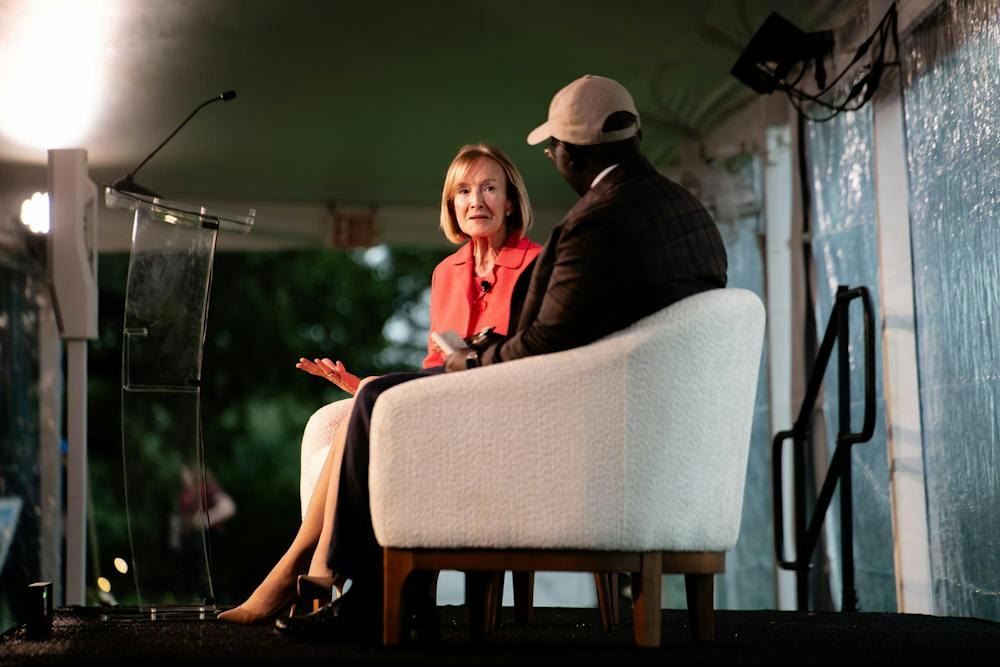
Members of the Charlottesville community gathered on Monticello’s West Lawn Monday to listen to former PBS News Hour anchor Judy Woodruff discuss freedom of the press and the state of news in the United States. Jamelle Bouie, New York Times opinion columnist and Class of 2009 alumnus, moderated the event.
After an introduction by Jane Kamensky, president and chief executive officer of Monticello, Woodruff answered Bouie’s prompts on topics such as modern threats to the press, the objectivity of the press and Americans’ declining trust in news outlets. They also discussed and emphasized the importance of local news.
Woodruff served as NBC News’ White House correspondent from 1977 to 1982 and as the chief Washington correspondent for PBS News Hour from 1983 to 1993. In 2013, she began anchoring for PBS News Hour. Bouie worked as a correspondent and political analyst for several publications before he joined The New York Times in 2019. His writing focuses on applying American history to examine present political and legal issues.
When Bouie asked Woodruff her thoughts on President Donald Trump’s Sept. 19 decision to bar several news outlets from reporting at the White House, she responded first by asserting that in her experience covering White Houses dating back to President Jimmy Carter, no president has liked the press.
“[The presidents] have a whole lot of bones prepared with the press, and we are on the receiving end of that,” Woodruff said. “Our job is not to bring favor or to be liked by whoever the president is … Our job is to go out and report the facts and write them down, deliver them on television, on radio, on digital, on newspapers.”
To Woodruff, conflict between the president and the press is a fact of White House correspondence and part of the job. She said she believes that although tensions between presidential administrations and the press are not unusual, the current White House’s treatment of news outlets encroaches on press freedoms.
CNN, MS NOW and Politico joined in levying a lawsuit against the Trump administration Monday. The lawsuit is a response to the president's decision to bar the news outlets from the White House, and Woodruff said she feels that Trump’s Sept. 19 ban is “of a piece with the other steps that he’s taken,” and said she supports the news sources’ decision to sue.
On the topic of journalistic integrity and public distrust in news media, Woodruff largely attributed the issue to Americans turning to national cable TV as reliable local news sources disappear. Woodruff claimed that as many local news sources go out of business or are bought by large corporations, Americans are inclined to turn their attention to national cable news. Woodruff also noted that the subjective and divisive reporting of many of these news sources is further contributing to the divide between American Republicans and Democrats.
“You turn on national news and see people screaming at each other, calling each other names, or you pick up your phone and you see that, then you’re more likely to buy into that,” Woodruff said.
When discussing the future of independent press and its relationship with the American public, Bouie and Woodruff considered the dangers of partisan, large media organizations. Bouie outlined Americans' distrust in these large news corporations, saying he thinks there is a fear amongst Americans about big corporations that are consolidating media organizations.
Woodruff also expressed her concern with the consolidation of news media and how it affects political discourse. She said she feels that one partisan news conglomerate having too much control over the news station in a region negatively affects that area.
“If you’re saying it’s okay for that big rich corporate owner to own stations in 50 cities, and they lean far left, and that’s the only station that’s viable in that city, then that’s a problem,” Woodruff said.
In an interview with The Cavalier Daily, Bouie said he would support a legislative review of national media conglomerates using existing antitrust laws or the authority of the Federal Communications Commission, so long as it is done with nonpartisan goals in mind.
“If you could somehow figure out a way to have … a sort of nonpartisan assessment of [if there is] too much concentration among media conglomerates … I would support them,” Bouie said.
Despite the concerns expressed during the forum about consolidation and freedom of the press, the speakers and audience members maintained a sense of optimism regarding the state of local and national news. Angilee Shah, audience member and CEO and editor-in-chief of Charlottesville Tomorrow, said it was great to see so many Virginians and members of the Charlottesville community come to listen to Bouie and Woodruff discuss the state of journalism.
“To see so many people care about the ability of journalists to do their jobs is really a great thing we have here in central Virginia,” Shah said.
Woodruff, too, expressed faith in the will of the American people to defend the press and free speech.
“I believe that democracy can’t survive without a free press, and I believe in our heart of hearts that’s what the American people want too,” Woodruff said.
Read More

Student Technology Council aims to represent students on technological issues
By Solomon Ross-Milligan | 2 hours agoSTC is currently a 20-member council and includes students from across schools and organizations within the University.

With midterm elections approaching, Miller Center experts share foresight
By Reilly Auld and Luca Bailey | YesterdayThese midterm Congressional elections are generally viewed as an opportunity for voters to evaluate the incumbent President’s performance in their first two years in office.

Honor Committee continues to debate changing appeals process
By Michael Racz and Bryan Dean | YesterdayThe proposed change, if voted into effect, would alter the way students are able to appeal either their hearing or sanctioning panel decisions, should they feel there has been a violation of a granted right or there is new evidence to introduce to the case.