
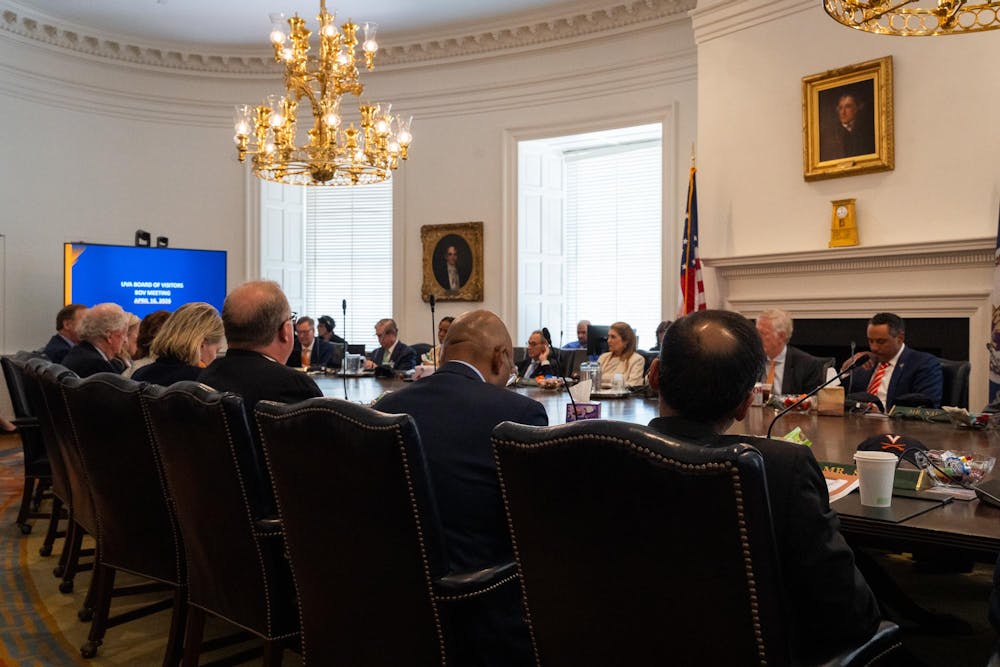
The full Board of Visitors convened Friday to discuss the University’s developing strategy for artificial intelligence with a presentation from Brie Gertler, interim executive vice president and provost. The Board also heard a presentation on research funding from Vice President for Research Lori McMahon, received updates to the strategic planning process from University President Scott Beardsley and reflected on the Board’s June retreat.
The Board also received an orientation on changes to NCAA athletics, completed its annual Atlantic Coast Conference certification, heard a report from Aaron Bloomfield, Faculty Senate chair and engineering professor, and discussed the University’s ongoing searches for a provost and several deans.
Gertler presented the University’s developing strategy for AI, outlining efforts to incorporate AI into research, teaching and healthcare while preparing students and employees to use the technology responsibly.
“AI touches virtually everything that we do, and it’s not possible for us to give an exhaustive account of everything that’s happening with AI,” Gertler said.
Gertler said that the University’s goal is not to become an institution focused exclusively on AI, but to use the technology to advance its broader academic mission and prepare the University community for what she described as the “age of AI.”
According to Gertler, the University has already held workshops designed to help faculty incorporate AI into their research and teaching. More than 350 faculty members have participated in the workshops, according to Gertler’s presentation, and the University has developed Faculty AI Guides to provide additional resources and the AI Policy, Usage and Guidelines Committee.
As an example of the implementation of AI, Gertler said that U.Va. Health is exploring “ambient AI” technology, which assists with clinical documentation by capturing and organizing information during health care appointments. The University has also begun to provide access to “protected chat” through tools including Microsoft Copilot and Google products, which are subject to University security and privacy protections, according to Gertler.
Gertler said students and faculty have expressed interest in receiving institutional licenses for more advanced AI models. According to Gertler, some students currently pay $20 per month for private AI subscriptions, while others may use free versions of tools that do not provide the same protections available through University-supported systems.
Board members also discussed how AI should be incorporated into the academic curriculum and whether students should take a common introductory AI course or receive instruction specifically tailored to individual disciplines.
During the Board’s discussion on AI learning implementation, Gertler distinguished between AI literacy and AI fluency. She described AI literacy as a baseline understanding of how to use AI, how AI models work and the technology’s implications for issues including intellectual property and ethics. However, she said AI fluency involves using AI effectively within a particular discipline or career.
Gertler also said that 221 faculty members have expressed interest in either conducting research with AI or studying AI itself. According to Gertler, the University is also participating in the Commonwealth Artificial Intelligence Institute — a collaboration involving eight universities, four state agencies and Virginia’s community college system. The CAII received $500,000 in funding July 1 and, according to Gertler, is intended to connect AI research across Virginia’s higher education institutions with industries and provide guidance to state and local governments.
Beardsley said that AI is an area where the University must lead, pointing to opportunities such as the School of Data Science and the University’s LaCross Institute for Ethical Artificial Intelligence in Business. He said that the University has “promising building blocks” needed to succeed, but still has work to do to reach the forefront of AI research and education.
“AI should be in the service of humanity. Humanity should not be in the service of AI,” Beardsley said.
During her presentation on the state of the University’s research enterprise, McMahon then provided an update on recent funding activities, reporting the University recorded $588 million in sponsored research funding during fiscal year 2026.
Sponsored research refers to research funded through external grants and contracts, including federal, state, corporate and nonprofit sources. Of the $588 million in sponsored research funding, $394 million — about 76 percent — came from federal resources, according to McMahon. The remaining $194 million came from non-federal funding sources.
McMahon further noted that the School of Medicine increased funding from the National Institutes of Health by approximately $71 million since last fiscal year. The College of Arts and Sciences also reached a record level of research funding which, according to McMahon, helped offset losses from the National Science Foundation.
McMahon also discussed proposed changes to the federal government’s Uniform Guidance — a set of federal rules governing how institutions administer federally funded grants. Under the federal government’s proposed changes, federal agencies would review grant applications before issuing awards to determine whether they are consistent with federal law, agency priorities and the national interest.
According to McMahon, a continuing resolution — a temporary federal funding measure used when Congress has not enacted a full appropriation bill — has paused implementation of the proposed changes to the Uniform Guidance. McMahon said that the University is continuing to monitor changes at agencies including the NSF, Department of Defense and NIH.
McMahon said that the University reported $896 million in total research expenditures for FY26. According to McMahon, research expenditures are broader than sponsored research funding and include sponsored research as well as state, corporate and nonprofit awards and University-funded research investments.
During his remarks to the Board, Beardsley provided updates on the University’s ongoing strategic planning process, which is expected to produce a new strategic plan in spring 2027, according to Beardsley. The University received 13,607 responses to its community survey that was opened from July 23 to Aug. 30 to gather general input from the University community.
According to Beardsley, alumni accounted for 6,500 responses — which is approximately 47 percent of respondents — while faculty had the highest response rate among other categories such as parents and families, students and University community members. Parents and families accounted for 2,100 responses while students submitted 1650 responses.
Beardsley noted that academic and research excellence and the student experience were each identified by 65 percent of respondents as priorities, followed by institutional culture and governance at 45 percent. Other themes included affordability, faculty and staff well-being and the effects of AI.
According to Beardsley, the next stage of the planning process will include analyzing the survey results and reporting the findings to the University community in December and January. He also said that the University launched a series of 30 workshops in collaboration with the Office for Organizational Excellence to further discuss potential priorities with the University community for the strategic planning process.
The planning process will establish a shared terminology around the University’s mission, according to Beardsley, which includes education, research, patient care and public service. Beardsley identified the University’s mission, its AAA credit rating and “affordable excellence” as non-negotiables for the strategic planning process.
“[University deans] highlight the importance of elevating our research impact, connectivity and collaboration,” Beardsley said. “I see [these themes and all other priorities] as ideas for strengthening us as a unified, resilient institution that grows our impact while removing some internal complexities.”
Regarding a question from Board member Rudene Haynes about increasing student participation in the strategic planning process, Jennifer West, dean of the School of Engineering and Applied Science, said the strategic planning committee is working with Student Council and class councils to incorporate student perspectives into the workshops.
Beardsley also updated the Board on searches for several University leaders. He said the University hopes to complete its search for a new provost by the end of the calendar year. The provost search committee is chaired by Gregory Fairchild, dean and chief executive officer of U.Va. Northern Virginia. Beardsley said that the search process includes the selection of four potential candidates — at least one internal and one external.
The University also expects to complete searches for the deans of the School of Architecture and the School of Medicine before the December Board meetings. According to Beardsley, searches are also underway for deans of the School of Data Science, the McIntire School of Commerce and the Frank Batten School of Leadership and Public Policy.
The Board also revisited its June retreat — which focused on academic excellence and innovation, accountability and aligned governance and the Board’s “collective norms.” Rector Carlos Brown said the Board is continuing to develop shared expectations for how its members should work together and interact with University leadership.
“The Board is evolving … [and must] come into alignment and agreement around how we want to operate so that we can be effective to students,” Brown said.
The Board further identified transparency and reviewing the University Financial Model as priorities for its continued work. The UFM is the system used to distribute revenue and costs between the University’s schools and administration. The Board and University leadership have been reviewing the UFM to determine whether changes are needed.
During his remarks to the Board, Bloomfield described the Faculty Senate as “wary but hopeful” following a period of significant change at the University. He said faculty are “one of the pillars of U.Va.,” supporting the University’s research, teaching, clinical care and ability to attract students. He said that the University risks losing faculty because of concerns about issues including academic freedom.
Bloomfield further encouraged the Board to create more opportunities for communication with faculty and said increased communication could help address misunderstandings between faculty and the Board. He proposed continuing interactions between the Board and Jeri Seidman, faculty representative to the Board and Commerce professor. Bloomfield also suggested creating more opportunities for the Faculty Senate and Board members to interact and to have a faculty member serve on each Board committee.
As part of his speech to the Board, Bloomfield highlighted academic freedom, which he described as one of the top concerns among faculty members. He said academic freedom includes faculty freedom in research, publication and classroom teaching, while noting that it does not exempt faculty from University policies or accountability.
“A lack of interference in teaching and research does not negate accountability. Academic freedom is at the core of what makes universities great. It is what our system of higher education is based on,” Bloomfield said. “Academics need the freedom to be able to challenge the status quo.”
As part of its agenda, the Board also received an NCAA orientation from Jason Baum, deputy athletic director for legal and regulatory affairs, on institutional control, recruiting and other changes to Division I athletics.
Baum reviewed the NCAA’s rules on institutional control — which outlines the responsibilities of universities and their governing bodies in overseeing athletics. He also discussed the role of “boosters,” or representatives of a university’s athletics interests, and the rules governing recruiting, including recruitment through the transfer portal.
The NCAA orientation for Board members also covered changes stemming from the NCAA’s settlement-related restructuring of Division I athletics. The new model replaces scholarship limits with roster limits and allows participating institutions to provide additional benefits to student athletes, including institutional Name, Image and Likeness payments.
For the University, the maximum institutional NIL pool is $21.5 million, according to Baum. The pool represents the maximum amount of benefits the University can make available to student athletes under the new model.
The Board also discussed requirements to third-party NIL agreements. According to Baum, student athletes must report third-party NIL contracts or payment terms worth $600 or more to the NCAA’s designated clearinghouse — NIL Go — within five business days of executing the agreement or agreeing to payment terms. The requirement also applies when multiple agreements with the same third party collectively reach the $600 threshold.
Baum reviewed changes to eligibility rules taking effect for the 2026-27 academic year. The NCAA recently changed pre-enrollment eligibility rules — including allowing prospective student-athletes to accept prize money and sign with professional sports agents before enrolling without automatically losing collegiate eligibility.
During the discussion regarding the University’s ACC certification, Brown emphasized that the Board relies on the expertise of the University president and athletics director and operates “without interference, other than broad financial oversight.” In accordance with the Board’s manual, the ACC certification was signed by Brown and Beardsley.
As part of their action items, the Board reappointed George Keith Martin to the University Investment Management Company Board of Directors. The Board also reappointed Steven Danziger as a public member of the Health System Board and appointed Richard Liekweg as a public member, with both four-year terms beginning July 1, 2026 and ending June 30, 2030.
Additionally, the Board also assigned Pavilion V on the West Lawn to Yael Grushka-Cockayne, dean of the Darden School of Business, and Pavilion X on the East Lawn to McMahon for five-year terms beginning in fall 2026.
The Board also elected its 2026-27 Executive Committee. In addition to Brown and Vice Rector Victoria Harker, Rudene Maynes, John Nau III, Amanda Pillion, Evans Poston Jr. and David Webb were elected to the committee.
The full Board will reconvene during the regularly scheduled December Board meetings.

Jaylynn Perez is a third-year College student from Chesapeake, Va., majoring in government and Public Policy and Leadership. She currently serves as a news senior writer and video staffer, after previously serving as senior associate editor for the news desk. She enjoys covering topics such as University governance and local politics.
Read More

U.Va. and United Way of Greater Charlottesville launch ‘Give Where You Live’ donation partnership
By Vrinda Vashisht | 1 hours agoThe program is set to run through Dec. 18, and its start date coincided with United Way’s 35th annual Laurence E. Richardson Day of Caring.

Student Council passes bill to create ad hoc committee to review UBE proceedings
By Edward Christopher and Anna Ivanov | 1 hours agoThe Commission will craft a report on the University Board of Elections’ current structure and governance practices, putting forth proposals for corrective action based on its findings.

Audit, Compliance and Risk Committee discusses risk management, internal auditing across University
By Charlotte Gabriel | YesterdayThe meeting commenced with opening remarks and a meeting overview by Owen Griffin, Committee chair, Commerce Class of 1994 and Darden Class of 1999 alumnus. The Committee also welcomed Steven Weber, new director of Health System Audits.


