
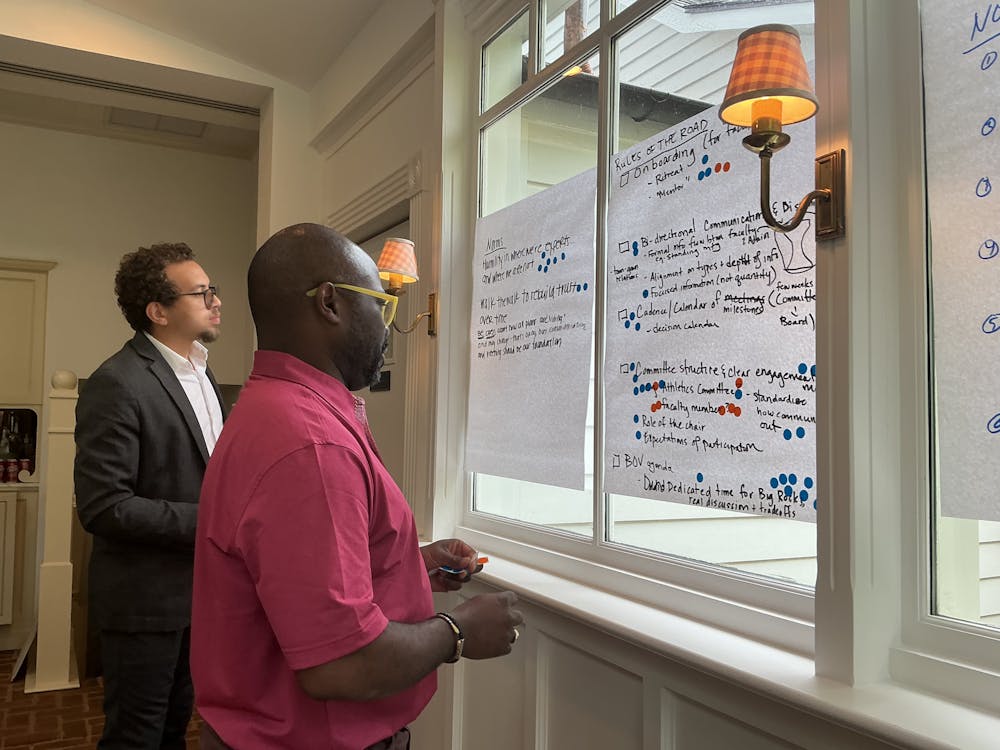
The Board of Visitors held a special meeting June 6 at Morven Farm in Albemarle County to discuss “accountability” and “aligned governance” — two areas of focus Rector Carlos Brown identified for the Board in March. During the “retreat-style” meeting, Board members and administrators began by engaging in a facilitated discussion on what role the Board should play in the future of University governance.
The Board welcomed four University alumni — Jeff Rudnicki, senior and managing partner at McKinsey & Company and Darden Class of 2011 alumnus, Bryan Hancock, McKinsey partner and Class of 1997 alumnus, Tyler Rose, McKinsey partner and Class of 2012 alumna, and Wan-Lae Cochran, McKinsey partner and Class of 2003 alumna — to act as pro-bono facilitators in this discussion.
Also present were the majority of Board members, and several University administrators — including Brie Gertler, interim executive vice president and provost, and Jennifer Wagner Davis, executive vice president and chief operating officer. University President Scott Beardsley was not present at the meeting.
Facilitators said that the meeting would have two immediate goals. The first, to help Board members and others present agree on “norms” that serve as the foundation for effective working partnerships with one another. The second, to encourage participants to “get specific” in narrowing down a set of shared, “near-term” priorities for governing the Commonwealth’s flagship University “as a team.”
“We’re a team,” Brown said. “It’s not Board [and] administration … we’re not competing. We’re trying to achieve a plan for U.Va. and ask, ‘how do we do it together?’”
During the first section of the discussion, Rudnicki shared an itemized summary of a McKinsey article from 2020, which outlined six functions of modern higher education boards — setting strategy, providing governance, reviewing finances, assessing performance, mitigating legal and other risks and engaging in external relations.
Board member Owen Griffin said that some words on the screen seemed too “action-oriented” — such as “set” and “develop” — and should be left to administrators. In response, Brown said a governance model where the body has supposedly taken a backseat role in setting strategy has been a major point of “tension” for Board members in recent years.
“I think there's been a [governance] model … over the last few years where the Board didn't feel that it was able to … participate in [strategy] actively,” Brown said. “We ought to unpack that.”
According to the University’s website, the Board is charged with “long-term planning” and approves the budget and “certain” additional policies including tuition rates. Typically, the Board also approves strategic plans from the University’s Office of the President with extensive community input. The bulk of the University’s current long-term strategy comes from the 2030 “Great and Good” plan — a 10-year agenda driven by former University President Jim Ryan — which the Board approved in 2019 and is monitored by the Board and University administration.
Several Board members indicated they thought it was time for the University to return to shorter, two to five year strategic plans. Board member Mike Bisceglia said that most goals in the 2030 plan are either projects that have been signed off on, or those yet to be completed in the distant future. Bisceglia said he believes there is room for more decisive strategies in the interlude that shorter-length plans could fill.
Brown indicated that, given the “dynamic nature” of university governing boards — members require an appointment from the governor and confirmation by the General Assembly — he does not believe Board members should be “captive” to plans passed before they took office. He said he believes Board members should have the freedom to reassess strategic plans, and that another source of “tension” in recent years has been administrative “inflexibility” to this idea.
Conversely, Davis said she believed that unprecedented federal cuts to higher education funding, as well as the recent period of “disruption” in University governance, were roadblocks to fully achieving goals in the 2030 plan. She highlighted the need for Board members and administrators to coalesce around established plans and work collaboratively toward completing unfinished projects, such as the Paul and Diane Manning Institute of Biotechnology.
“The biggest thing we can do is partner right now,” Davis said. “This period of disruption and discourse and negative press has been a real detriment in the ability to continue to realize the [2030] vision.”
Some participants also expressed support for a more collaborative system of day-to-day decision making that better incorporates the Board's perspective. This idea drew support from Dr. Mitchell Rosner, U.Va. Health chief executive officer and executive vice president for health affairs, who pointed out that the University is a complex organization composed of academic and health divisions, which grow in different ways and therefore have differing interests. He expressed hope that a more hands-on Board actively “engaged in strategic setting” could help reconcile the differing needs between the divisions.
However, not all Board members were convinced that more hands-on work was the best path forward. Vice Rector Victoria Harker said that in her experience, “really great” boards can be “situationally relevant” and involve themselves on day-to-day matters of exceptional importance, while otherwise stepping back operationally. Board member C. Evans Poston indicated that he was supportive of the Board playing an involved role in long-term strategy, but that the administration should be allowed to “run the show.”
“We’ve got great people [administrating], we hire great people. [University President] Scott Beardsley is going to continue … let him do the job,” Poston said.
Communication between the Board and its audience was another point of discussion. Jeri Seidman, incoming faculty representative to the Board, outgoing Faculty Senate chair and associate professor of Commerce, told facilitators that while administration works to govern the University, she said she felt there is a lack of accountability for the Board to communicate with stakeholders about how they are governing.
“There's a lot of doing,” Seidman said. “But how do your stakeholders know whether this is being done well?”
Harker and Board member Mohsin Syed also stressed the importance of the Board appearing as a unified front. Syed, as one of Spanberger’s 10 newly-chosen appointees, said his perception of the previous Board under former Rector Rachel Sheridan was that members were “not getting along” and that this seemed to have a destabilizing effect on the body.
“Whatever past tensions might stand, [the model we want is] just [about] making sure that the Board comes to a decision collectively after hearing everybody's perspectives,” Syed said.
After the discussion ended, participants broke off into three smaller breakout groups in different rooms of the Morven Meeting Barn. In these groups, Rose asked Board members to document five concrete and short-term goals they believe the Board should act on in the next year on large sheets of paper.
As one of the groups deliberated, Davis emphasized the need for the University to pay respect to Ryan — who resigned amidst pressure from the U.S. Department of Justice in June 2025.
“We have not honored [Ryan],” Davis said. “We also have [former University President] Terri Sullivan who hasn’t been honored. I’m just saying to move forward, you’ve got to take a step back and do that appropriately.”
Following the small group discussions, participants came back together. Gertler, speaking for her group, said they primarily brainstormed the process of strategic planning. She said that her group re-discussed the idea of shorter strategic plans — possibly four years in length and in sync with the terms of Virginia governors — and also considered taking extra time to develop the 2030 plan with more extensive community input.
Board member David Okonkwo said his group primarily discussed norms. Okonkwo said that one key focus included external communication. He said the group felt it would increase the efficiency of the Board to further emphasize the rector, vice rector and committee chairs as the formal points of contact for other stakeholders, rather than every committee member communicating with “every layer” of the University and its constituents themselves.
Other committee-focused reforms Okonkwo’s group discussed included having individual committees meet a few weeks in advance of the full Board. At these meetings, he said, members could have more time to identify the “big rocks” — the biggest tradeoffs and points of contention — on the Board’s agenda before the full Board meets. Typically, Board committee meetings take place in the days leading up to full Board meetings, or the day of.
Participants then indicated which proposals they liked or disliked. Ideas which generated the most support included developing a long-term sustainable funding model for AccessU.Va. — the University’s financial aid program — dedicating more time to discussing the “big rocks” in Board meetings and the various proposals from Okonkwo’s group to revise the committee structure. Proposals which participants downvoted included the addition of a permanent faculty Board member in lieu of a nonvoting representative and acting on a new strategic plan before completion of the 2030 plan.
Brown also indicated during the meeting that brainstorming new ideas would help him narrow down a set of topics for subsequent regular meetings of the Board.
“We have this leadership section in the Board meetings, and … at times … who knows what we're going to talk about,” Brown said. “[Meeting members are] going to help set the agenda for the next three meetings by identifying the ‘big rocks.’”
The Board also held three other special meetings June 6 to discuss additional components of Brown’s new agenda. It is unclear whether the Board will take part in another special accountability meeting before its next series of regularly scheduled meetings Sept. 16-19.

Luca Bailey is a third-year College student majoring in politics from Free Union, Va. As a staffer on the news and video desks, he has covered topics ranging from the General Assembly and state elections to local politics and University governance. He is also The Cavalier Daily’s beat writer for the Charlottesville City Council.
Read More

U.Va. and United Way of Greater Charlottesville launch ‘Give Where You Live’ donation partnership
By Vrinda Vashisht | 4 hours agoThe program is set to run through Dec. 18, and its start date coincided with United Way’s 35th annual Laurence E. Richardson Day of Caring.

Student Council passes bill to create ad hoc committee to review UBE proceedings
By Edward Christopher and Anna Ivanov | 5 hours agoThe Commission will craft a report on the University Board of Elections’ current structure and governance practices, putting forth proposals for corrective action based on its findings.
Board of Visitors discusses the implementation of AI in research and academics
By Jaylynn Perez | 14 hours agoThe Board also received an orientation on changes to NCAA athletics, completed its annual Atlantic Coast Conference certification, heard a report from Aaron Bloomfield, Faculty Senate chair and engineering professor, and discussed the University’s ongoing searches for a provost and several deans.


