
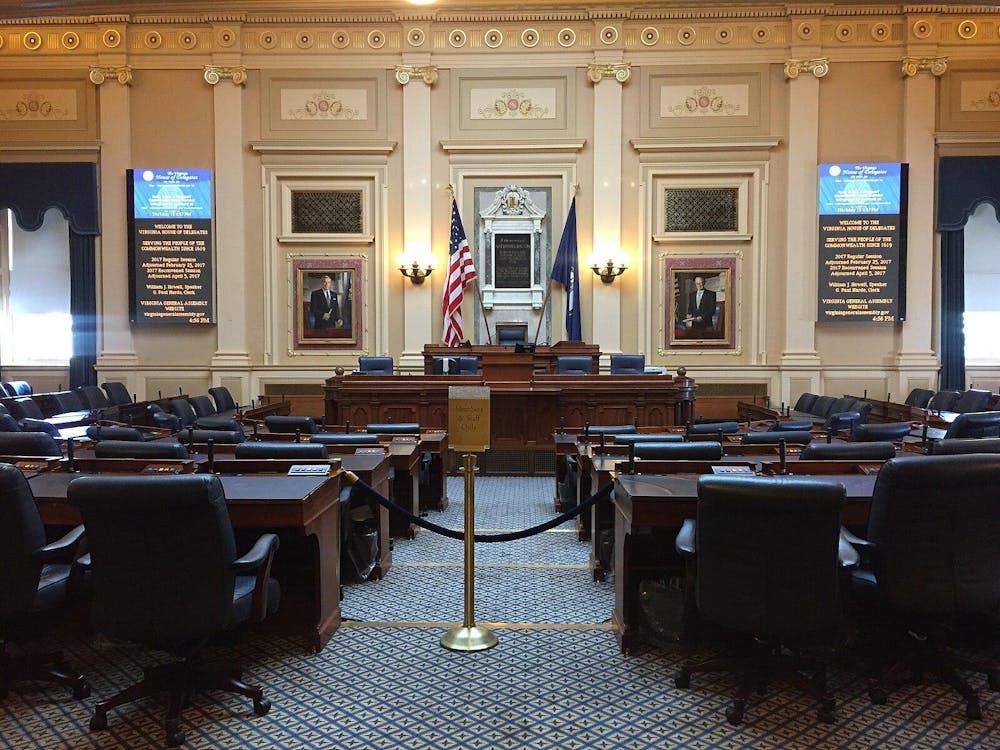
2026 has proven to be an abject disaster for the Virginia General Assembly. Much more so than in years past, the state legislature appears entirely divorced from the people it was elected to represent. The legislative session began with a series of nonsensical bills rammed through on party-line votes and ended with the General Assembly missing spectacularly on perhaps the one issue that transcends party lines. If a facially illegal gerrymandering fiasco and a greenlight for streets dotted with KGB-style artificial intelligence spy cameras were not absurd enough, it gets much worse. With less than 48 hours before an impending government shutdown, the General Assembly voted to approve a budget proposal that would preserve $2 billion in tax breaks for data centers in the Commonwealth. This is both morally and practically indefensible. As families across our Commonwealth struggle to make ends meet, the General Assembly is steaming forward with a policy that will only exacerbate the high cost of living. In these uncertain times, the last thing Virginians need is a state legislature that is astonishingly disconnected from the reality of everyday Virginians’ lives.
In years past, Virginia has been considerably generous when it comes to data centers. In 2010, the General Assembly exempted swaths of data centers entirely from the Commonwealth’s 4.3 percent sales and use tax on electronic equipment with the aim of increasing Virginia’s economic attractiveness. In doing so, the state entered into a 25-year Memorandum of Understanding with data center firms, promising to preserve this tax break until at least 2035. To be clear, the MOU has produced some positive effects — it attracts a substantial amount of business activity. The problem is that the situation on the ground has changed dramatically since 2010.
While data centers then may have been somewhat more innocuous and dispersed, today they present an entirely different animal. Today’s data centers paralyze the electrical grid and divert drinking water, devastating nearby homeowners and depleting natural resources. The largest data centers campuses are expected to consume more energy than the generation capacity of Virginia’s largest nuclear reactor. The General Assembly of 2010 did not and could not have foreseen the modern-day data center explosion, and it certainly did not enter into a 25-year MOU under the expectation that these data centers alone would come to drain a quarter of the state’s power production capacity just 15 years in. This is a 2026 problem that cannot be solved by maintaining a 2010 policy.
Virginia’s budget attempts to appease data center hardliners by introducing a new $0.011 per kilowatt hour tax on data center electrical usage. This may be a step in the right direction, but it is wildly insufficient and does not make any attempt to protect homeowners. The revenue collected from this new tax does not go to homeowners struggling to pay their electrical bill — it goes right to the general fund where politicians can spend it. Therefore, the budget does not meaningfully reduce the skyrocketing price of electricity for consumers. What is worse, revenue from this new tax is capped at $600 million, meaning that any revenue beyond that will be refunded back to the data center companies. It does not matter if data centers tomorrow exploit twice the energy they consume now — under the budget, the state is blocked from collecting anything more.
Worse still, the budget fails to adopt a robust statewide standard for data center water usage. Some areas of the state benefit from comprehensive regulatory safeguards, but other areas — disproportionately in the western half of the state — remain quite literally hung out to dry. It does not take a rocket scientist to predict the logical effect of such a policy. Data centers will naturally flock to localities with less stringent water usage restrictions and set up shop. Without a uniform regulatory standard, homeowners’ access to quality drinking water may hinge on their zip code and further exacerbate regional divides. Virginians should not tolerate such regulatory imbalance that puts many rural Virginians squarely in the gunsights of Silicon Valley artillery fire.
To add insult to injury, Richmond politicians then rewarded themselves with a more than 175 percent pay raise. This is pathetic. While Virginians across the Commonwealth deal with higher gas prices and a persistent car tax that still has not been repealed despite Gov. Abigail Spanberger’s repeated promises, politicians in Richmond have voted themselves more of our tax dollars. All this from a General Assembly that just ignored the overwhelming majority of Virginians. This is not leadership — it is self-serving cronyism.
There are many things this session that the General Assembly has gotten wrong, but most were hyper-partisan legislation supported by at least a few left-wing ideologues. When it comes to data centers, though, the reality is much different — it may be the one issue that still unites most Virginians. Senate President Pro Tempore L. Louise Lucas has traveled the state holding meetings with voters across our Commonwealth, and nearly every Virginian is saying the same thing — we do not want more data centers. Faced with an 80-20 issue, the General Assembly somehow managed to balk at the opportunity to secure an easy bipartisan win. Virginia should repeal the data center tax exemptions and use the revenue to reduce electrical bills and taxes for the vast majority of Virginians. Virginia deserves a government responsive to the needs of the citizenry, not the needs of the Amazon C-Suite.
Joshua Hawkins is a senior associate opinion editor for The Cavalier Daily. He can be reached at opinion@cavalierdaily.com.
The opinions expressed in this column are not necessarily those of The Cavalier Daily. Columns represent the views of the authors alone.
Read More

ELJAZZAR: Do not be fooled by the Vanderbilt Report
By Farah Eljazzar | YesterdayA report chaired by a philosopher that aims to invoke objective inquiry is hypocritically holding itself to a lower evidentiary standard than it criticizes.

GARVIE: Fighting the sustainability fight requires an army
By Adeline Garvie | 2 days agoIn order for these students’ sustainability actions to reach a broader sphere of attention, green practices need to be encouraged and attainable, both of which can be achieved with increased advocacy.

HASNAIN: Virginia must be for all lovers
By Zehra Hasnain | 3 days agoAccording to various bumper stickers, t-shirts and other state gift-shop paraphernalia, Virginia is for lovers — yet the state constitution begs to differ.


