
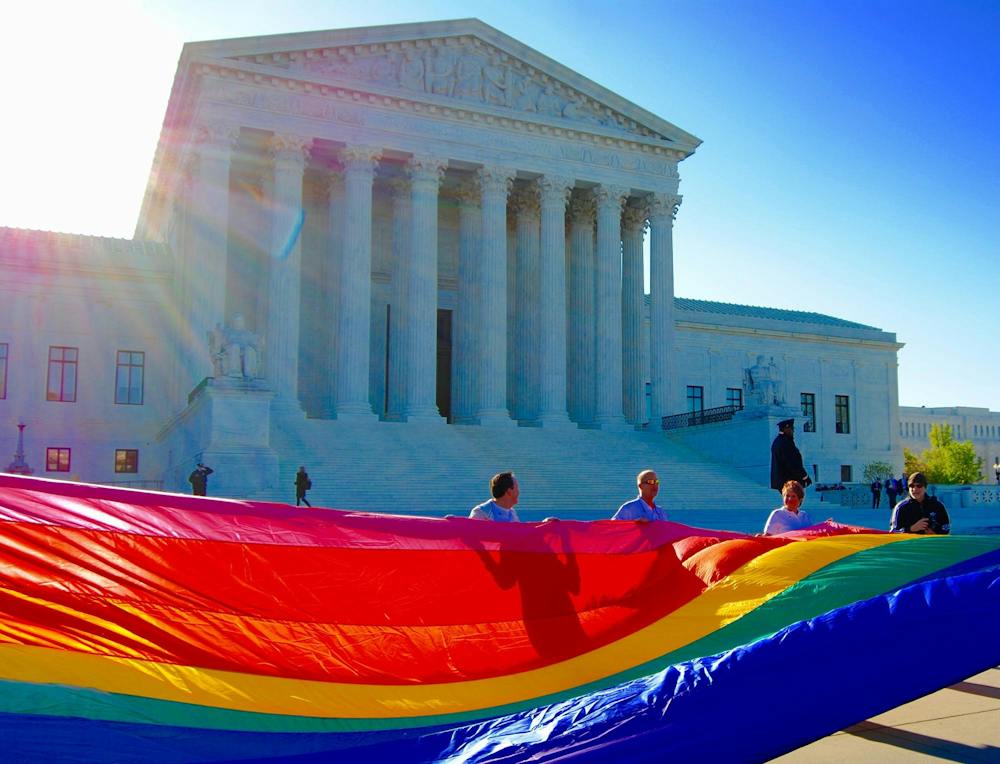
According to various bumper stickers, t-shirts and other state gift-shop paraphernalia, Virginia is for lovers — yet the state constitution begs to differ.
The Marshall-Newman Amendment, which states that only a union between one man and one woman may be a marriage valid or recognized by the Commonwealth, was enacted in 2006. Although the amendment was eventually nullified through the federal ruling of Obergefell v. Hodges in 2015, which legalized same-sex marriage nationwide, it remains written in the state constitution. In the upcoming general election on Nov. 3, Question 2 of the constitutional amendments, would, if passed, rightfully repeal the ban on same-sex marriage. Virginia must pass this amendment for the proper acknowledgement of all marriages.
Specifically, the proposed amendment removes the one man and one woman limitation, replacing it with the assertion that “marriage is one of the vital personal rights essential to the orderly pursuit of happiness” — thus concluding marriages should be treated equally under the law regardless of sex, gender or race.
Indeed, this amendment may seem unnecessary as the ban on same-sex marriage is unenforceable as long as Obergefell stands — and the Supreme Court has fortunately shown minimal interest in overturning that federal precedent anytime soon. Yet, the importance of the ban’s removal resides not necessarily in tangible legislative benefits but in its symbolism. By rigidly defining valid, recognizable marriages as that of a man and a woman, the corollary is that those of the same-sex are invalid and inferior. This is antithetical to the state moniker which touts a place conducive to “loving” — or in other words, an environment warmly accepting and inclusive of its residents. Such aspirations of southern hospitality should not come with conditions like sexual orientation or gender.
These exclusionary implications contradict not only Virginian values but American rights — the rights of its citizens to authentically express themselves without being relegated to a status of inferiority. Although some see same-sex relationships as “un-American” for seemingly clashing with the traditional values often associated with the nation’s identity, America — which proudly refers to itself as the land of the free — deeply values individual rights and freedoms. This, then, makes the Marshall-Newman amendment quite un-American, for it conveniently excludes LGBTQ+ individuals and endows little respect for freedoms promised to every American.
Furthermore, the amendment would scrub away the ban’s reflection of the ignorant, outdated beliefs towards LGBTQ+ individuals of 20+ years ago. This creates a sharp dissonance to the more open-minded sentiments of the majority of Virginians today — 68 percent polled to support same-sex marriage in 2025. Understandably, that justification alone might raise fear among some that this amendment’s passing marks the tyranny of the modernized majority upon those who hold more conservative values. However, there is nothing tyrannical in simply expanding the definition of marriage — with no resulting limitations on anyone’s freedom — to include their same-sex counterparts.
Regardless of majority public support, as facing intolerance is unfortunately inevitable, Virginians must pass this amendment. One’s discomfort and apprehension toward same-sex marriages are not legitimate grounds for denying these unions basic respect and the recognition that they do indeed exist. Such apprehension is mainly rooted in, aside from personal religious qualms, a respect for upholding long-standing traditions. Specifically, the tradition of a nuclear family model — purported to offer both social and filial stability unlike same-sex couples. Not only is this logic painfully reminiscent of past justifications for interracial marriage bans, it is also highly flawed. Based on 20 years of data regarding same-sex marriage in America, researchers concluded that extending marriage and other forms of legal recognition to same-sex couples has been consistently positive for their children and the general population. Ironically, any instability faced by these relationships is a consequence of social unacceptance — like the ban, for example — rather than an inherent flaw. In the same vein, opponents argue marriage should be a well-defined institution — one not unraveled by same-sex unions, feared to set the precedent for the legalization of polygamy and incest. However, fears like this are riddled in slippery slope fallacies and thus irrelevant to the debate of same-sex unions.
Moreover, change or deviation from tradition is not inherently bad — and in fact vital for progress. In the apt words of our university’s founder, Thomas Jefferson, “We might as well require a man to wear still the coat which fitted him when a boy as civilized society to remain ever under the regimen of their barbarous ancestors.” I quote this not to discredit our nation — which, in some ways, has far surpassed the “barbarous” prejudice of its past — but rather to highlight the long-held understanding that change is a practical imperative for society. From Lawrence v. Texas to the repeal of “Don’t Ask, Don’t Tell” to the aforementioned Obergefell, America is a significantly safer, more welcoming place for LGBTQ+ individuals than in past times throughout its history. This, then, is precisely why Virginia should discard the archaic attitudes — and amendments representative of them — which no longer suit the public sentiment, majority scientific opinion and societal progress of today.
Ultimately, pivotal moments and landmark legislation for LGBTQ+ individuals were not caused in a vacuum. Rather, they were created from symbolic action. From big leaps like the Stonewall Riots to small yet impactful steps like coming out, every instance of effort paved the way for progress. On Nov. 3, Virginians will have a unique opportunity to participate in this — not only honoring the decades of efforts towards marriage equality but furthering it — by voting for Question 2.
Zehra Hasnain is an opinion columnist who writes about politics for The Cavalier Daily. She can be reached at opinion@cavalierdaily.com.
The opinions expressed in this column are not necessarily those of The Cavalier Daily. Columns represent the views of the author alone.
Read More

EDITORIAL: USPS cannot override the Constitution to regulate elections
By Editorial Board | 13 hours agoThe whistleblower report exposes more than a flawed system. It exposes a federal agency, empowered by President Trump, unafraid to attack democracy and judicial oversight.

U.Va. MEDICAL STUDENTS: Why e-bikes and e-scooters need real rules
By U.Va. Medical Students | 2 days agoAs medical students who will soon be treating the consequences of these injuries firsthand, we believe e-bike and e-scooter safety is a public health issue the University and the Commonwealth can no longer afford to overlook.

OPINIONS: What to watch for this November election in Virginia
By Wylie Brunman , Scarlett Sullivan , Michael King and Joshua Hawkins | 3 days agoFour opinion columnists write on upcoming ballot measures and key races for Virginia’s Nov. 3 general election.


