
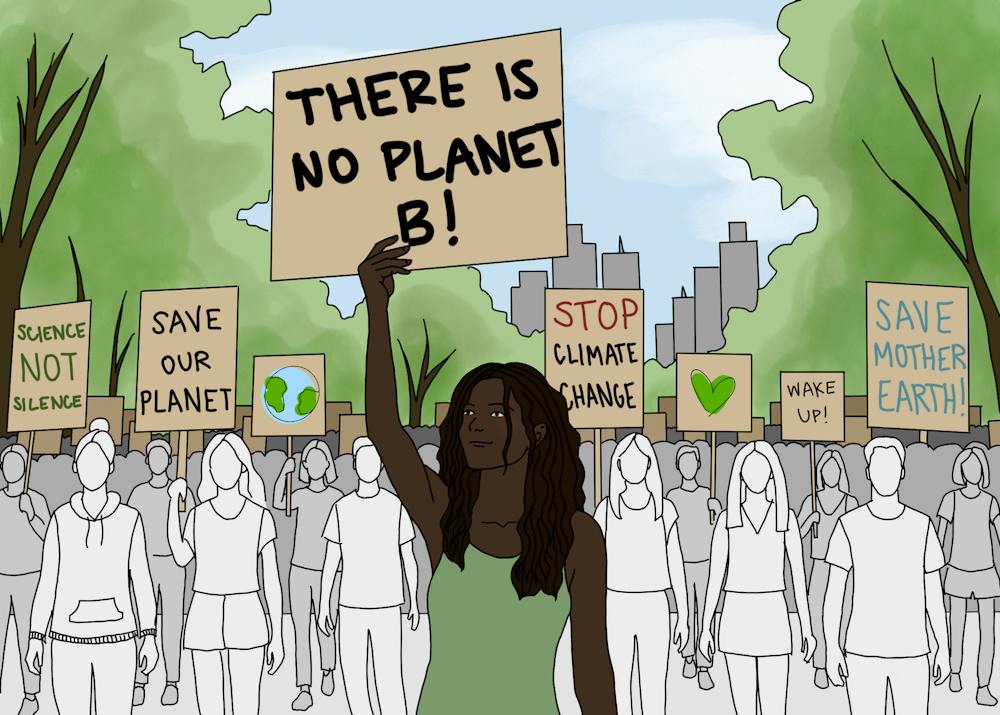
Earth Overshoot Day has been creeping up the calendar since the 1970s. In 2026, that day was July 30, meaning that just over halfway through the year, society’s demand for resources already exceeded what the Earth is capable of producing in a year. This global crisis is manifesting in Virginia, with rising temperatures, coastal erosion and rising sea levels. The present climate situation was not caused by just one year of poor decisions, but rather, decades of humans not caring enough about where they live. Despite generations upon generations contributing to the current state of the world, it seems to have become solely up to the youngest generations to fix the messes of society’s past due to older generations’ complete abdication of any responsibility. Luckily, this group — and particularly young adults at the University — has proven more than willing to take up the fight. However, it takes more than one slice of the population to make a difference in this issue — indeed, it takes a concentrated effort across the spectrum.
In July, the University’s Office for Sustainability announced the winners of their 2026 Sustainable Leaders award. These winners — along with many other students — have been hosting countless volunteer events, gathering others to recover recyclable and compostable material and leading a vegan pilot program, along with joining in on sustainability practices in their day-to-day lives. The University also has students working and volunteering for Morven Kitchen Garden, which provides food for U.Va. Dine, local residents and food insecurity programs. Beyond simply getting involved in these sustainability events themselves, students are also encouraging their peers to join in. These types of students exemplify what it means to be a leader for sustainable practice, and Grounds certainly feels the impact. The University has had a 44.5 percent reduction in greenhouse gas emissions, a 27 percent decrease in water usage and 32 percent waste reduction in the past 15 years. If all of Charlottesville — and, indeed, Virginia — followed suit in these students’ footsteps, our University could be setting the precedent for how society should interact with its environment.
In order for these students’ sustainability actions to reach a broader sphere of attention, green practices need to be encouraged and attainable, both of which can be achieved with increased advocacy. Indeed, University students have done a spectacular job of helping our environment, but some issues require broader involvement. Students should bring these issues to the next level by platforming them before the public through advocacy before local governments, allowing all generations in a community to coalesce and fight climate change.
Common sense dictates that the more people involved in making an impact, the larger that impact will be. There are a variety of ways in which students can advocate for environmental justice outside of Grounds. For one, students can become more involved with governmental advocacy, which not only pitches issues to people who can adequately address them, but also spreads information much quicker than word of mouth and other forms of advertisement. Talking to a local representative will not always result in a policy change, but any press is good press, even if it is just spreading the word by having a public conversation with our politicians. Charlottesville City Council holds a public speaking session known as “Community Matters,” where individuals are able to present issues or ideas at a City Council meeting — this provides the perfect opportunity to lobby for sustainable efforts in the community.
Governmental advocacy is not the only way to involve more people in implementing sustainable practices. The best way to engage more people is to share everyday opportunities that create small yet impactful changes. For example, U.Va. Sustainability offers corner cleanups every two weeks, which are accessible, low commitment events open to everyone in the Charlottesville area. This is an event that is relatively simple to organize, so citizens of other towns could engage in this way as well. The more University students advertise these types of events, the more potential there is for increased community representation. In addition to hosting events that are open to all, students and clubs can strive to spread sustainability information and tips as much as possible. For example, Grit Coffee offers discounts to those who bring their own coffee cups, providing a sustainable approach that also saves money. There are thousands of ways for individuals to exercise easy practices in their day-to-day lives, and often the only thing holding people back is not knowing about them.
We have already seen the Office for Sustainability showing off University students’ efforts, providing opportunities for events like Student Garden Workdays and volunteering at Green Games, along with integrating sustainability practices like recycling, composting and litter cleanups around Grounds. When dealing with issues on such a large scale — and the Earth is a pretty significant size — it is equally important to provide tangible, attainable goals for individuals to work towards. Seemingly small, everyday actions make this immense global problem digestible and solvable.
Reading about the daily tragedies and increasing issues caused by climate change in the news and pollution can often lead to inaction because of the overwhelming scale of the problem. Finding others who are just as passionate helps make the problem more manageable. Environmental clubs and volunteer groups are plentiful at the University and around Charlottesville, but oftentimes what can hold people back from greater involvement is simply a lack of knowledge on sustainable approaches in everyday life. Getting students and citizens to speak up, especially to local governments, about the world they care about makes more of a difference than any one club — but the University is still off to a great start.
Adeline Garvie is an opinion columnist who writes about health, technology and environment for The Cavalier Daily. She can be reached at opinion@cavalierdaily.com.
The opinions expressed in this column are not necessarily those of The Cavalier Daily. Columns represent the views of the authors alone.
Read More

HASNAIN: Virginia must be for all lovers
By Zehra Hasnain | YesterdayAccording to various bumper stickers, t-shirts and other state gift-shop paraphernalia, Virginia is for lovers — yet the state constitution begs to differ.

EDITORIAL: USPS cannot override the Constitution to regulate elections
By Editorial Board | YesterdayThe whistleblower report exposes more than a flawed system. It exposes a federal agency, empowered by President Trump, unafraid to attack democracy and judicial oversight.

U.Va. MEDICAL STUDENTS: Why e-bikes and e-scooters need real rules
By U.Va. Medical Students | 4 days agoAs medical students who will soon be treating the consequences of these injuries firsthand, we believe e-bike and e-scooter safety is a public health issue the University and the Commonwealth can no longer afford to overlook.


