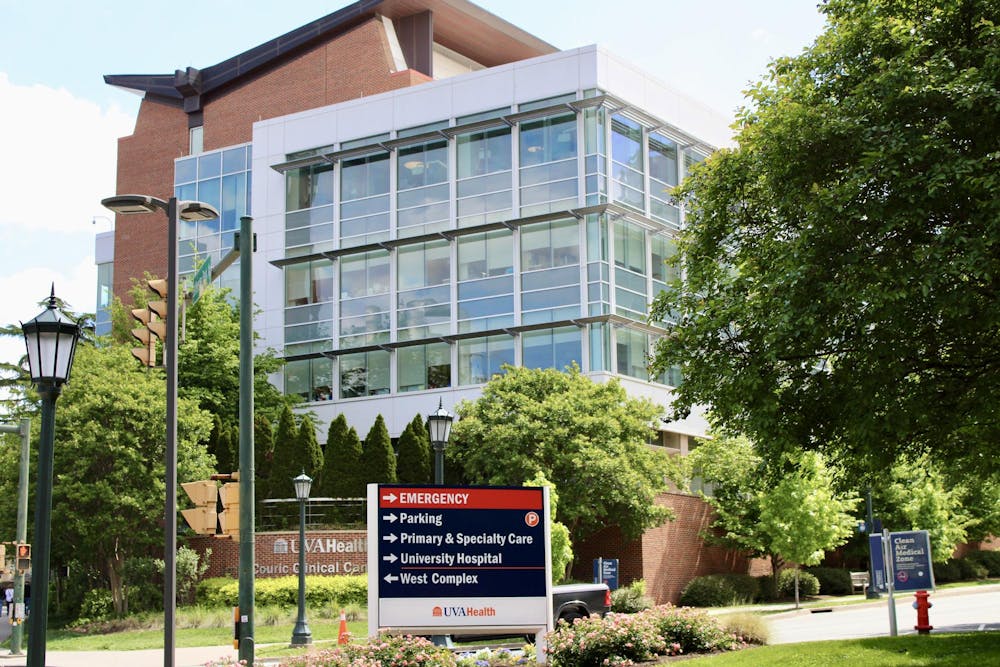
During a media briefing July 10, U.Va. Health announced a new treatment for melanoma that has spread to the liver, in hopes of caring for patients whose cancer has few remaining therapeutic options. U.Va. Health is the first health system in Virginia to offer the treatment — Hepzato — according to the media briefing from the health system. U.Va. Health interventional radiologist Dr. Daniel Sheeran and U.Va. Health Cardiac Anesthesiologist Dr. Paul Gallo helped bring the treatment to U.Va. Health.
Melanoma is a form of cancer that originates in the melanocytes — specialized cells needed to create melanin, which is a pigment that gives color to the eyes, skin and hair. This treatment targets uveal melanoma, which is classified as both eye cancer and melanoma because it arises from melanocytes in the uvea — the middle layer of the eye — rather than the skin.
According to Gallo, about 50 percent of uveal melanomas will metastasize, or spread, elsewhere in the body. Roughly 90 percent of uveal melanomas spread to the liver — making it the primary focus of Hepzato treatment. According to Sheeran, there are more than 100,000 new melanoma diagnoses in the United States every year, but only a small fraction are uveal.
“[Uveal melanoma] does act a little bit differently than what many people may think of when they think about melanoma,” Sheeran said. “It is nonetheless still the most common diagnosis of a primary eye cancer in adults.”
Treatment options for uveal melanoma become limited once the cancer spreads beyond the eyes, partly because the tumor is difficult to target, according to Sheeran. Systemic therapies — medications delivered through an IV that treat the whole body — are available, but their response rates are not ideal, Sheeran said. One medication, Kimmtrak, is available only to the small population of patients who carry the specific mutation the drug targets, according to the media briefing.
“Some have theorized that the number of quote unquote mutations within this tumor is not as many as other tumors … so our ability to then target said mutations is a bit limited,” Sheeran said.
The new treatment that U.Va. Health is offering — Hepzato — is a delivery system developed by Delcath Systems, an interventional oncology company, and it was approved by the Food and Drug Administration in 2023. The system delivers a chemotherapy drug called melphalan through percutaneous hepatic perfusion — a procedure that isolates the liver’s blood supply to deliver high doses of chemotherapy directly to the affected areas while filtering the blood afterward to prevent toxicity in other organs.
According to Sheeran, the procedure is minimally invasive, using small needles and tubes rather than large cuts or incisions. The team works through tubing, the size of which he compared to the “tip of a pen,” and the tube threads through blood vessels to reach the liver and deliver the drug.
This procedure takes around four hours, though the medication itself is delivered in far less time than that — the majority of the window is set-up time, according to Sheeran. Patients spend one night in the intensive care unit following the procedure for observation, which Sheeran said is required so the team can confirm blood levels return to normal and remove the tubes safely. According to Sheeran, it can be repeated up to six times per FDA approval, every six to eight weeks, with physicians checking that patients are tolerating the therapy and that the tumors are responding to the treatment.
Delivering this treatment requires a team, including an interventional radiologist, an anesthesiologist and a perfusion team — specialists who operate the machine that delivers the chemotherapy and filters it out — as well as pharmacy and nursing staff, according to Gallo. He also said patients are placed under general anesthesia and are fully asleep for the operation.
“As an anesthesiologist, my role in all of this is to help this patient safely and comfortably undergo this procedure,” Gallo added. “We see that our role as anesthesiologists is to really provide safe, compassionate care, on these big days for folks. That is really the continuity of our approach.”
Not every patient with uveal melanoma is a candidate, however. Sheeran described a “Goldilocks period” of when the procedure can be done — when the cancer has spread within the liver, but not overtaken the organ or moved outside it. Sheeran added that oncologists on the multidisciplinary team help determine whether this therapy is the right fit, as there are side effects associated with the procedure, which patients are informed of beforehand.
“We want to make sure we take the risk in the right patient at the right time as a team approach,” Sheeran said. “We’re looking to, with this new therapy, be very focal, and while there are some side effects, [we] also [want to] try to mitigate those in the long term.”
The goal of this therapy is to contain, rather than cure, uveal melanoma, according to Sheeran.
“We know we can’t cure cancer in this setting,” Sheeran said. “But we can get a response within the liver and help people live longer and hopefully [have a] better quality of life.”
Sheeran said patients diagnosed with uveal melanoma should maintain follow-up appointments with their ophthalmologist and oncologist. Even with the best medical and surgical therapy, he said the tumor has a predisposition to return even many years after treatment. Follow-ups allow physicians to have the best chance at finding recurrence early and offer therapy when appropriate, according to Sheeran.
Gallo said Hepzato is currently under clinical trials for other types of cancers, which will hopefully provide results in the next couple of years.
"Dr. Sheeran and I are really proud to help bring this therapy here to Virginia, [and to be] the first in the state," Gallo said. "We've done additional training to really make sure that this is the best experience possible."
Because patients return for repeat treatments, the team comes to know them well. Gallo explained his love for seeing patients return as they begin to feel better, and said the team also tailors each session to what worked the last time — which they can do because of following patients over the course of treatment.
“[The] real joy of being part of this team is building those relationships with patients,” Gallo said. “[To see] them really continue to live their lives and [feel] like we're offering a new innovative treatment to the community and trying to make the world just a little bit of a better place.”
Patients cannot schedule this treatment directly. U.Va. Health requires a physician referral for all interventional radiology care. Providers can refer patients by calling 434-924-9401.
Vrinda Vashist is a staff writer on the news desk. She is a second-year student in the College.
Read More

Gregory Perryman reflects on term as Board of Visitors student representative
By Abigail Larkin | YesterdayPerryman expressed his belief that it was particularly important, given the administrative changes, to consistently make students’ concerns known to the Board.

University relaunches the provost search with reconstituted search committee
By Lauren Seeliger | YesterdayA media release from University Spokesperson Bethanie Glover Thursday announced that the new search for the University's permanent executive vice president and provost began Monday.
From the Archives: 1980s
By Cassie Nokes and Maisy Callahan | 2 days agoThe University’s Gay Student Union invited members of the LGBTQ+ community and supporters to wear jeans to class for Blue Jeans Day, the kickoff to the annual Gay Acceptance Week.