
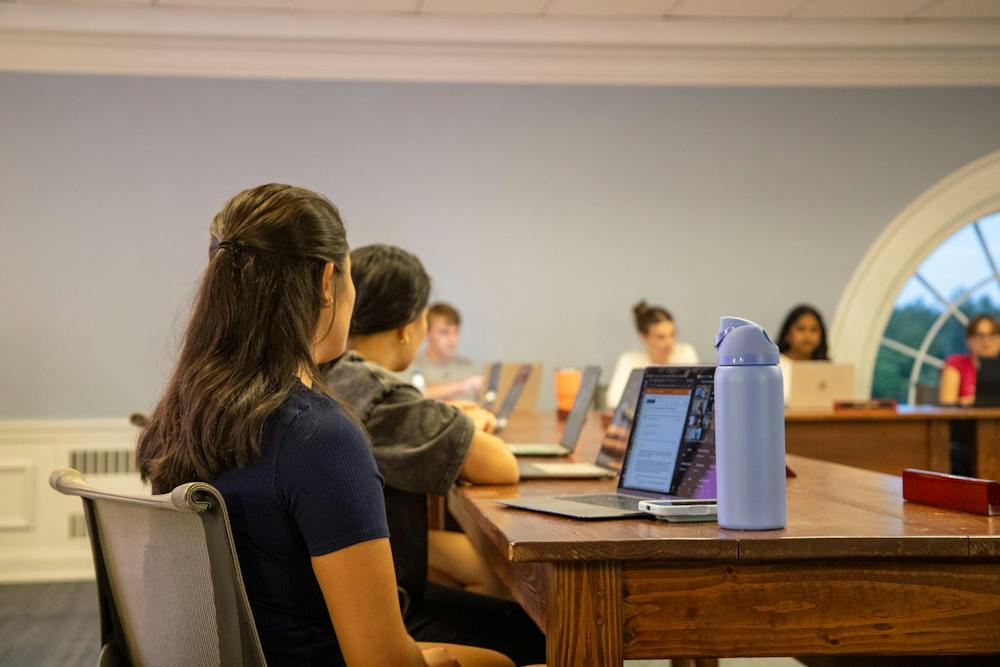
The Honor Committee continued discussions about amending its appeals process at its weekly Sunday meeting. The proposed change, if voted into effect, would alter the way students are able to appeal either their hearing or sanctioning panel decisions, should they feel there has been a violation of a granted right or there is new evidence to introduce to the case.
At Sunday’s meeting, the Committee debated whether or not to remove the finality clause in the proposal — a clause that states students under the new bylaws would only be allowed to appeal a decision following the conclusion of the panel for sanctions. The committee also discussed whether or not to remove the language in the proposed change requiring a student to explain how a possible infringement on their rights is substantive enough to alter the results of a trial.
The Committee initially proposed the bylaw amendment at their first meeting of the semester, citing that students were using the prior appeals process as a way to appeal unwanted sanctions instead of using it as it was intended. According to the bylaws, the intended use of an appeal is to investigate whether a student's rights have been violated during the proceedings or when new evidence is introduced into the case that could have changed the outcome.
Under the current bylaws, if students wish to submit an appeal, they must submit a brief to the Committee outlining their reason for appeal. Students may appeal on the grounds of either new evidence or good faith — where good faith includes provisions such as the timeliness or fairness of an accused student's Honor proceedings.
If the Committee chair and appeals coordinator — a randomly selected Committee member that is not associated with the case — considers the appeal brief complete based on the aforementioned requirements, a student on the Committee is appointed as the appeal investigator. Following the completion of the investigation by the appeal investigator, an Appeal Review Panel can then vote on whether to alter or dismiss the sanctions or grant the students the right to a new investigative panel or panel for sanction.
If the new proposal is implemented, students would now have their appeal briefs weighed against nine different criteria for validity and would have to provide an enumerated list of the nine criteria that they believe their appeal aligns with. The appeal brief would then be reviewed by the Committee chair and the appeal coordinator — a selected Committee member without any prior knowledge of the case — then work together in the Appeal Validity Conference to determine if the appeal is considered both “complete” and “valid.”
The Committee is continuing to rework the phrasing and procedures in the bylaws before they draft and vote on a final decision.
Genny Freed, Committee chair and fourth-year College student, opened a discussion regarding two points of debate among the Committee and the Support Officer pool regarding the new proposal.
According to Freed, one question the Committee is still considering is whether to remove the finality clause in the proposal, which would have limited students to submitting an appeal brief only after the sanctions panel.
Multiple members of the Executive Committee shared deliberations and their personal opinions on whether or not the proposal should include finality clauses — but the Committee ultimately voted to remove the finality clause.
Annie Linely, vice chair for investigations and fourth-year College representative, said that she believes that if a finality clause was included in the proposal, it would merely delay students from appealing their sanction decision if they were unsatisfied with an earlier part of the sanctioning procedures, such as the Hearing Panel.
Linley also said that if a finality clause is included, then students may not wish to appeal if they deem their sanctions fair.
“If they felt that there might have been a problem with their hearing [and] they're not [happy] with the guilty verdict for whatever reason, but the appeals bylaws force them to go through to [panel of sanction] and they get sanctions that they think are fair or reasonable, they may not even appeal their hearing, because they're okay with the outcome,” Linley said.
Jessica Drennan, vice chair for sanctions and fourth-year Batten representative, stated that allowing students to submit an appeal before receiving sanctions may actually be an argument for removing the finality clause, as a student seeking to appeal before receiving their sanctions may indicate that they are not appealing simply because they disagree with the sanctions imposed.
Jack Copeland, third-year Engineering representative, also supported removing the finality clause. He argued that the Committee should be able to address potential errors when they occur rather than waiting until the sanctions process has concluded.
“If there’s a football game and there’s a foul … you don’t say, ‘Oh, let’s complete the quarter and then we’ll come back and consider it,’” Copeland said.
Lastly, Cody Scarce, vice chair for the undergraduate community and fourth-year College representative, said he believes if a finality clause was in place, students could potentially get to their panel for sanctions and be under the impression that they will be appealing their case and may subsequently put less effort into their panel for sanction — ultimately adding the potential for more severe sanctions should their appeal be deemed invalid.
Members also debated the language of bylaws concerning appeal criteria, which currently state that the alleged issue must have had a “substantive impact” on the student’s verdict.
Scarce said he believes that requiring students to include how alleged rights infringement has affected the student's case in a substantial way in the appeal brief may add an additional barrier to students unfamiliar with the Honor Sanctioning process. He said that students may face another layer of complexity if required to not only acknowledge where their rights were infringed, but also how it may have impacted their verdict.
Scarce also said that he thinks that by including this requirement, the bylaws are becoming too specific for an appeal. He said this could result in unwarranted denials of an appeal simply because an unnecessary requirement is missing.
“We have had such broad and vague bylaws surrounding appeals for so long, and these [proposals] are funneling everything down to really specific language. I don't want us to feel like we have to do all of this at once,” Scarce said. “I'd rather [we] start lighter and maybe narrow it down later if we realize an issue that's coming up frequently than go all in and have people's appeals be denied because they didn't meet a certain checkbox.”
However, Freed said she believes including information for how a potential violation of a granted right could have significantly impacted the proceedings is easier than identifying the actual violation, and thus should be included. Freed explained that, by filing an appeal, a student has already identified where in their case they believe a granted right was violated. As a result, detailing how that violation would substantially affect them would not require much additional work to the student's appeal.
Lastly, two members of the Committee — Law Representative Brie Bauer and Medicine Representative Grant Williams — said that they believe the inclusion of language requiring students to explain the substantive impact is necessary. William stated that, for example, if a student’s guaranteed lunch time during a hearing is cut one minute short, that would technically be a violation of a granted right, but would not substantively affect the case. The two both explained, however, that substantive impact may be best suited to be decided upon in the Appeal Validity Conference, as the idea of substantial effect is included in the good cause provision which is already analyzed at that time.
The Committee did not decide whether or not to include a demonstrated “substantive impact” among the criteria for students’ appeal briefs.
Other than the Appeal Proposal, Scarce said the Committee recently sent acceptance emails to their new class of support officers. He thanked Committee members for their time helping with selections and recruitment.
Additionally, Pippa Harris, vice chair for operations and fourth-year Engineering representative, discussed an influx in co-sponsorship requests — funding requests from student organizations for events and initiatives — having received 10 this week. She also said she has been working with the requesting Contracted Independent Organizations to figure out ways to better involve Honor in their organizations. Harris said the Committee has approved three events including the Jefferson Society Restoration Ball, an economics review session and the National Organization of Minority Architecture students.
The Committee's next meeting is Sunday at 7 p.m. in Newcomb Hall Room 480. The meeting can also be attended via Zoom, and Zoom links can be requested from the Committee chair.
Michael Racz is a staff writer on the news desk. He is a second-year College student majoring in biology with plans to go to medical school. He enjoys writing about health topics and student self-governance.
Read More
With midterm elections approaching, Miller Center experts share foresight
By Reilly Auld and Luca Bailey | 35 minutes agoThese midterm Congressional elections are generally viewed as an opportunity for voters to evaluate the incumbent President’s performance in their first two years in office.

University Medical Center nears top safety grade, looks to improve in November
By Michael Racz | 22 hours agoIn the spring 2026 Leapfrog Hospital Safety Grades, the University Medical Center received a “B” grade — the second-highest grade awarded by The Leapfrog Group — with a numerical score of 3.18, just 0.02 points below the threshold for an “A.”

U.Va. and United Way of Greater Charlottesville launch ‘Give Where You Live’ donation partnership
By Vrinda Vashisht | YesterdayThe program is set to run through Dec. 18, and its start date coincided with United Way’s 35th annual Laurence E. Richardson Day of Caring.


