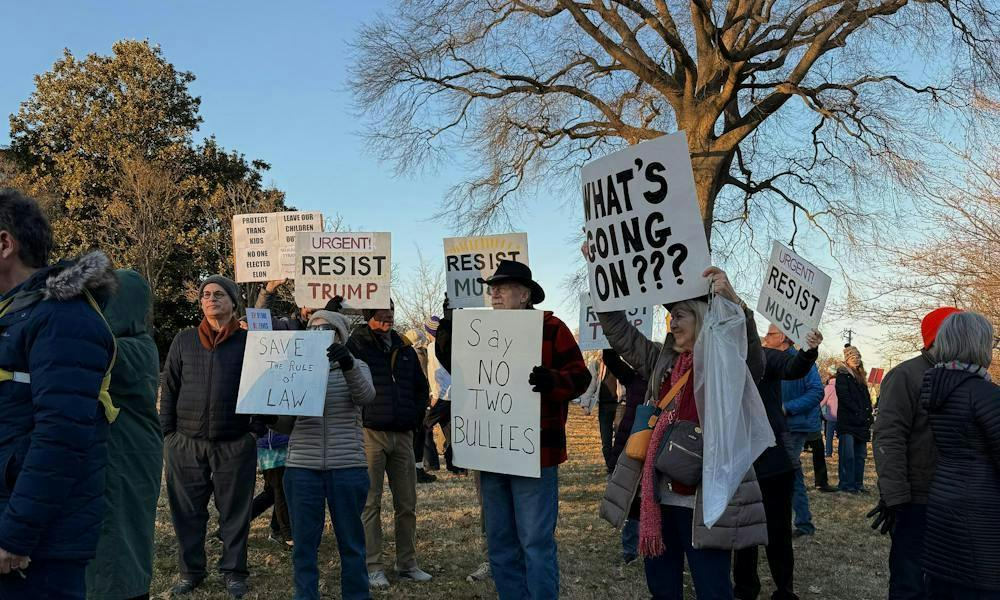
Since President Donald Trump’s first election in 2016, Charlottesville has seen a white supremacist rally, the removal of its Confederate statues and federal pressure influence the University’s governing body. Politics Prof. Larry Sabato, Assoc. Politics Prof. Rachel Potter and Media Studies Prof. Aniko Bodroghkozy each described how the City and the University have changed since the 2016 presidential election.
They weighed in on the continuing prevalence of a rally that occurred nearly 10 years ago, how Trump’s presence before the rally and in the period since has shaped the City’s persevering traits and the Trump Administration’s targeted efforts to assert control in higher education.
The beginning — Trump’s election in 2016 and Unite the Right
Potter, who has taught at the University since 2014, said Charlottesville was never friendly towards Trump. Only about 13 percent of City voters chose him in 2016. Eight years later, he won 14.63 percent of the City’s vote in the 2024 presidential election to Kamala Harris’ 82.94 percent.
Nine months into Trump’s first term, on the night of Aug. 11, 2017, white nationalists carrying tiki torches marched across Grounds to the Thomas Jefferson statue north of the Rotunda. Fights occurred that night between nationalists, students and counterprotesters, and the police response was largely deemed as slow. The next day, as the Unite the Right rally dissolved into street clashes, James Alex Fields Jr. drove his car into a crowd of counterprotesters, killing 32-year-old Heather Heyer. Fields was sentenced to life in prison in 2019.
The rally drew hundreds of white nationalists, neo-Nazis and members of the alt-right — a loose movement that promotes white identity and rejects mainstream conservatism — to Charlottesville. Organizers said they were protesting the City’s plan to remove its statue of Confederate Gen. Robert E. Lee.
Bodroghkozy, who joined the University in 2001 as one of the founding faculty members of the Media Studies Program, was among the counterprotesters that weekend. Her 2023 book, “Making #Charlottesville: Media from Civil Rights to Unite the Right,” compares events of that summer to the 1963 Birmingham and 1965 Selma campaigns of the civil rights movement. In the civil rights movement, organizers staged demonstrations that drew national television coverage of violence against peaceful Black protesters and built public pressure for federal civil rights legislation. Bodroghkozy said the Unite the Right rally’s organizers deliberately borrowed from that movement’s media strategy.
“The civil rights movement [used the media] to shake the conscience of the nation around the evils of segregation, African American disenfranchisement and the wrongs of racial discrimination,” Bodroghkozy said. “The alt-right wanted to use that same media playbook to reverse basically all the gains of the various social justice movements from the Black freedom movement, to the women’s movement, to gay rights, immigrant rights, etc.”
Bodroghkozy said the tiki-torch march on Grounds was planned in a way that recognized that the event would be filmed and broadcast, and that the images it produced would spread beyond Charlottesville.
“The tiki-torch parade on U.Va. Grounds fit the strategy really well,” Bodroghkozy said. “We still see those images to this day. If it wasn’t for the mayhem and chaos the next day with the terrorist car attack, the tiki-torch parade could have served as excellent recruitment material [for ‘disaffected young men’].”
She added that the City’s debate over its Lee and Stonewall Jackson statues gave organizers an opening, but that the monuments were never the real point of the rally.
“The reason for the rally wasn’t fundamentally about the statues but about using Charlottesville as a stage set to build a far-right extremist movement,” Bodroghkozy said. “The ‘alt-right’ had been a growing, but mostly online phenomenon. Unite the Right was about bringing it into ‘real life.’”
Bodroghkozy also tied the rally directly to the 2016 election.
“The 2016 election of Trump galvanized the alt-right,” Bodroghkozy said. “Organizers like U.Va. alum Richard Spencer saw Trump as a kind of ally, with his virulent anti-immigrant statements and his misogyny.”
Spencer, who graduated from the University in 2001, was among the leaders and scheduled speakers of the rally.
Days after the attack, Trump said at a press conference that there were “very fine people on both sides” of the events in Charlottesville, referring to both the white nationalist marchers and the counterprotesters who opposed them. Potter said this remark was taken poorly in a city that had already shown a distaste for Trump at the polls.
“[The ‘very fine people on both sides’ comment] did not play well here,” Potter said. “Charlottesville is a very blue place and was not primed to be receptive to Trump or his messaging.”
The Unite the Right aftermath — community and the Lee statue’s removal
Potter said she remembers clearly how residents responded in the weeks that followed the Unite the Right rally.
“In the aftermath of the Unite the Right rally, the community really came together,” Potter said. “I recall seeing the ‘hate has no home’ slogan plastered across the city. The bakery I go to had even printed [the slogan] on the loaves of bread they sell.”
Potter said the University itself responded as well, pointing to the Karsh Institute of Democracy. In 2021, the University announced plans to invest $100 million in the study and promotion of democracy, backed by a $50 million gift from Martha and Bruce Karsh. The Karsh family said in the time that followed Unite the Right, they had noticed a rise in misinformation and attacks on the foundational institutions and processes of constitutional democracy.
“[The community response to Unite the Right] was the impetus for the Karsh Institute of Democracy, which has put into place extensive programming to raise awareness of democratic values across Grounds and throughout the broader community,” Potter said.
The Lee statue and the Stonewall statue were both taken down July 10, 2021, after years of legal battles and public debate. Months later, a federal jury in Sines v. Kessler found rally organizers liable and awarded more than $26 million in damages to people injured the weekend of July 10.
The Lee statue had stood in downtown Charlottesville since May 21, 1924, when it was unveiled during a reunion of Confederate veterans at which then University President Edwin Alderman spoke. Sabato said that historical events like the statue’s unveiling shape how City residents view the past decade differently than non-residents unattuned to this history.
“Where you stand depends on where you sit,” Sabato said. “Local folks in Charlottesville have a very different perspective [than non-locals]. They saw the Lee Statue as a continuing insult to Black people that started in the 1920s when President Alderman, along with the president of Washington and Lee, dedicated [the statue] to the Old South and the Lost Cause.”
Bodroghkozy said the removal of the Lee statue mattered, and she emphasized that it was the result of years of local pressure rather than a response to national events.
“Symbols matter,” Bodroghkozy said. “The monuments didn’t come down on their own — this is what’s important. They came down because Charlottesville had a powerful and coordinated local coalition of anti-racist and anti-fascist people who pushed for the statues’ removal before the Unite the Right came to town.”
The Lee statue has since been melted down through Swords Into Plowshares — a project launched after the 2021 removal of the City’s Confederate Statues. The Jefferson School African American Heritage Center took possession of the Lee statue and had it melted so that artists could recast the bronze as public art.
Moving forward — recognizing racism’s legacy and grappling with Trump’s 2024 victory
On July 10, 2026 — the fifth anniversary of the statue’s removal — the African American Heritage Center announced that nearly 1,000 residents had ranked three finalist proposals for reuse of the melted bronze, and a design called ROOTED was the first choice of 64 percent of respondents. The ROOTED design, from MASS Design Group and sculptor Dana King, centers on a 27-foot bronze baobab tree, a pan-African symbol of resilience and shared knowledge, at the heart of a redesigned Market Street Park.
Bodroghkozy said the project does not mean the City has moved past its history, but that it has changed how residents approach local decisions.
“Does this mean Charlottesville has solved its legacy of racism? Of course not,” Bodroghkozy said. “But it means Charlottesville as a community is trying to construct a different narrative — and … [when] other issues [arise] like … housing, like okaying a massive student apartment complex in a traditionally African American neighborhood — [these] get a lot more scrutiny.”
Residents of Fifeville and the 10th and Page neighborhood, two historically Black areas, have spent more than a year opposing luxury student housing projects they say raise the cost of living and push longtime residents out. In April, the City’s Board of Zoning Appeals upheld a decision allowing “The Mark at Charlottesville,” a proposed complex in Fifeville, to qualify for student housing incentives, and residents of Westhaven, a public housing community in 10th and Page, continue to oppose an apartment building proposed on West Main Street.
Bodroghkozy said that years after the rally, it seemed that the Unite the Right “lost.” Their groups splintered, they lost in court and the statues came down. However, she said the 2024 election changed that narrative of defeat for the right.
“Things changed again, profoundly, when Trump won again [in] 2024,” Bodroghkozy said. “His administration’s agenda in the second term is even more in line with alt-right policy objectives and philosophies than was the case in the first term.”
Trump and higher education — a motivated series of interventions
Trump’s second term reached the University through federal civil rights enforcement. In March 2025, the Board of Visitors voted to dismantle Diversity, Equity and Inclusion initiatives following a January executive order from Trump.
Between April 11 and June 17, 2025, the Justice Department’s Civil Rights Division sent seven letters to University officials asking the University to confirm that it had ended affirmative action in admissions and dismantled DEI initiatives, and alleging in some letters that the University had failed to protect students from antisemitism. The letters led to federal investigations into the University’s policies and practices.
Jim Ryan, Law professor and former University president, resigned June 27, 2025, under pressure from the federal government. In October of the same year, interim President Paul Mahoney signed an agreement with the Justice Department. Under the agreement, the University will comply with civil rights laws and report quarterly on its compliance through Dec. 31, 2028, in exchange for the suspension of the government’s investigations.
The University’s leadership has shifted since the agreement. The Board named former Darden School Dean Scott Beardsley as University president in December, despite a request from then-Gov.-elect Abigail Spanberger (D) to pause the presidential search. Before Spanberger’s inauguration in January, five Board members resigned, including the rector and vice rector, and Spanberger made 10 appointments to the Board when she took office.
Sabato declined to comment on the Board composition and recent turnover, but he said the federal government’s recent approach to higher education — filing lawsuits, withholding research funding and reaching settlements with various higher education institutions — has no parallel to anything else he has seen in his time at the University.
“The Trump interference in universities all across the nation is simply unprecedented, at least during my time here,” Sabato said.
Potter said the federal government’s leverage over universities is not new, but the way it is being used is.
“The federal government has vast regulatory powers, particularly when it comes to activities that it is directly funding,” Potter said. “Some of the enforcement power it is using today have long been in the books, but have rarely been exercised. Others are new authorities being asserted for the first time.”
Almost 10 years out from Unite the Right and nearing the conclusion of Trump’s time in office, Bodroghkozy said Charlottesville’s name remains tied to 2017, and the national media continues to speak about the City.
“Charlottesville still gets evoked in national media with some regularity,” Bodroghkozy said. “It’s not clear to me that political commentators are quite making the link from Unite the Right in 2017 to the current Trump administration and aspects of the contemporary Republican party, especially its more youthful wing.”
Komal Reddymachu is a second-year College student majoring in government and English. He is a staff writer on the news desk and has been writing for The Cavalier Daily since his first semester at the University. Komal enjoys writing about all topics, but he especially enjoys covering events around Charlottesville.
Read More

Student Technology Council aims to represent students on technological issues
By Solomon Ross-Milligan | 23 hours agoSTC is currently a 20-member council and includes students from across schools and organizations within the University.

Woodruff and Bouie discuss freedom of the press, emphasize need for nonpartisan news
By Robert Head | 23 hours agoAfter an introduction by Jane Kamensky, president and chief executive officer of Monticello, Woodruff answered Bouie’s prompts on topics such as modern threats to the press, the objectivity of the press and Americans’ declining trust in news outlets.
With midterm elections approaching, Miller Center experts share foresight
By Reilly Auld and Luca Bailey | 2 days agoThese midterm Congressional elections are generally viewed as an opportunity for voters to evaluate the incumbent President’s performance in their first two years in office.