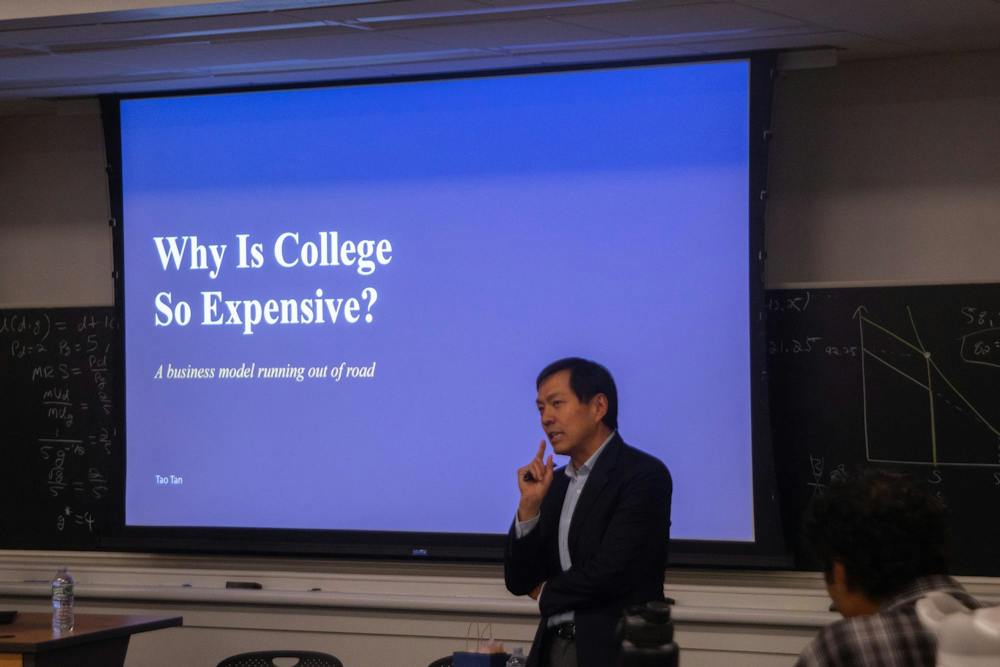
The Blue Ridge Center hosted an event Monday evening led by Tao Tan, private equity investor and affiliate of the Center for the Future of the American University, covering “Why College is So Expensive.” Tan explained how tuition costs will shape the future of academic institutions such as the University.
The Center for the Future of the American University brings together scholars interested in developing ideas to generate practical projects supporting academic reform. The event was co-sponsored by the Economics Club and the First Generation Low Income Partnership at U.Va.
After an introduction from Gerard Alexander, president of the Blue Ridge Center and associate professor of politics, Tan began his presentation describing tuition as a “price-discrimination engine” utilized by the University.
Tan agreed with the student-offered sentiment that this engine works by tailoring the price of attendance to the specific wealth demographics of students, creating a system that uses financial aid as a mechanism to calibrate the expense of tuition to the students' families’ financial information.
“[The University] can figure out exactly how much your family can afford to pay, and say that's your price. So the published price [of tuition] on the internet is usually not the actual price,” Tan said. “What I found, and this is something utterly fascinating … is that [tuition pricing] evolved to extremes … In reality, U.Va. now has three distinct price points.”
Tan explained that the University uses the information about students' family incomes to divide its price points into three central groups.
These groups are in-state students who qualify for financial aid and pay $18,427 a year in tuition, in-state students who do not qualify for aid and pay $41,803 a year and out-of-state students who do not qualify for financial aid who pay $79,512 a year, Tan explained. His presentation asserts that these groups make up 57 percent, 14 percent and 29 percent of the undergraduate student body, respectively.
However, Tan said that while financial aid appears as a “perfect price-discrimination engine,” it also acts as a “customer-isolation engine” — in this case, a management strategy that separates customers to support long-term financial sustainability of universities. According to Tan, U.Va. uses financial aid to separate different groups of students by price point groups, allowing control over the financial contribution each group of students makes towards the University’s tuition revenue, with full tuition-paying students subsidizing those receiving financial aid.
According to Tan, while out-of-state students who pay full tuition make up 29 percent of the student body, they contribute 59 percent of tuition revenue. In-state students who receive aid are 57 percent of the student body and contribute 27 percent of tuition revenue, and in-state students who do not receive aid make up 14 percent of the student body and contribute 15 percent of tuition revenue.
Tan explained in his presentation that this categorical system means only 43 percent of total students pay the full tuition price, thus allowing for the other 57 percent of students to attend the University with financial aid. He said this composition explains the high expense of the sticker price of college, which most students do not pay.
“If you're full-pay out-of-state, you're basically contributing $2 for every one percent of your revenue base, and you're basically subsidizing the aid recipients who pay roughly half,” Tan said. “That is the model of … elite institutions now. You maximize revenue from those who can pay, and you heavily subsidize those who can't.”
As for why colleges are able to charge higher prices, Tan pointed to the federal government’s 2006 GradPLUS loan program. This initiative largely shifted student loans from private to federal borrowing, and when Congress committed to funding unlimited student loans up to the cost of attendance, universities bore none of the credit risk. Instead, U.S. taxpayers did, Tan said.
Tan stated that these unlimited loans enabled universities to raise tuition, even if a higher cost may not correlate to improvements in academic treatments or outcomes for students.
However, President Donald Trump’s One Big Beautiful Bill has ended the GradPLUS program, effective in July, by placing caps on federal student loans. Tan said this could be a contributing factor to more universities facing significant financial strain in coming years, and that school closures like Hampshire College and Valley Forge Military Academy may become more prevalent.
Tan also cited lowering fertility rates, nationwide resistance to tuition price increases and recent visa caps and concerns for international students as other sources of financial strain for U.S. universities.
Additionally, Tan expressed concern about Medicare’s projected insolvency by 2033 by Medicare Trustees, meaning that Medicare is projected to run out of reserves in just seven years, after which it will no longer be able to cover 100 percent of scheduled costs. He explained that at institutions such as the University, health systems contribute a significant proportion of the total revenue, and 40 percent of U.Va. Health’s revenue comes from Medicare and Medicaid. Tan said this projected insolvency will likely have a significant impact on the University’s financial future and those of universities across the country.
While Tan said he believes that larger and elite universities like the University will survive because of their demand, support and size, he is concerned that smaller schools across the country will not, with the number of universities already shrinking by 11 percent between 2004 and 2024.
“[Universities] may be asset-rich, but they are actually very cash flow fragile,” Tan said. “What that means is the illusion of endowment is actually a little bit of a myth against the financial strength, and it can be used for it. Basically, U.Va. will survive its time. Most schools will not.”
Tan predicted that future closures and the consolidation of universities as a result of monetary strain will result in an emphasis on a stronger U.S. industrial base, with more of a focus on jobs and trades that do not require a college degree.
“There are lots of jobs, lots of trades in this country that do not require a college degree, that deserve dignity, that deserve people to feel like … [they haven’t] taken a back seat in life,” Tan said. “If we want our country to not be hostage to the vagaries of the world and supply chain interruptions … We have to build that industrial base in our country again.”
In an interview with The Cavalier Daily, third-year College student Lauren Gallagher said she attended the event to better understand the high price of college and to better advocate for student financial accessibility as a member of the president’s Student Advisory Council.
“I’m on the [president's Student Advisory Council], and making college more affordable … is something that we talk about,” Gallagher said. “I just wanted to be more informed so that when I go to those meetings, I can help advocate for students and understand why college is expensive.”
The next Blue Ridge Center event is Oct. 12 and will host Kalshi senior executive Nicole Kagan discussing “Prediction Markets: Investing or Gambling?”

Lily Kostro is a staff writer on the news desk and a third-year College student studying politics. Lily is from Beverly, Mass., and enjoys writing about events happening on Grounds.
Read More

U.Va. Health cuts scribe hours as AI documentation tools expand across Health System
By Vrinda Vashisht | 8 hours agoScribes in the undergraduate medical scribe program said in interviews with The Cavalier Daily that a new emergency department schedule that began Sept. 15 has reduced or eliminated certain scribe shifts and has decreased scribe availability to clinicians in the Emergency Department.

How does the Honor Committee manage its endowment?
By Isabela Delgado | YesterdayThe Honor Committee manages an endowment upwards of $200,000, and for its 2026-27 academic term, it has budgeted $204,500 — just over its available endowment.

Provost search committee seeks Faculty Senate’s Executive Council input on qualities for next provost
By Jaylynn Perez and Cassidy Hazel | 2 days agoBrie Gertler, interim executive vice president and provost, also provided updates on the University’s developing approach to artificial intelligence.