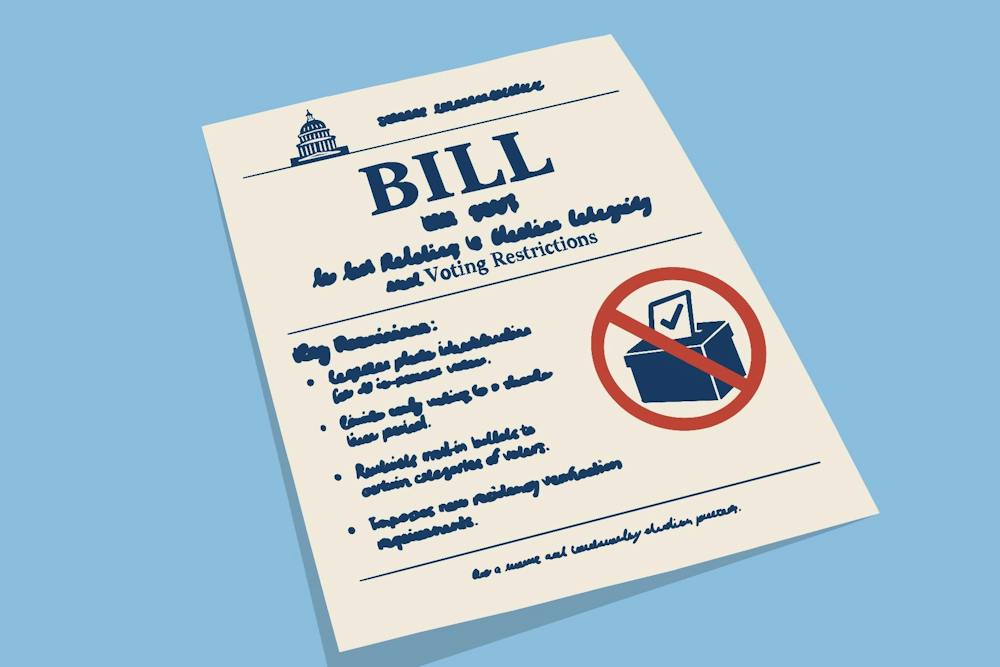
Ahead of the 2026 midterm elections, discourse around the efficacy of voting and civic engagement arises, especially in the midst of new proposals from the Republican Party that make it more difficult for American citizens to vote. Voters of all ages, races and backgrounds question if their vote or engagement is really significant — with this lack of confidence especially apparent for Black, Latino and Native American citizens, as well as young people, who feel that their government does not have their best interests in mind. Roughly one in five Americans report becoming less engaged with politics over time. Yet, our country needs to hear all voices, namely the marginalized voices, more than ever under severe federal threats to democracy.
Right now, politics are especially disheartening for all voters to engage with. Behind democratic elections lie a daunting list of corporations and powerful politicians who harness significant power in Washington, discouraging everyday citizens from meaningful civic engagement. This, in combination with polarization and government shutdowns, support that our government’s main priorities are serving corporate elite interests and disregarding the common good. President Donald Trump has even proposed bribes, offering $5,000 to all U.S. adults if Republicans maintain power in Congress. Tech lobbyists spend millions to buy influence, and the median net worth of a lawmaker sits roughly five to 12 times higher than a typical American household. This makes it difficult to believe in our system, as those in power struggle to personally understand the livelihood of the average American. However, the outcomes that result from this mentality, namely low voter turnout, hurt our democracy more than it helps us reform this broken system.
In the 2026 midterm elections, there are several issues at stake — attacks on higher education through DEI bans and legal questions about immigration policy and foreign policy amidst conflict in the Middle East. While these issues have been mainstream for several years, the present-day federal government has taken on an unprecedented amount of executive power — ignoring Supreme Court orders and undercutting civil rights and liberties through deportations have undermined the government’s ability to dutifully serve its citizens. Sitting on the sidelines of the 2026 midterms grants an opening to those in power in the House and Senate to ultimately stall opportunities for significant social change. If voters deliver nothing, we maintain the status quo and ultimately silence our own voices. During elections, our agency is only gone if we allow it to be.
Despite the serious political challenges facing the United States, disengagement has only been on the rise. Growing frustrations with the two-party system layout and the corruption of both the Republican and Democratic parties have left most youth voters disconnected from the political system. Disengagement may seem like the more favorable option in a highly polarized society. Party leaders such as President Trump and media outlets like Fox News promote and advance disinformation to lead their audience toward a certain conclusion, where it often becomes difficult to distinguish facts from disinformation. However, studies support that neutrality or general disinterest in politics threatens democracy altogether. Democracy naturally invites conversation and disagreement. If we decide not to participate a democratic, free expression of ideas, we are handicapping ourselves from the potential of a truly representative government.
Cynics of our current political system should point out how elected officials can pass harmful policies without consequence — but ironically, lackluster participation only gives politicians the chance to capitalize on our inaction. If our vote did not matter, there would not be any initiatives to restrict voting registration, such as the Supreme Court recently striking down Trump’s proposal to permit the U.S. Postal Service to withhold mail-in voting ballots. Not to mention, current legislation surrounding the 2026 SAVE Act may further limit voter registration options. Besides the other branches of government, voters are the most commanding check on their representatives’ power, and any effort to quash accessible voting is to protect policymakers from being voted out of office. As efforts to implement these restrictions grow, they only demonstrate that democracy is never guaranteed — it must be maintained and fought for every election.
Disinterest toward both the Republican and Democratic parties can also explain voter apathy — the feeling that both parties only attack each other and disregard the real needs of everyday people. A stalemate over federal immigration policy caused the longest government shutdown in history in 2026. For young voters, many feel that they have to choose the lesser of two evils every election — how can we choose or feel motivated to vote for two undeserving options? However, inaction only feeds this dynamic by allowing a vastly small group to sway the results of our elections, thereby removing the considerations from everyday people with opinions crossing both political aisles.
While you consider entering the polls this November, remember that abstaining is not changing. Many Americans are frustrated or discouraged by our government — but not using our platform only makes theirs bigger, stronger and more apt to destroy ours completely. Our power as everyday citizens may be limited — but as voters, our power will never be absent.
Jenna Caron is a senior opinion columnist who writes about politics for The Cavalier Daily. She can be reached at opinion@cavalierdaily.com.
The opinions expressed in this column are not necessarily those of The Cavalier Daily. Columns represent the views of the authors alone.
Read More

CLIPPINGER: Grade inflation is killing curiosity
By Grace Clippinger | 3 days agoWhen a high GPA is deemed important for future opportunities, students have more reason to avoid difficult courses, choose classes based on their expected grades and protect their transcripts, rather than pursue what genuinely interests them.
GARVIE: Do not let data center development fly under the radar
By Adeline Garvie | 5 days agoThere is a new power-sucking facility being built less than two miles from you, and you may not even be aware of it.

EDITORIAL: College sports need fixing
By Editorial Board | September 23, 2026College sports, in their current state, are fundamentally broken, and they desperately need legislative stabilization and reform.