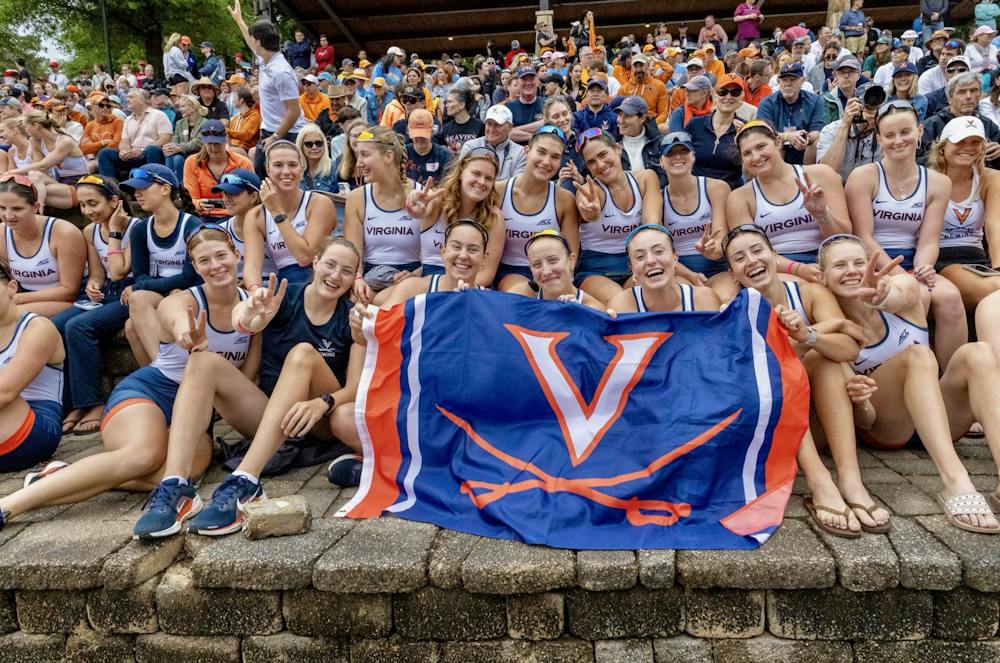
Virginia rowing spent much of the 2025-26 season proving who the Cavaliers are. After finishing 10th at the 2025 NCAA Championships, Virginia returned to the national stage one year later and climbed to fourth — its highest finish since placing third in 2016. Three Cavalier boats reached the NCAA Grand Finals, with the Second Varsity Eight finishing third, the Varsity Eight fourth and the Varsity Four sixth.
It was the kind of season that can change the trajectory of a program. Now, Virginia has to do it again. The Cavaliers enter the 2026-27 season not as a team trying to announce themselves nationally, but as one aiming to establish that last season was the beginning of a new standard. And in a conference where Virginia once dominated, that means chasing a new benchmark — Stanford.
For nearly a quarter century, ACC rowing was synonymous with Virginia. The Cavaliers won 22 of the first 23 conference championships ever contested, and strung together 13 straight titles before Syracuse snapped the streak in 2024. Virginia enters this season in a different position within the same conference, one whose landscape has become increasingly competitive in the past two seasons.
The Cardinal won the 2025 and 2026 ACC Championships, and were the 2026 NCAA runner-up. In the latter competition, Virginia demonstrated that the gap between itself and Stanford was not quite as large as may have been suggested by the conference standings. Placing fourth, the Cavaliers advanced the same number of crews as Stanford to the NCAA Grand Finals — the only other team to do so.
The Cavaliers’ Varsity Eight crossed the line in 5:52.398, just over two seconds behind Stanford's second-place crew and just under five seconds behind national champion Texas. The Second Varsity Eight finished in 5:58.225, about five and a half second behind Stanford's winning boat. That is the space that Virginia has to close next time it is next to the Cardinal at the starting block.
That separation shows that while the Cavaliers may not yet be the best team in the ACC, they can hold their own nationally. The depth of the conference makes repeating as national contenders far from automatic. Last season, Virginia was joined by Stanford, California, Syracuse and Miami in the NCAA Championship field. That meant five ACC programs made the 22-team national championship, more NCAA qualifiers than any other league.
At the 2026 ACC Championships, the Cardinal swept all five Grand Finals. Its Varsity Eight finished more than five seconds ahead of the Cavaliers, while Stanford's Varsity Four won by more than 12 seconds. Virginia still finished second in the ACC, but the results showed just how much ground remained between the Cavaliers and the top of the conference.
Virginia is returning much of the roster that powered it to 114 points at NCAAs including fifth-year rower Elsa Hartman and fourth-year rower Lila Henn, while a strong class of first years joins a roster with significant championship experience.
This summer only reinforced the program's growing depth. Henn and Hartman both won gold medals at the World Rowing U23 Championships in July. Henn raced in the U.S.'s quadruple scull, while Hartman helped the U.S. women's eight race to gold. At the same regatta, fourth-year rower Emma Alimbau-Borràs, third-year rower Paula Lutz and third-year rower Ayla O'Neill raced for their home countries.
These results are just another indication of the incredible amount of experience and expertise the Cavaliers are bringing back to Charlottesville this year.
Hartman and Lutz are returning after earning All-ACC First Team and CRCA All-American honors last season. Returning fourth-year rower Skylar Morrison joined them as a CRCA All-American. Virginia also returns second-year rower Georgia Allen, who was named ACC Newcomer of the Year after helping the Second Varsity Eight to an ACC runner-up finish and an NCAA bronze medal.
The Cavaliers have also added 16 new first-years, including first-year rower Hannah Al-Karmi who raced to win the Di Ellis Trophy in the junior 1x competition at the 2026 Henley Royal Regatta. This creates a combination of established experience and new competition for lineup spots, and a challenge of determining which combination of these strong rowers will create the fastest possible combinations.
This mix gives the Cavaliers a strong group of rowers who already know what it feels like to race in an NCAA Grand Final. Yet now the team's biggest challenge is figuring out how to move beyond fourth place, particularly against a Stanford team that has established itself as the ACC's benchmark.
This process will come with a larger role for Taylor Ruden, who was promoted from assistant coach to associate head coach in September. Ruden has been a part of Virginia's rise over the last two seasons, and her promotion gives her a larger role at an important point for the program.
Virginia has made the jump from a strong program to a national contender — the next jump requires much more than repeating what worked last season. It will require finding ways to make already-strong crews even faster, deeper and more consistent. The Cavaliers’ fall schedule will give them a chance to begin figuring that out.
Virginia's 2026-27 schedule begins Oct. 18 at the Head of the Charles Regatta in Boston, where last year the Cavaliers placed second overall and first in collegiate 4+ crews. From there, Virginia will race at the Princeton Chase Nov. 1, return home for the Rivanna Romp Nov. 8 and close out fall racing at USRowing Small Boats Nationals in West Windsor, N.J., Nov. 14-15.
That last event is particularly notable, because Small Boats Nationals is both a new addition for the Cavaliers and to the USRowing calendar. The regatta will let them compete in single sculls and pairs before the spring season takes over — a different test than putting athletes into the large boats that matter most at NCAAs, like the Varsity Eight. For a program that has historically leaned on sweep rowing, as the NCAA Championship does, mixing in sculling can give coaching staff another way to evaluate individual rowers and pair combinations, particularly with a roster blending returning athletes and first years.
The Head of the Charles and Princeton Chase will put Virginia against strong competitors early in the year, while the Rivanna Romp will give the Cavaliers their only chance to race at home — all events which have become routine in Virginia's fall schedule.
Small Boats Nationals is an experiment, and for a team coming off a fourth-place NCAA finish, that experimentation has a purpose as the Cavaliers already know they can build competitive boats. Now, the goal is to figure out how to make them stronger and build even more.
Read More

Early promise gives way to growing pains for Virginia at Ben Hogan Invitational
By Sofie Keppler | 14 hours agoVirginia finished 14th out of 16 historically accomplished programs, tying with Stanford at a 43-over 883.

Often weak this season, Pribula’s passing and receivers breakout led Virginia to victory
By Drew Dillman | YesterdayThough not a strong suit for the large part of the season so far, the aerial attack spearheaded the offensive domination of the Blue Hens during Virginia's 42-3 victory.

Rice secures NCAA singles bid as Cavaliers show promise in ITA All-Americans
By Margaret Piatos and Noah Cinel | 2 days agoContinuing their early-season prowess, the Cavaliers put on a strong showing in Tulsa, Okla. with multiple deep tournament runs against top competition.