Correction: A previous version of this article incorrectly stated that Virginia’s overtime victory against Florida State was Sept. 27. The game occurred Sept. 26. The article has been updated to reflect this change.
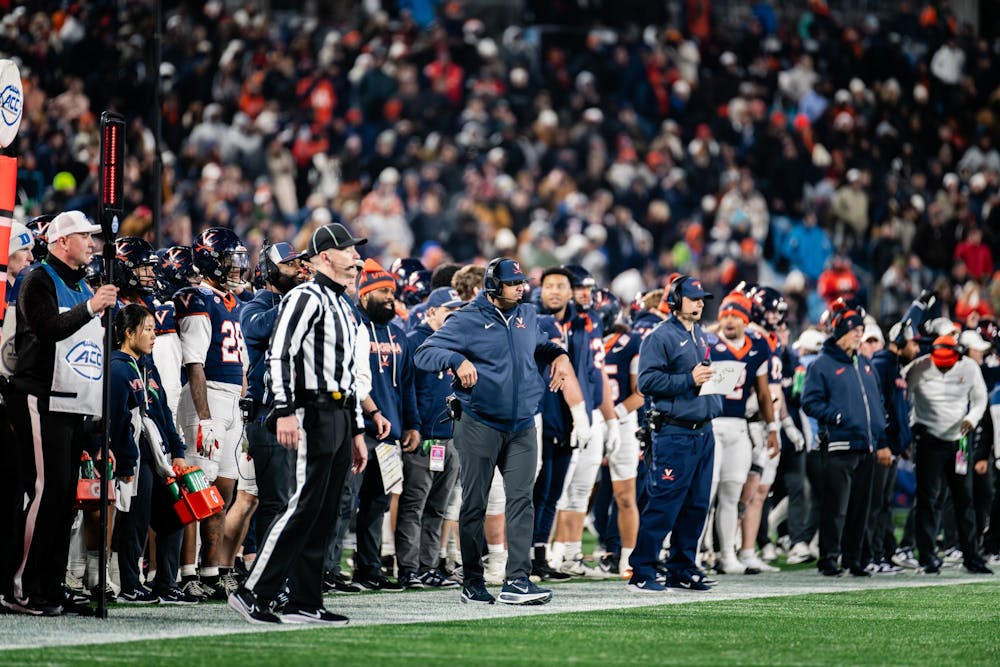
The word for what happened in Scott Stadium on the night of Sept. 26, 2025, is pandemonium. Described by many as “the fastest field storm” ever, a flood of Cavalier faithful cascaded down the Hill and spilt onto the field following an overtime victory against then-No.8 Florida State.
That crisp fall night was one highlight in a year full of them for Virginia athletics, defined by the resurrection of their two flagship programs from ruin.
When the Class of 2025 entered their first year at the University, football and basketball were one year removed from an ACC title game berth and a national championship, respectively. Every member of that Class graduated without experiencing a single winning football season or a single NCAA Tournament victory for basketball.
Lackluster performance and a rapidly shifting college sports landscape, combined with the departures of Coach Bronco Mendenhall from football after the 2021 season and Coach Tony Bennett from men’s basketball in 2024, left the futures of these programs in flux.
Virginia’s Class of 2030 enters an entirely different athletic environment than the fourth-years of yesteryear. Unprecedented financial investment allowed ACC Coach of the Year Tony Elliott to construct the football program’s greatest season ever in his fourth year in Charlottesville. The hiring of Coach Ryan Odom and a complete roster overhaul yielded basketball’s first NCAA Tournament win since the title game in 2019.
Unlike the successes preceding the disasters of the early 2020s, the revamped iterations of these programs are here to stay. Elliott’s 2026-27 Cavaliers is the most experienced roster in college football. Although key leaders like Chandler Morris and J’Mari Taylor are gone, senior linebacker Kam Robinson and graduate guard Drake Metcalf remain — new additions such as graduate quarterback Beau Pribula and senior safety Brandyn Hillman will join them.
Robinson is perhaps the best player on the roster. Last campaign, he achieved the rare feat of being the only FBS player in 20 years with a punt block, a pick six and a fumble recovery in one season — he did this despite only playing in eight games.
Metcalf, a former Stanford Cardinal and Central Florida Knight, has played well at both guard and center throughout his career. His mistake-averse play means fans will not hear his name called out often on broadcasts for blown assignments or false starts.
Pribula spent the first three seasons of his career at Penn State before jumping to the SEC and spending a year with Missouri, where he went 7-3 across his starts. The former Tiger is the presumed starter, with junior Pitt transfer Eli Holstein set to back him up.
Hillman is likely to introduce himself quickly — and loudly — to Virginia football fans. The former Wolverine more than earned a reputation as one of the Big 10’s hardest hitters across his past two seasons at Michigan.
Elliott retained almost the entire offensive line and brought in nearly 30 players for a top 30-ranked transfer class in the country by most evaluators. Virginia is set up to compete at the top of the ACC for years to come — they flipped a four-star 2027 cornerback from Penn State earlier this month, offering a peek at potential for more sustainable roster-building in the future.
If Elliott’s portal performance was impressive, Odom put on a masterclass. He retained all players with eligibility remaining — not a single player elected to transfer away from the program. Between sophomore guard Chance Mallory, senior wing Sam Lewis, sophomore power forward Thijs De Ridder and sophomore center Johann Grünloh, Odom already had most of his starting lineup sorted out without any external additions.
Odom, of course, still added plenty in the portal, including veteran guards Jurian Dixon and Christian Harmon. Both are threats from beyond the arc and should see plenty of minutes this upcoming season. Four-star freshman center Favour Ibe adds immediate depth behind Grünloh and shows immense potential as a future starter, given his 7-foot-1 frame.
In a sport filled with revolving door rosters across the nation, Odom mostly maintaining the same roster from last year to this one is nothing short of miraculous — if he can manage remotely similar effort year to year, the Cavaliers will enter each season under his tenure among the most cohesive squads in the country.
Fans should be excited at the prospect of Virginia becoming one of the privileged few schools that can field competitive teams in both football and basketball. However, the programs that have consistently delivered this decade deserve recognition.
Virginia has 37 NCAA championships across team sports. The 2025-26 academic year alone featured two championships — one tennis, one swimming — as well as top 10 rankings for 18 of 27 programs.
Women’s swimming is particularly dominant. Arguably, the program under Coach Todd DeSorbo has been the true flagship for Virginia this decade. With six straight NCAA women’s titles — an unparalleled achievement — the Cavaliers have staked a strong claim as one of the most inevitable teams across collegiate and professional sports.
The University has plenty to offer for its students, and excellence in many athletic programs has been part of that deal for decades. With the best set-up for sustained success in recent memory, football and basketball have begun to catch up with the pedigree of other programs. Brighter days lie ahead in Charlottesville for the Class of 2030.
Read More
Five takeaways from the first two Virginia men’s basketball exhibition showcases
By Jordan Zimm | 13 hours agoWith one more exhibition remaining at Villanova Thursday, here are five takeaways from Virginia’s first two preseason tests.

Virginia volleyball looks to extend historic winning streak to 10 against Virginia Tech
By Jonathan Altshuler | 14 hours agoWhile both teams have struggled recently, Wednesday’s result further strengthened the Cavaliers' advantage in the rivalry — which remains one-sided.

Virginia volleyball extends winning streak against Virginia Tech with four-set victory
By Jonathan Altshuler | YesterdayThe Cavaliers defeated the Hokies in four sets Wednesday night at Memorial Gymnasium with scores of 25-19, 25-19, 22-25 and 25-23. This was the Cavaliers’ first win since Sept. 25, extending a five-year winning streak against the Hokies since 2022.