Just over a year ago, in the weeks following Coach Ryan Odom’s hiring, I wrote a column entitled “Ryan Odom’s resume does not inspire confidence.”
After 30 wins, an ACC Tournament run to the championship game and Virginia’s first NCAA Tournament win since 2019, it’s safe to say I was wrong. Dead wrong.
Odom was tasked with recreating everything that Tony Bennett accomplished in Charlottesville — the ACC titles, the NCAA Tournament success, the Virginia brand — from scratch. He was given three roster carryovers, just one of whom played mere minutes previously in orange and blue, and a brand new coaching staff.
From the rawest of materials, Odom indeed built a tournament team in his first season as a Power Four head coach. The season proved that Odom is made to win in the new era of college basketball, one defined by budgets and teambuilding above nearly all else.
The lack of any foundational pieces — no savvy veteran point guard, no strong interior piece, no solid perimeter shooter — acted as both a blessing and a curse for Odom. The new regime took the opportunity to pick and choose players to fit his playstyle.
Early transfer portal decisions inspired confidence as the talent level of Odom’s first team came into focus, but they also offered more questions than answers — namely, who was supposed to take control of this team? The new group was seasoned, with several potential go-to guys primed to step into the limelight.
Instead, Odom’s team demonstrated its unselfishness from the very beginning of the season. Scratch that — the Cavaliers thrived on unselfishness. Virginia passed nonconference tests with flying colors as different players took their turns front and center.
Freshman forward Thijs De Ridder made his presence known early, scoring 26 in a win over Northwestern. In a game where others struggled to find space, graduate guard Jacari White dropped 25 on 7-7 from deep against Dayton. Graduate guard Dallin Hall scored 20 — his season high — versus Maryland in Virginia’s last major nonconference test. Five Cavaliers scored double digits in a December drubbing of Texas.
It was clear at this point that Odom’s team was better than projected. When Virginia shot well from three, competed for rebounds and limited turnovers, the Cavaliers were a serious contender.
However, Virginia’s flaws became glaring as ACC play began. Just as the Cavaliers were capable of putting several players into double digits, so too were they susceptible to stagnant spells. Virginia lost in triple overtime to Virginia Tech on the road to open up ACC play — De Ridder and graduate guard Malik Thomas had to carry heavy burdens as the Cavaliers shot a dismal 10-45 from three.
The early loss put two issue areas in clear focus — perimeter shooting and rebounding. The Hokies posted 60 boards in the game as both of Virginia’s centers struggled on the glass. Both teams shot poorly from beyond the arc, but Virginia Tech relied on it less. Both areas harassed Virginia well into the postseason.
Mostly, though, the Cavaliers just kept winning. They responded to the loss with a road demolition of NC State, a clean homestand over West Coast opponents Stanford and Cal and gutsy road wins over then-No. 20 Louisville and SMU.
Virginia’s final two losses of the regular season once again demonstrated the flaws. No. 1 Duke did everything better than Virginia, including dominating the rebound battle. Then-No. 22 North Carolina challenged the Cavaliers to play clean, efficient basketball, and they responded by shooting 8-27 from three and committing 11 turnovers.
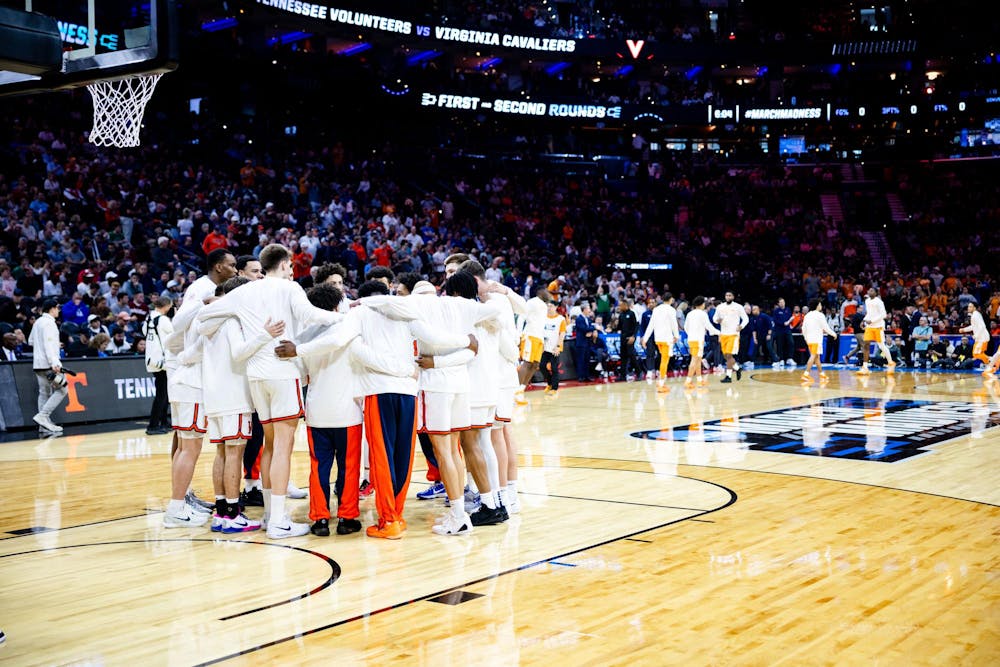
It was a pattern that repeated itself in the most critical moments. Virginia bowed out of the ACC Tournament in the championship, going silent from beyond the arc and losing the rebound battle in the Cavaliers’ second loss to Duke. In the NCAA Tournament, a physical Tennessee team downed Virginia.
Even as the same old issues beat the Cavaliers again and again, Odom displayed a continued willingness to try new things. That’s how Virginia beat NC State thrice and Miami twice, a major challenge given the degree of parity in the ACC — adaptability was the name of the game for Odom’s Cavaliers.
The so-called bench mob played as many or as few minutes as they were asked to play, a testament to the team’s selflessness. Odom relied on freshman center Johann Grünloh and senior center Ugonna Onyenso increasingly over the course of the season, culminating in dominant defensive performances across the ACC Tournament.
It is fair to expect even greater things in the future. Odom has demonstrated his savvy as a teambuilder — now, he will operate with some degree of continuity. Freshman guard Chance Mallory, De Ridder and Grünloh will all return in 2026-27. That would be three of five starters returning for a second year in Charlottesville.
With the full trust of Virginia Athletics, a few critical building blocks returning with postseason experience, a proven track record and — perhaps most importantly — a hefty NIL budget, Odom’s Virginia appears primed for great things in the years to come.
Read More
Five takeaways from the first two Virginia men’s basketball exhibition showcases
By Jordan Zimm | 14 hours agoWith one more exhibition remaining at Villanova Thursday, here are five takeaways from Virginia’s first two preseason tests.

Virginia volleyball looks to extend historic winning streak to 10 against Virginia Tech
By Jonathan Altshuler | 14 hours agoWhile both teams have struggled recently, Wednesday’s result further strengthened the Cavaliers' advantage in the rivalry — which remains one-sided.

Virginia volleyball extends winning streak against Virginia Tech with four-set victory
By Jonathan Altshuler | YesterdayThe Cavaliers defeated the Hokies in four sets Wednesday night at Memorial Gymnasium with scores of 25-19, 25-19, 22-25 and 25-23. This was the Cavaliers’ first win since Sept. 25, extending a five-year winning streak against the Hokies since 2022.