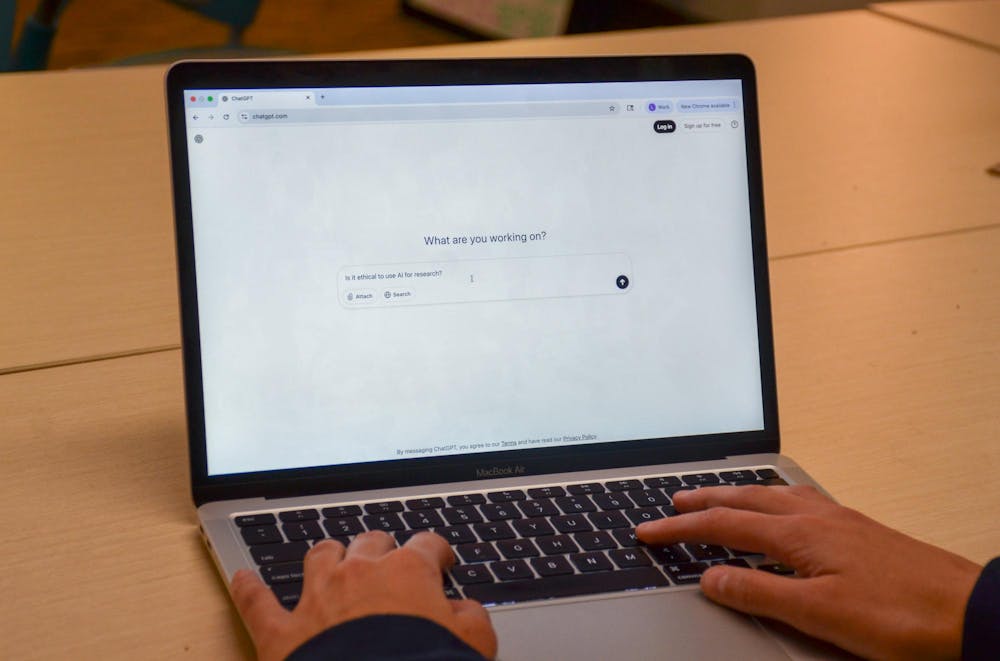
Artificial intelligence regulation is scant and eclipsed by accelerating development. As technological evolution outpaces oversight capacity, students and faculty are left to their own devices in navigating these complex tools. Recent initiatives have enriched institutional AI knowledge — the University’s GenAI Task Force produced a 2023 Generative AI in Teaching and Learning report, the Center for Teaching Excellence has reached hundreds of educators with their Faculty AI Guides program and most recently, the Student Technology Council asserted the need for a student-governed AI overview committee. A plan for regulation is necessary to guide AI users and ensure the University’s academic standards continue to be met in a new era. To address rather than observe AI on Grounds, the University must develop an adaptable regulation process to navigate AI progression across the University’s education, research and academic spaces — best exemplified in the promise of the STC.
Typical regulatory bodies have not stepped in to offer meaningful direction. Few of the recent state laws or federal orders addressing AI usage offer prescriptive norms surrounding AI use, and for good reason — the exponential speed of complex technological change has historically outpaced the slow, deliberative nature of policymaking, creating intermediary periods lacking clear prescriptive architecture. However, the near future promises a landscape chock full of AI, and regulation is crucial to mitigate risks related to ethics, critical thinking and academic standards.
This vacuum presents a special opportunity for the University to decide its fate in a complex, new landscape. The malleable nature of AI poses a unique challenge to the creation of educational best practices. According to the American Psychological Association, AI can either enhance learning when used in "interactive" and "constructive" ways or threaten education when it “displaces higher-level processes.” A nuance-conscious approach is needed to meaningfully distinguish between potential benefits and risks in uses of AI across each school’s unique academic setting. In lieu of state policymakers, who better than faculty, students and researchers to collectively evaluate the implications of AI usage in their academic environment to create custom boundaries for all crevices of the University?
A partnership between the Sloane Lab and Digital Technology for Democracy Lab, the STC initiative is meant to act as a legislative body of students elected by peers to perform technology advocacy on behalf of the student body. The STC would be made up of 12 representatives — two from each undergraduate class, two graduate students and two professional students. Additionally, two ex officio representatives from the Honor Committee and Student Council would operate as key partners. This intentionally structured representation accounts for experience across the University to ensure that legislative discussions are centered around the concerns and academic needs of students.
The STC is currently seeking Special Status Organization recognition, which would make it privy to official mentorship, delegated authority and funding from University administration. SSO status for the STC would be a step in the right direction to incorporate University administration and faculty into legislative decisions regarding AI usage on Grounds. University administration should seize the opportunity to set a legislative function specific to AI and build out the representative regulatory body that the STC has set forth.
Securing administrative support for the STC would provide the institutional weight necessary to seriously introduce new guidelines across the University's diverse academic community, especially if stakeholder voices beyond those of students are incorporated. Students, faculty and administrators could use the STC as a space to discuss AI use and ethics across specific departments, assignments and major programs to best serve students across various conditions. Currently, instructors across the University are required to include language in their syllabi regarding the usage of generative AI tools in the classroom, but such unilateral enforcement will likely create vast variance across departments, professors and schools. The current approach is a short-term solution that is quickly losing traction as technological development continues to outpace even the lifetime of a semester-long syllabus. An STC composed of a representative set of voices and granted SSO status would be equipped to evaluate the impacts of AI usage across academic settings and assign boundaries across scenarios.
The University of California, Berkeley offers a peek into the future if the STC were granted faculty input and administrative authority. Berkeley’s Compliance and Enterprise Risk Committee's Artificial Intelligence Risk Subcommittee is a set of faculty, staff and students who conduct risk assessments and provide advice to departments and schools across Berkeley by reviewing proposed AI tools or new uses of existing tools. Proposals address a myriad of scenarios, spanning administrative, teaching and research uses of AI. At the University, inputting community proposals into a structured evaluative and decision-making process would offer flexibility across schools, major programs and educational requirements. For example, the School of Data Science and the College of Arts and Sciences may develop separate review committees due to their differences in curriculum, and the College could even utilize specialized subcommittees for research-focused majors, such as the Distinguished Majors Programs, which enable students to produce unique academia.
University regulation must move away from reactive syllabus bans and toward a proactive model of regulating AI based on an assessment of usage across different contexts. Given the unprecedented rate of AI development, no one policy will be able to stand the test of time. A review committee that incorporates student and faculty voices and focuses on AI applications currently at hand will institutionalize adaptability, protecting the University's traditional standards while realistically adapting to the contemporary technology environment. By empowering participants from across Grounds to propose usage scenarios and enabling representative students and faculty to methodically tackle these questions and set guidelines, the University can incrementally construct a future in which AI can be meaningfully used as a tool.
Celeste Wetmore is an opinion columnist who writes about academics for The Cavalier Daily. She can be reached at opinion@cavalierdaily.com.
The opinions expressed in this column are not necessarily those of The Cavalier Daily. Columns represent the views of the author alone.
Read More

ELJAZZAR: The ‘accommodation nation’ argument misses the mark
By Farah Eljazzar | 8 hours agoThe question the University must start asking is not how harshly students should be scrutinized for seeking accommodations, but why so many of them feel that they have no other choice.

EDITORIAL: U.Va.’s chance to resolve institutional distrust
By Editorial Board | 2 days agoAffordability, AI use and free speech — these are all issues critical to ensuring that our University is accessible to all and that its culture is rigorous, rational and accepting.

HAWKINS: SJP’s animosity toward Darden’s new dean is patently absurd
By Joshua Hawkins | 4 days agoNo, Grushka-Cockayne should not be forced to resign before Darden even opens its doors for the fall, and SJP should seriously reconsider suggesting such a dramatic step.