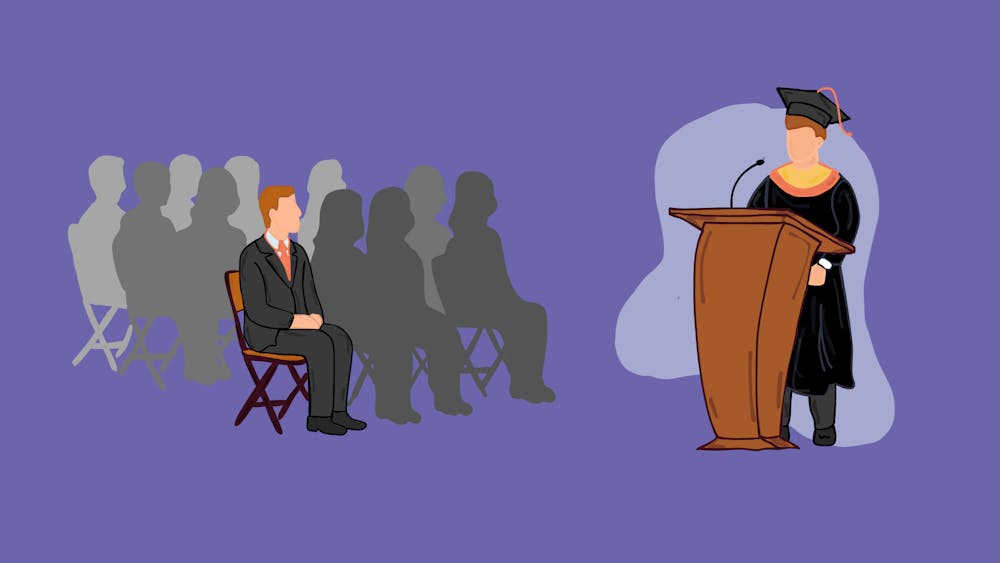
Undoubtedly, the story of last month’s graduations at top American universities was the chorus of boos speakers received after touting the potential of artificial intelligence. Executives and socialites lined up to herald in the dawn of a new Industrial Revolution, one led not by physical machines but by immense computational ones. In almost every instance, the graduates greeted this news not with joy, but with antipathy. Their animosity is completely understandable — as Scott Borchetta, CEO of the record label Big Machine Records, told graduates of Middle Tennessee State University, “The things [they] learned in [their] first year here may already be obsolete.” This is, predictably, not welcoming news to students who have spent countless hours and hundreds of thousands of dollars to earn a college degree. Furthermore, the callous disregard with which these speakers turned joyous events into moments of existential dread must be spurned. For these reasons, I do not believe that these graduates represent a “jaundiced crowd” acting “with a sophomoric bitterness.”
The editorial unfairly characterizes the problem as a battle between modern-day Luddites, recklessly opposing the inevitable technological advancements humans create, and those brave entrepreneurs charging boundlessly into the new AI frontier. On the contrary, the issue is found in the irony of wealthy individuals, already secure in their jobs, telling graduates entering a flagging labor market that they may never be able to establish a career at all. It is an issue of ignorance on the part of the speakers, not naivety on the part of the students. As Cornell University professor Sarah Kreps puts it, “These tech executives are not reading the room.”
To feel indignant at being told at your graduation ceremony that your degree might be worthless, and to also recognize the potential for massive human innovation via AI, are not mutually exclusive. Indeed, when used properly as a supplement for the work humans themselves create, AI is just like those inventions that propelled the world into the modern age. Tasks that could take months or years of research can be completed in days and hours as AI synthesizes the vast body of human-produced knowledge up to today. Indeed, this is AI’s main promise — allowing humans the flexibility to delegate the time-limiting tasks that necessarily limit their ability to produce new knowledge. These graduation speakers might be used to AI being used in this way in their own lives and work. Yet, there is also the risk that AI is adopted in a more banal way, producing the sort of “slop” that is ridiculed online. Think unoriginal essays and clever-sounding research that is merely concatenating existing bodies of work. College graduates have experienced this latter type of AI production themselves for the past few years, as this is how AI is used most often on college campuses today.
Understandably, then, the prospect of being replaced in favor of mere convenience instead of being able to utilize AI to further human knowledge can only be met with jeers. It is still too early to see which path companies will take in using AI — the path of advancement or the path of convenience. No matter which path is chosen, however, future graduation speakers would be wise to study up on the way AI is used in college today and recognize the very real, very potent anxiety this use has produced in recent and soon-to-be college graduates. I agree with the editorial’s insistence that students should take the time to experiment with how AI can be used in their own lives. Just as knowledge of computer systems has developed into a field unto itself, so will the specialized knowledge of AI systems. The more that recent graduates discover how AI can be used to supplement, as opposed to supplant, human labor, the less chance those who come after them will be sacrificed for mere convenience. It is incumbent on the next generation of workers to pave the way.
This, then, is the true source of the chorus of boos found in May’s graduations. It is not the naive fear of technological advancement, as the editorial suggests. Rather, it is the fact that out-of-touch executives are the ones pontificating on the future of AI with no recognition of how it is viewed by the younger generation. It is the fear of being replaced for the convenience of said executives. The solution is two-fold — executives must recognize and understand the fear felt by new college graduates, and new college graduates must do their part to make AI a useful tool in the workplace. Only through the cooperation of both groups can AI be used by humans, rather than humans being used by AI.
Michael King is the Opinion Editor of The Cavalier Daily. He can be reached at opinion@cavalierdaily.com.
The opinions expressed in this column are not necessarily those of The Cavalier Daily. Columns represent the views of the author alone.
Read More

KURTZWEIL: Keep Virginia’s energy Virginian
By Paul Kurtzweil | 57 minutes agoThis merger will only make Dominion and NextEra more powerful, but the benefits to taxpayers are slim.

EDITORIAL: The Board’s McKinsey retreat prioritizes corporatization over cooperation
By Editorial Board | 4 days agoWhile some private meetings under certain circumstances may have benefits, McKinsey’s involvement flips the script in a dangerous way.

TAYLOR: Are younger generations in the US going deaf?
By Nat Taylor | 6 days agoAlthough this remains a multifaceted dilemma, there are indeed concrete steps, both personal and societal, that can be taken to protect the essential sense of hearing.