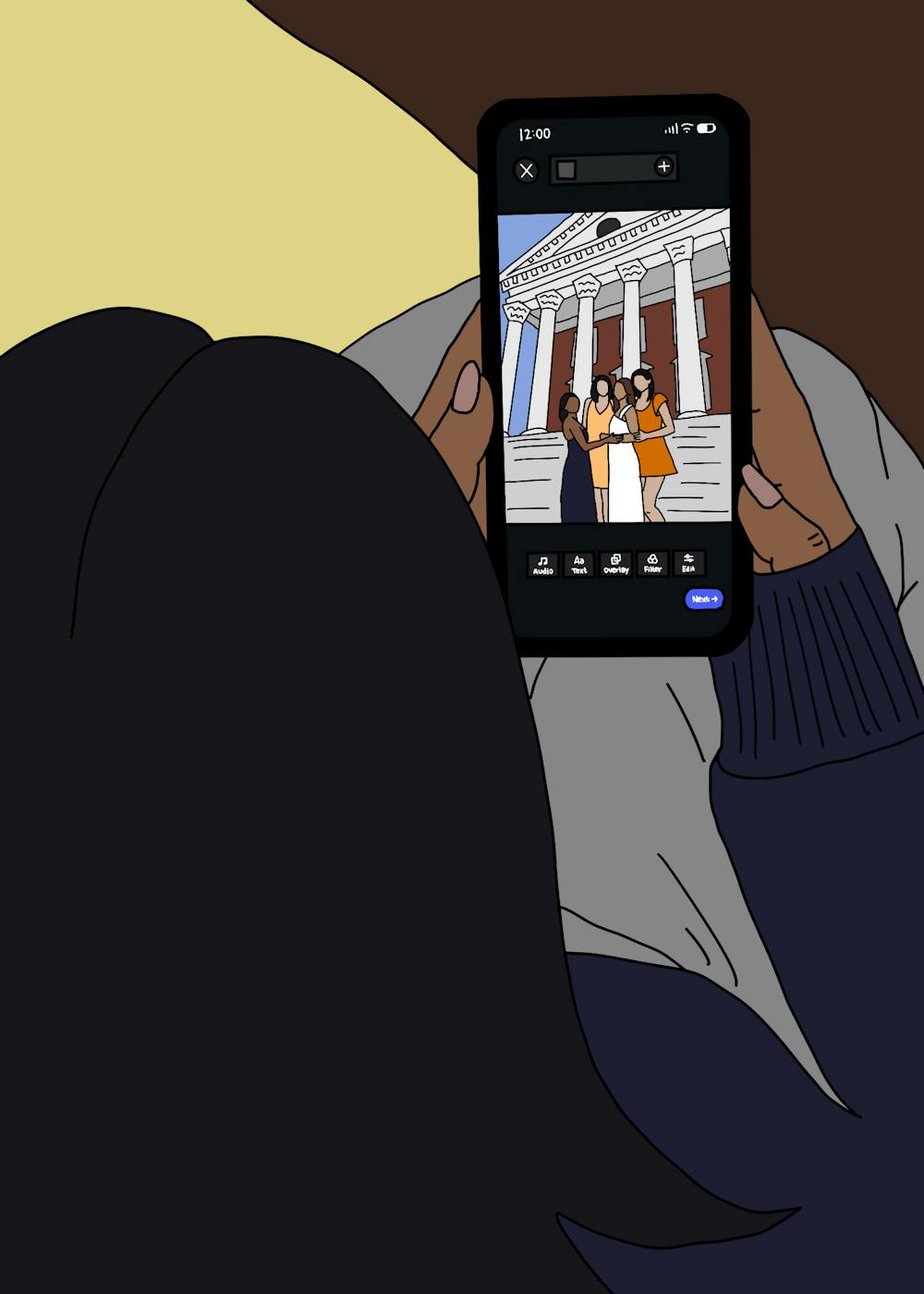
Lunch hour, finals season. As I stood waiting for my Grubhub order, I opened social media and began scrolling. My eyes scanned post after post, noting smiling faces and upbeat captions — “Lucky to be a Hoo,” “Love letter in orange and blue,” “1/4 done at the best place to be.” The obligatory end-of-semester social media update was due, and I was stressed.
During the first semester of my first year, as an international student who was still trying to find her place, I found it difficult to relate to the experiences selectively displayed by my Virginian peers. I did not have a mirror selfie of me and my besties in the bathroom at Ellie’s. I did not dress up for Oktoberfest or even the third night of Halloweekend. I did not go to football games flanked by two guys in orange-and-blue-striped overalls. I did not have a big group of friends who pregamed in my dorm or dragged me off to Foxfield, and if I did, I doubt I would have had the presence of mind to take out my digicam and ask everyone to pose for a picture.
Part of this, I told myself, was simply due to personal circumstances. I have spent a great part of my life thousands of miles away in an Asian culture where Friday nights didn't revolve around fraternity basements, where “football season” was basically nonexistent and tailgating unheard of. Even when I lived in America, my lifestyle was relatively quiet and intimate. I preferred evenings spent with small gatherings of friends and family, where we shared drinks in the privacy of a dining room before settling in for a movie night or a nice long talk.
I hadn't had as much exposure to unspoken rules of American college life the way some of my peers had through social media and TV — rules about which parties mattered, which traditions were sacred and which photos signaled that you’d “made it” socially.
But none of this stopped me from trying to fit myself into the narrative. I examined each post with care, hoping to pinpoint at least one small thing that I could relate to. I told myself that I, too, went to football games with my friends. I, too, dressed up in orange and blue for various occasions. I, too, could invite people to unleash chaos in my dorm before a fun night out.
Yet the fact remains that I could not create a post that would blend in seamlessly with the end-of-semester panegyrics flooding my feed. As ironic as it may seem, I was more bothered by the perceived gap between my college experience and that of my peers than by the prospect of taking my upcoming — notoriously difficult — exam. I had enough confidence about my academic abilities to be convinced that any academic setback would easily be remedied, whereas the college experience — something much less tangible and measurable — could not be gained simply by following a formula of diligence.
On each post, I zoomed in on the clothes worn by my peers, on their smiles and poses and their surroundings, noting the crowded bars, the basements, the fireworks and sunsets. I was looking for clues that would tell me what college was really about, pointers that would direct me to the right experiences.
But is there a “right” experience? After hours of analytical scrolling, I realized my mistake in taking the experiences portrayed on social media as definitive models. The vast majority of these recap posts looked more or less alike — going the rounds of bars, parties, football games, Carter Mountain, the Rotunda and Halloween in the company of perfectly smiling friends. They were valid experiences, but they told a singular, generic story of college life.
Is this, I asked myself, how I want my own college experience to look like? Did I want every chapter of my life in college to align with each picture in the slide deck?
We often feel pressured into believing that we must check off certain boxes, attend certain events and cultivate certain friendships — fearing that if our experience doesn’t mirror the curated narratives we see online, we are somehow falling short. But the truth is, college isn’t a handbook with prescribed steps that lead to some idealized outcome, and the college experience should not be defined by a master narrative.
This pressure was especially strong for me because I was still figuring out where I belong. Because I didn’t yet have a settled sense of my own college story, it was tempting to borrow someone else’s. But my first year taught me that belonging isn’t something you can copy and paste from someone else's feed. It has to be built, slowly and often invisibly, out of the small and unpolished moments that never make it into a recap.
I realized that to look for the ingredients of a perfect college experience on Instagram or TikTok is almost as irrational as trying to replicate the life of a TV show protagonist. Just as TV shows exaggerate the glamor and excitement of college in order to entertain, social media posts have a tendency to become the miniseries of their account holders, dramatizing an experience that becomes formulaic in its efforts to fit a predetermined narrative structure. But just as real life often does not follow a well-worn TV show structure, my college experience should not be defined by the repetitions seen on social media.
I may not find it easy to replicate the experiences portrayed by social media protagonists, and I’ve come to accept that. I no longer feel the need to construct my life according to a template, to curate the “standard” group of friends or the “standard” list of unmissable activities for my social media. Instead, I’ve found my sense of belonging in genuine moments that often don’t make it onto a camera roll.
Some of my favorite memories from this year have nothing to do with the pictures I zoomed in on social media. A peaceful hike that turned out to be an unexpected bonding experience. A long late-night conversation with friends that was only possible because we were caught in traffic. An afternoon spent busily preparing cookies and banana bread. None of these moments would have made a good slide in an end-of-semester recap. But they were meaningful to me in ways that social media can never capture.
There is no harm in following the crowd to a football game or on a night out, just as there is no harm in snapping a picture to capture a good memory — I still do that a lot. To me, what matters more than the activity itself is my intentions behind it, whether I do something for the pressure of a post or out of genuine interest.
I am living and owning my college experience, not curating, selecting or editing it according to an end-of-semester post template. I won’t pretend I have it all figured out, but I’ve stopped waiting for my life to fit a storyline before deciding that it’s worth something. It’s worth what you make of it, when you forget about the templates and do what feels real and natural to you. And then the good memories begin.
Read More

Seventy years later, Betty Phillips still looks forward to Monday
By Dana Douglas | Yesterday“‘You just become that nurse you want to be,’” Phillips said, quoting her grandmother. “That’s what I did. I never changed my mind from nursing, not one time.”

SugarBear Ice Cream: A sweet addition to Charlottesville's food scene
By Lucy Larsen | 5 days agoIn a city famous for what is on the menu, SugarBear convinced me to save room for dessert.

The Center for Teaching Excellence navigates the rise of AI use in education
By Phoenix Banks | July 18, 2026Through using a program like the Faculty AI Guides and promoting alternative grading methods in the classroom, CTE makes an attempt to further understand AI head-on.