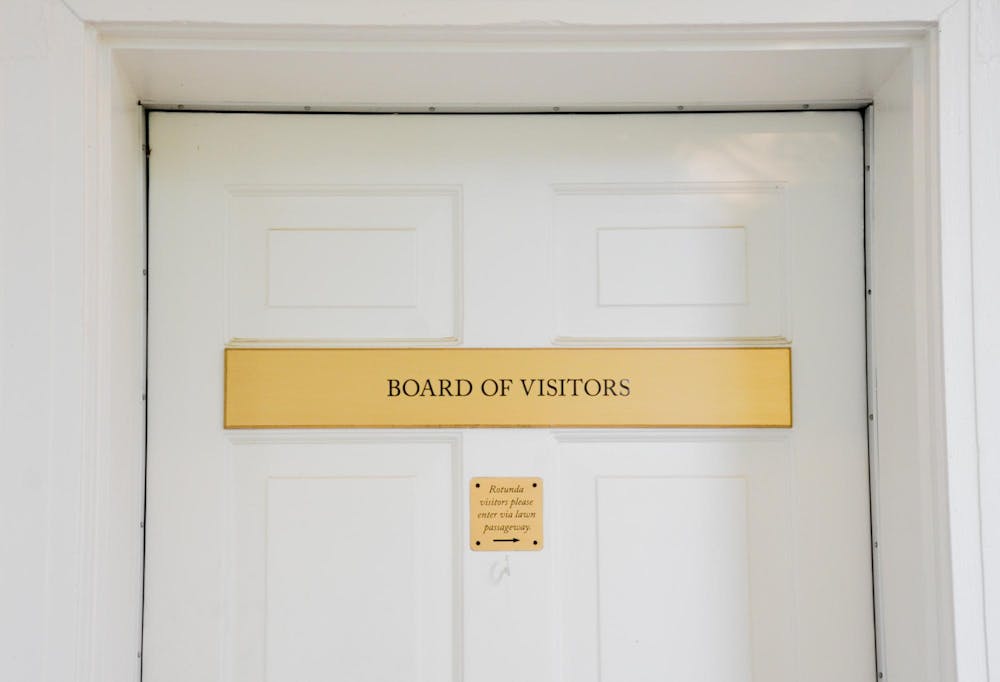
On June 6, the freshly confirmed Board of Visitors convened for a special meeting focused on the “accountability” of their leadership and strategic mission. Aimed at addressing accountability and aligned governance, the retreat-style meeting is notable in that its format departed radically from the ordinary course of business. Rather than a typical Board meeting in the Rotunda, closely watched by cameras and eager students, this meeting took place at a private resort at Morven Farm.
The Board undoubtedly enjoyed a calm and picturesque session in the hills of Albemarle County, but this comes with an institutional price. While many key student leaders were absent, the meeting involved several outside voices whose intentions are unclear. This signals an apparent unwillingness to engage with important stakeholders while amplifying voices that may not have student interests at the forefront.
One stakeholder group, however, included at least four McKinsey & Company consultants who acted as pro-bono facilitators in discussions of what role the Board should play in the future of University governance. McKinsey, which primarily specializes in business-oriented management consulting, appears to be a notably poor fit in advising higher education policy. The aim of a typical McKinsey client is to turn a profit, an aim that is fundamentally at odds with the purpose of our University. A simple journey to McKinsey’s website underscores the point. The website repeatedly emphasizes the firm’s financial expertise and ability to bring in more revenue — it makes no mention of how our University can restore sound governance and build a stable culture of trust.
While some private meetings under certain circumstances may have benefits, McKinsey’s involvement flips the script in a dangerous way. Last year, this Editorial Board warned about the dangers of increasing the corporatization of higher education, as the University has geared itself in recent years aggressively toward expansion and revenue. This appears to be more of the same. The consultants gave a presentation on values for higher education governance strategies, but coupled with the firm’s financial posture towards higher education and the absence of multiple leaders within the University’s shared governance system, it is unclear whether the presentation serves our University’s best interests. Management consulting firms are a shortsighted mismatch when it comes to education policy — they fundamentally misunderstand that the value of higher education extends beyond the balance sheet, feeding into further corporatization of our institution.
What is worse, McKinsey has a checkered history of blindly chasing profit seemingly at all costs, without regard for safety or public trust. Some of the firm’s more nefarious horror stories are comically depraved. In 2024, McKinsey entered into a $650 million settlement with the Department of Justice for the firm’s involvement in the Purdue Pharma scandal. Federal investigations concluded that McKinsey was instrumental in “turbocharg[ing]” the sale of a drug that was well known to be highly addictive and dangerous. In 1997, the firm even went as far as to recommend that Disney cut back safety inspections on its rides in order to save money, culminating in the death of a passenger. This is McKinsey’s model — it lasers in heavily on the bottom line at the expense of virtually everything else. Does the Board believe that this corporate strategy is the appropriate model for the University? All told, McKinsey’s presence should concern the University community about the direction the University will take as it navigates a tumultuous and polarized environment.
While McKinsey presumably made its voice heard with respect to the future of the University, student leaders and other important members of our community could not. Noticeably absent from the meeting was Student Council President Michael Mitchell and the chairs of both the Honor Committee and the University Judiciary Committee, among other major student and faculty leaders. For a Board selected largely on the promise of transparency and fidelity to students’ voices, this omission is disheartening. While some students — such as fourth-year College student Jackson Sleadd, who currently serves as the student representative on the Board — were in attendance, it is nonetheless unfortunate that many of the students charged with making decisions about the future of student self-governance in a perilous moment appear to not be properly consulted. This upcoming year will be another pivotal moment for student self-governance at our University — it is high time that the Board recognizes this and works more diligently to include student voices in its decision making.
This meeting could have signaled to students and other stakeholders that openness, transparency and community involvement are among the Board’s top priorities. Instead, an ethically questionable management consulting firm made its voice heard while the broader University community was left unable to voice their concerns directly to the Board. It may well be that the Board’s meeting was productive and will yield tangible results for the University in the next few months. Unfortunately, due to its closed setting, it is nearly impossible to make that judgment call now. Regardless, all decisions that the Board makes — even the seemingly inconsequential ones — send a clear message about the direction of the University. With this in mind, the Board should keep meetings open to the public, involve students and faculty regularly and give students the stability and confidence that their Board is standing up for them.
The Cavalier Daily Editorial Board is composed of the Executive Editor, the Editor-in-Chief, the two Opinion Editors, two Senior Associates and an Opinion Columnist. The board can be reached at eb@cavalierdaily.com.
Read More

U.Va. MEDICAL STUDENTS: Why e-bikes and e-scooters need real rules
By U.Va. Medical Students | 18 hours agoAs medical students who will soon be treating the consequences of these injuries firsthand, we believe e-bike and e-scooter safety is a public health issue the University and the Commonwealth can no longer afford to overlook.

OPINIONS: What to watch for this November election in Virginia
By Wylie Brunman , Scarlett Sullivan , Michael King and Joshua Hawkins | YesterdayFour opinion columnists write on upcoming ballot measures and key races for Virginia’s Nov. 3 general election.

YOUNIS: The false promise of neutrality at U.Va.
By Ayat Younis | 3 days agoAcademic excellence and diversity have never been competing ideals.