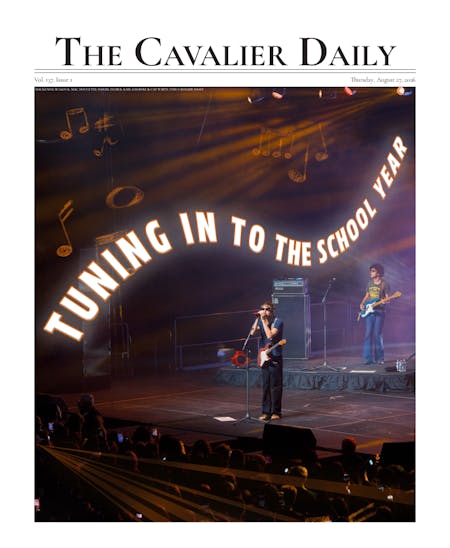
Over a billion young adults and teenagers face a neglected challenge unique to our era. In a time where music, advertisements and loud noises constantly bombard our lives, we are perhaps the first generations to grow up without an undervalued and disappearing commodity — silence. The American college experience can be found at the heart of this cultural issue. Between blaring speakers at fraternity parties and blasting hype music at the gym, there is little respite for our ears. Even looking around Shannon Library while studying or the McCormick Road bridge on the way to class, the waves of AirPods and Beats headphones demonstrate the pervasiveness of the assault on our hearing. But to save the precious gift of hearing for adolescents, it is imperative that this problem begins to be treated with the gravity it deserves by parents, legislators, technology companies and, most importantly, young adults themselves. Although this remains a multifaceted dilemma, there are indeed concrete steps, both personal and societal, that can be taken to protect the essential sense of hearing.
It is important to contextualize the reach and severity of early-onset hearing loss. Global Burden of Disease data and National Library of Medicine reports demonstrate that close to 20 percent of worldwide teenagers or young adults are already presenting sensorineural hearing loss. Additionally, one in eight Americans over 12 years old have some kind of bilateral hearing loss. This type of problem has historically been concentrated among older individuals, but new generations growing up surrounded by headphones have hearing loss rates matching — and in some cases surpassing — those of their elders. For example, 17 percent of Generation Z face this issue compared to only 10 percent of Millennials.
And hearing loss is not simply a minor injury that can be repaired. The type of hearing loss that is afflicting waves of children, sensorineural hearing loss, is irreversible as overstimulated hair and nerve cells in the ear die off and do not grow back. Along with the obvious problem of making conversation exhausting, this kind of damage is associated with higher rates of tinnitus — a condition causing a constant, often maddening ringing in one’s ear — along with depression. Oblivious adolescents and young adults are unknowingly crippling their hearing for the rest of their lives due to unhealthy everyday habits.
Although there are a variety of contributing factors to this trend, a few key sources drive the hearing loss epidemic. Contrary to popular belief, most hearing loss results from prolonged exposure to sounds slightly above the safe level, rather than a single loud noise. Headphone usage seems to be the single biggest reason for such loss. Anything above 85 decibels results in damage, and almost every modern listening device easily reaches 100 to 110 decibels — volumes often hit by students attempting to drown out noise while studying or working out. In addition, the rise of online gaming has encouraged children to listen to louder sound effects longer, often with the added emphasis of headphones. Moreover, against natural intuition, ear damage scales exponentially rather than linearly as noise levels increase. This means for every three decibels above the safe limit, the amount of time required to deal permanent hearing damage halves.
Furthermore, another staple of younger generations, concerts and parties, are perhaps even more problematic. These events easily top over 110 decibels, which at that point causes irreversible harm in just a few minutes. In fact, there may be a larger cultural shift at the root of this issue — research indicates that music, movies and even restaurants have all gotten louder in recent decades. For our younger generations, there is nowhere to escape the constant onslaught of blaring sounds.
To tackle the myriad of factors producing youth hearing loss, a variety of solutions need to be implemented. For one, a more comprehensive framework of federal government regulations for maximum volumes on everything from consumer headphones to video games to concerts is a must. The Occupational Safety and Health Administration’s restrictions on workplace noise levels and Apple’s new warning notification on unsafe listening practices are promising, if not mild, places to start. Moreover, designated “quiet zones” in bars and clubs are emerging as a way to provide relief for strained ears, which is certainly a move in the right direction.
However, the largest impact is on the personal level. As crazy as it may sound, health organizations are now advising individuals to bring earplugs around with them, particularly if they plan on going to concerts or other loud venues. Turning down the volume, even just slightly, on headphones can also go a long way to maintain long-term ear health. In the end, until technology companies, government officials and various event planners recognize this mass epidemic of hearing loss and adjust, it will remain a personal responsibility to protect the gift of hearing.
Communication and music are some of the true blessings of our society. But until we are willing to fully comprehend the danger of this ignored problem afflicting hundreds of millions of teenagers and young adults, a whole generation might be deprived of their sense of sound.
Nat Taylor is an opinion columnist who writes about politics for The Cavalier Daily. He can be reached at opinion@cavalierdaily.com.
The opinions expressed in this column are not necessarily those of The Cavalier Daily. Columns represent the views of the author alone.
Read More

YOUNIS: The false promise of neutrality at U.Va.
By Ayat Younis | 2 hours agoAcademic excellence and diversity have never been competing ideals.

BOUCHARD: Hiring Oren Cass is a slap in the face to our institution
By Joseph Bouchard | YesterdayThis is all happening as the Trump administration is currently destroying democracy, the Constitution and the University itself.
KING: A University Board of Elections that cannot take a hint
By Michael King | 2 days agoThere is still time to avert its current course — extend the time limit for submitting post-election complaints, open hearings to the public and honor the JRB's avenue of review.