
When Laura Colombell walked out of Coach Fred Binggeli’s office at the end of her first year at Virginia in 1988, she knew that she was off the track team.
As head coach of track and field, Binggeli met with each student athlete at the end of the year to discuss their performance, but Colombell, now Laura Marshall, had not expected that this conversation might mean the end of her collegiate running career.
“I was thinking that there was going to be discussion about next year,” Marshall said. “And I think, in his mind, he assumed that I was no longer going to be on the team … he started off by thanking me for coming out and just talking about how ‘Division I sports isn't for everyone. It's a huge commitment.’”
Marshall had a great first year at Virginia in many ways, but her indoor and outdoor track seasons had been almost non-existent. She had injury after injury and had not gotten to compete whatsoever during both indoor and outdoor track.
Marshall came home defeated and unsure about what her second year at Virginia would look like, particularly since she knew she would be living in a house with a number of other female athletes.
However, Marshall, encouraged by the other women on the team, decided she was not ready to give up yet and concocted a plan to get back on the team. She asked her teammates to mail her their workout schedules and began training.
Marshall trained twice a day that summer in Northern Virginia while also balancing a full work day of waiting tables. She did not have a weight room, so instead she found workarounds, like push-ups or using the side of her car to do tricep dips. Once she had built up some endurance running, Marshall would then head to the indoor track at George Mason University or run around Burke Lake.
“What I learned that summer was that there's no benefit to junk miles,” Marshall said. “If you're going to go and run and put that stress on your body, you need to make sure that … there's a benefit training wise, from the time that you're running. And so I just started doing shorter runs, but at a faster pace, instead of just going out and running for an hour. And little by little, just, you know, started to feel really good.”
The tradition for track athletes, who came back in August a week before all the other non-athletes, was to kick off the season with a brutal two-mile time trial. Marshall, though not on the team, headed to Charlottesville with them.
Coach Binggeli was closing the gate to the track as Marshall bounded up, and he, not recognizing her, dismissed her, telling Marshall that the track was off-limits to the public. Marshall decided to get onto the track anyway, and Binggeli, sensing her determination, allowed her to run.
Marshall finished the time trial that day, beating the vast majority of the women’s team, and was back on the Virginia track team from there on out. She went on to become a strong contributor for the team, winning points and continuing to improve her times. This moment showed her the returns that came from taking a risk — a moment that would influence her professional career as well.
“The biggest lesson for me was just that some of the greatest successes — and this is a pattern that sort of continued in my professional life — are sort of born from failure,” Marshall said. “I don't think if I had suffered that somewhat dramatic setback my first year, I don't know that I would have achieved the same level of success that I had running at U.Va.”
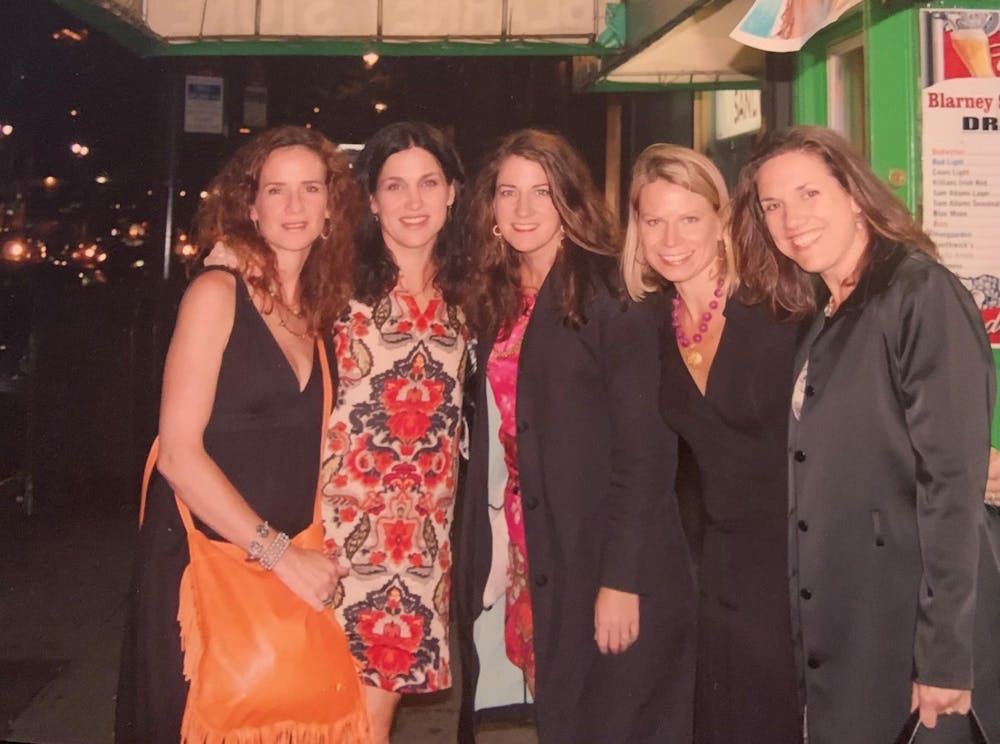
Marshall spoke highly of her time on the Virginia team, particularly noting the bonds she formed with her fellow teammates that have continued long past her time in Charlottesville.
“I remember a lot of bus rides,” Marshall said. “A lot of pranks, jokes, things like that. But the women that I lived with and ran with — this is a group of women that I still talk to. You know, we have a group text. We see each other once a year for a girls trip. It definitely formed lifelong bonds.”
Marshall and a few of her teammates lived on 14th Street, and so almost every morning they would have to get from there to University Hall — or U-Hall — the arena before John Paul Jones, to Coach Binggeli’s car to check in by 7 a.m.
“I just remember coming from 14th Street,” Marshall said. “Trying to go, as the crow flies, and [we were] hopping fences trying to get [there] … [because] we didn't have cars.”
The team was instrumental in building a sense of confidence within Marshall. She had coaches tell her they believed she could run a certain time, when even Marshall doubted that, but their belief in her allowed her to keep improving on the track.
At the end of her time at Virginia, Marshall applied to law school with hopes of becoming a federal prosecutor, a goal which she would later accomplish.
In law school at the University of Richmond, Marshall no longer had coaches telling her they believed she could take on the next challenge or break a personal record. Instead, she had to become that for herself.
“I wasn't super comfortable in terms of public speaking,” Marshall said. “I definitely had a heart for representing clients' interests and defending the Constitution, but when it came to going into court and putting on a case and speaking to a jury, that did not come naturally to me … [but] I didn't let that define me … And again, it's that track experience where I'm capable of doing whatever it is that I decide I'm capable of doing.”
Marshall went on to become an associate at McGuireWoods before joining the Army Reserve as a trial attorney. Following this, in 1998, Marshall became an AUSA, an Assistant United States Attorney, at the Department of Justice. Later, she also became a partner at Hunton Andrews Kearth and then McGuireWoods.
Throughout her career, Marshall frequently realized that, like with running, many of the limits she thought she was bound in were self-created. Marshall had to make the bet on herself to believe that she could do more.
“Confidence is a skill,” Marshall said. “It's a muscle … And so it's just strengthening that [and] that belief system that you have in yourself, and realizing that your perception of yourself is the only thing that matters.”
Marshall recently decided to start her own law practice. She had wanted to build something entirely her own and desired more flexibility, particularly after the death of her father in the fall of 2024.
Marshall knows that creating her own practice will be a new challenge, but she seems more than ready to take it on. The confidence she’s built since her days on the track team has allowed her to bet on herself.
“I just have to trust that process and believe that success will come,” Marshall said. “There's no guarantees … [but] when the time comes, I'm gonna have to put myself on the track again and see what happens.”
Read More

No. 9 field hockey strikes early, lands intense bounce-back win against No. 11 North Carolina
By Adair Reid | 3 hours agoWith defensive finesse and an electric offense that came out swinging and kept up the pressure, Virginia put North Carolina and the conference on notice, defeating the Tar Heels at Chapel Hill for the first time in 20 years.

Virginia fights to five sets, but Buckeyes complete the sweep
By Joby Jung | 4 hours agoOhio State (7-3, 0-0 Big Ten) waltzed into the Aquatic and Fitness Center and took two back-to-back wins against an injury-riddled Virginia (4-5, 0-0 ACC).

Late drama denies Virginia men’s soccer’s ferocious comeback against Wake Forest
By Mofeoluwa Akande | 14 hours agoAll four of Virginia’s losses have been the result of 80th minute or later breakthroughs by their opponents.


