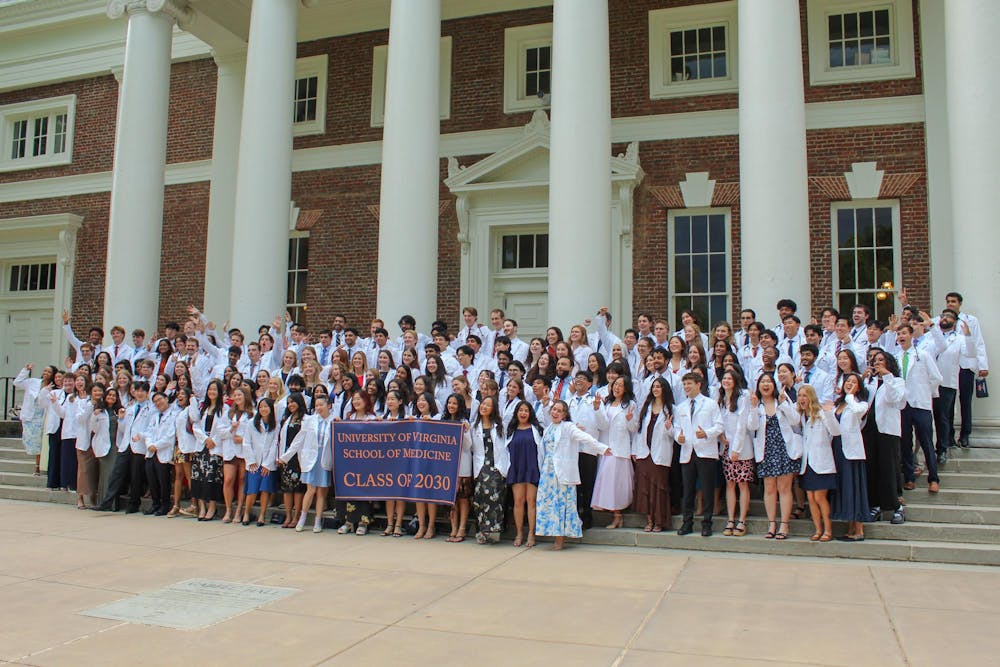
The School of Medicine’s Class of 2030 took part in the school’s annual White Coat Ceremony Friday. The ceremony is a longstanding tradition in medical schools across the country in which incoming first-year medical students receive their first white coat as they enter the medical profession, signifying their dedication to the profession and patient care.
Barry Collins, associate dean for alumni affairs at the School of Medicine and executive director for the Medical Alumni Association and Medical School Foundation, opened the ceremony by conveying the importance of the white coat as a symbol and discussing the history of the ceremony both at the University and across the country. This year’s White Coat Ceremony was held in Old Cabell Hall and is traditionally attended by students and their families.
Collins began his remarks by discussing Dr. Robley Dunglison, a physician from England, and the University’s first professor of medicine. Dunglison helped establish a classroom-based medical school curriculum, emphasizing scientific study rather than the apprenticeship model that instead focused exclusively on on-the-job training under the supervision of another physician.
Collins explained that the white coat first started being used in medicine in the late 19th century, as medicine underwent a dramatic transformation due to new scientific discoveries and a greater focus on public health. He said that the white coat was initially used by physicians as a symbol of scientific rigor and professional responsibility, but over time, it has started to become symbolic of the trust placed in physicians.
“Today, as you receive your white coat, you are accepting not only an honor, but also a responsibility," Collins said. “You are joining a profession built on compassion, integrity, humility and service. The journey ahead will challenge you. It will inspire you, and it will change you. And throughout that journey, the values represented by this coat will help guide you.”
Collin Derdeyn, interim dean of the School of Medicine, gave a series of remarks about the constant innovation that occurs in medicine. Derdeyn said that despite how frequently the field is disrupted by new treatments and technologies, medicine continues to remain a human endeavor.
According to Derdeyn, the core values of medicine — including the maintenance of privacy for those in your care and avoiding harm — date back nearly 2,500 years to the time of Hippocrates, and despite how much innovation there has been in medicine, those core values remain the same.
“We have this privilege of being present at some of the most powerful and vulnerable moments of people's lives — for birth, for hope, for loss, for death — and it's inspiring to see all of you here drawn to the same flame that we were," Derdeyn said. “We also have a unique legacy here at U.Va., and that was Jefferson's vision of this University — to educate and develop the leaders of this young nation.”
Derdeyn elaborated on Jefferson's vision for a medical education that extended beyond an apprenticeship style education and instead focused on the importance of students learning biology, physiology, latin and greek — a multidisciplinary approach to medical education that persists today.
Derdeyn also emphasized how rapidly medicine is advancing, citing breakthroughs in patient care within the past decade. He specifically mentioned advances in stroke treatments which have allowed physicians to treat previously fatal strokes, as well as T-cell and gene therapies that have expanded treatment options for diseases such as cancer. Derdeyn also highlighted artificial intelligence as a technology that will increasingly shape medical education and patient care, while emphasizing that medicine will remain fundamentally human-centered.
Medical Alumni Association President Keith Warren further discussed with the class the importance of the white coat and its symbolism in the medical profession and to patients. According to Warren, the length of the white coat has been historically linked to a person's position in healthcare, with medical students and residents wearing shorter, hip-length white coats, and senior fellows and attendings wearing longer, knee-length white coats. The length of a physician’s white coat is still tied to their educational level in most medical settings today.
Warren also shared that beyond signifying someone's position in healthcare or their educational status, the coat also serves to represent the core values of medicine.
“That coat represents professionalism, knowledge, ethics and compassion. Similar to the white flag of surrender, similar to the Red Cross on an ambulance, the white coat is a symbol that you are to protect those who are at their most vulnerable moments,” Warren said. “That's what that white coat is all about.”
The Class of 2030 also heard from Mulholland Society President Taylor Washington, who emphasized the transformative nature of medical school and the importance of building a community. The Mulholland Society is the student self-governance organization of the School of Medicine.
During her speech, Washington emphasized three things she wanted the Class of 2030 to remember throughout their time at the University — that they were selected for who they are, they are capable of succeeding in medical school and they must prioritize their own well-being in order to care for others.
“You were individually selected for your exemplary and individual accomplishments, talents and your experiences, but most importantly, for the person that you are,” Washington said. “The fact that you're here in this building today reflects the belief of the students and physicians [in your potential].”
Derdeyn closed his remarks by reminding students that medicine is all about human connection as its core.
“I ask each of you to remember that in the years to come, that seeing the person and patient in front of you and forming human connections is at the core of what we do,” Derdeyn said. “It has been for the past 2,500 years, and no matter what advances the future holds, it'll continue to be.”
Medical students will continue to wear these white coats during their medical education until they graduate in the spring of 2030.
Michael Racz is a staff writer on the news desk. He is a second-year student in the College majoring in Biology with plans to go to Medical School. Outside of The Cavalier Daily, Michael is a member of the Emergency Medicine Scribe Program and the Alpha Epsilon Pi fraternity. He enjoys writing about health topics and student self-governance.
Read More

U.Va.’s planned data center expands $30 million amid statewide debate over energy use
By Jaylynn Perez | 10 hours agoThe project has grown since it was initially approved by the Board of Visitors in June 2025 as a $72 million, two-story data center facility.
From the Archives: 1990s
By Tori Vonderheid and Livia Shrednick | YesterdayUniversity physician Dr. Joel Trugman discovered that some children who had been diagnosed with cerebral palsy, an incurable movement disorder, instead have a rare biochemical disorder that is treatable.

New Education Department letter urges university reforms — U.Va. professors weigh in
By Grace Little | 4 days agoThe letter called on all postsecondary institutions to issue statements of allegiance to its educational mission and address questions regarding fair admissions criteria, open discourse, intellectual pluralism and affordability.