
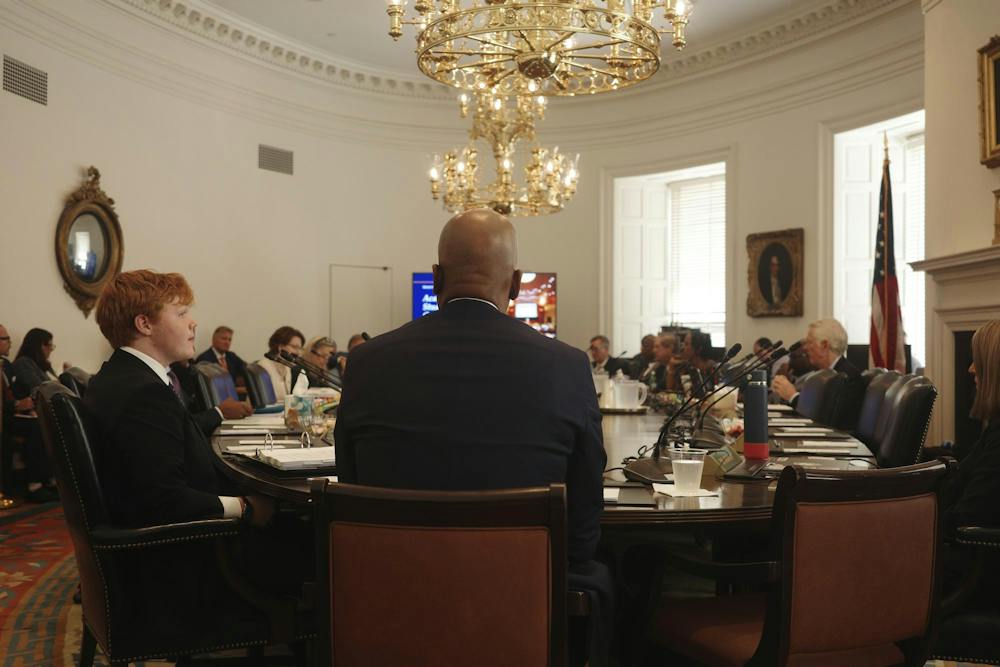
The University Board of Visitors’ Committee on Academic and Student Life met Thursday to discuss the current status of academic and student life at the University. The meeting featured presentations from Kenyon Bonner, vice president and chief student affairs officer, along with three students who shared their experiences at the University.
Bonner opened the meeting by describing student self-governance as a “deliberate educational philosophy.” In his view, University student self-governance drives wellness, community and citizen leadership. He then outlined the relationship between student self-governance and Student Affairs, presenting the different organizational structures of student involvement.
“We're guided by our mission — to help students build community, pursue wellness and grow as citizen leaders,” Bonner said. “We work in partnership with students and colleagues across academic and non-academic units, and aspire to support a holistic student experience, where students do more than survive — they thrive, and they flourish.”
Bonner also highlighted the Cavalier Fund, which was established in 2022 through support from the University’s alumni and friends with the purpose of ensuring that all undergraduate students have the same access to educational experiences while at the University, regardless of financial need. Bonner shared that the Cavalier Fund has provided over 700 students with grants to participate in various Contracted Independent Organizations and student organizations across the University.
The Committee also heard from three students who presented their personal experiences of student self-governance at the University. Third-year College student Katie Frick discussed her experience as vice chair of outreach for University Programs Council.
“I think that [defining student self-governance] is a pretty much impossible task because it's not one thing, one person, one place,” Frick said. “It's really a way of living and a way of embracing the U.Va. experience.”
Frick also spoke on her experience as a Summer Orientation Leader, and how she was tasked with presenting an “I am U.Va. speech” — a speech multiple OLs give to the incoming class each summer to share their University story. She said she emphasized to the incoming first-years that the University will challenge them, but by embracing student-self governance, it brings a renewed individual sense of purpose.
“I told [incoming students] that they belong here and we want them here,” Frick said. “They should just do the things they love because that's what student self-governance gives you the power to do.”
Next to present was fourth-year Data Science student Rebecca Vanni. Vanni talked about being a part of the inaugural class for the B.S. in Data Science and navigating the formation of the Undergraduate Data Science Council. Vanni shared how she and her classmates deliberated and worked together to create a functional undergraduate council, emphasizing the importance of diligent leadership and partnership.
“Just through being … a student leader, I realized how important it is to have good mentors and people around you,” Vanni said.
Vanni also spoke to the Committee about how her involvement at the University has made her a more capable and confident student, explaining how the University's culture of student self-governance gives students the capacity to make a change and creates a culture of being a “doer.”
Followed by Vanni was fourth-year College student Ashwin Durvasula. Durvasula highlighted his experience as president of Food Assist @ U.Va. and as the student co-chair of the Board of Directors at Madison House. Durvasula explained his experience with student self-governance as a motivator to give back to the larger communities the University is a part of. Madison House, he explained, inspires students not just to volunteer but also to be leaders, connecting it to the unique relationship of student self-governance at the University.
“[Student self-governance] enables so many students every day … to be in rooms that they wouldn't have been in, be faced with problems that they wouldn't have seen and therefore gain lessons and experiences that they never would have gotten otherwise,” Durvasula said.
Following student presentations, the Committee heard from Brie Gertler, interim executive vice president and provost, who shared the new advising initiatives the University is undertaking to enhance the undergraduate advising experience. Gertler shared how starting in 2021, the University looked at surveys, data and experiences to optimize the advising experience. The advising report created at this time, Gertler explained, helped the University design a better experience for both the student and the advisor.
Following the advising report, the University implemented Stellic in 2024 — a new advising software — and launched an annual advising summit, monthly student support working group, professional development opportunities for advisors and new advising awards, according to Gertler.
Gertler also shared how the University's decentralized nature means that individual schools have their own autonomy with advising. In practice, she explained that this means the University focuses on providing resources, not necessarily exact plans.
“We are very decentralized, and we give individual schools a lot of authority about their curricula, their pedagogy and their academic advising. I think that that's the right thing to do because it respects the differences between schools,” Gertler said. “It also means that it's really hard to implement a central initiative.”
The meeting ended with a short presentation from Josipa Roksa, associate provost for undergraduate education. Roksa explained how the University is working to create more experiential learning opportunities for students, as student demand exceeds university supply of resources like undergraduate lab space and internship opportunities.
She said one way to solve this problem is to integrate more experiential learning in the classroom for all undergraduates. Roksa said experiential learning — in the form of internships, study abroad opportunities and work with faculty members — is critical to the University's mission of creating strong, capable students, and faculty began brainstorming programs over the summer and fall of 2026. This coming spring, she said the program infrastructure will be built and launched, and the programs will be integrated into the classroom next fall.
“U.Va.’s mission calls on us to develop responsible citizen leaders and professionals,” Roksa said. “But doing that in the 21st century requires building a range of skills and capacities — from critical thinking to problem solving, teamwork, cultural competence [and] leadership.”
The next meetings of the Academic and Student Life Committee will take place when the full Board meets Dec. 2-3.
Ruby Budetti is a staff writer on the news desk. She also works as a staffer for The Cavalier Daily social media team. She is a second-year student on the pre-Batten track and hopes to major in public policy and leadership.
Read More

Audit, Compliance and Risk Committee discusses risk management, internal auditing across University
By Charlotte Gabriel | 14 hours agoThe meeting commenced with opening remarks and a meeting overview by Owen Griffin, Committee chair, Commerce Class of 1994 and Darden Class of 1999 alumnus. The Committee also welcomed Steven Weber, new director of Health System Audits.

Finance Committee reviews UVIMCO investment performance, approves Darden housing rates
By Avantika Jadhav | 14 hours agoThe Committee also approved updates to the University’s six-year institutional plans and state funding requests and heard an audit report of the Strategic Investment Fund.

U.Va. Health System Board discusses leadership turnover, telehealth initiatives across the system
By Michael Racz | 14 hours agoThe Board of Visitors’ Health System Board met Thursday and discussed recent leadership changes across the Health System, presented a new set of strategic pillars and priorities and distributed information on the history and current status of U.Va. Health’s telemedicine offerings.


