
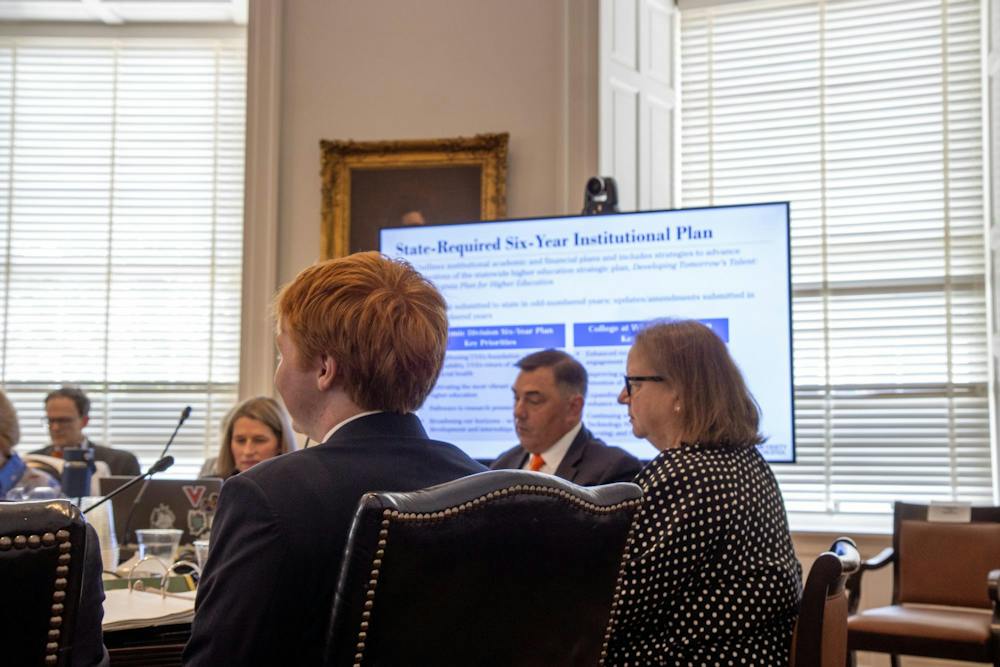
The Board of Visitors’ Finance Committee reviewed the University’s investment performance — including a 27 percent return for its $18.8 billion long-term pool — and approved rates for the Darden School of Business’ new graduate student housing during its Thursday meeting. The Committee also approved updates to the University’s six-year institutional plans and state funding requests and heard an audit report of the Strategic Investment Fund.
The University of Virginia Investment Management Company manages the University’s $18.8 billion long-term investment pool — which includes the University’s endowment and other long-term investments — according to the UVIMCO website.
Robert Durden, chief executive officer and chief investment officer of UVIMCO, emphasized the long-term pool’s particularly strong performance in 2026, reporting a return of 27 percent. The company estimates that the pool must generate approximately 7.5-8 percent in annual returns over periods of approximately 5 years to support University spending, while preserving the purchasing power of its endowment.
The pool ended fiscal year 2026 at $18.8 billion, up from approximately $15.5 billion at the beginning of the year. UVIMCO evaluates its investment portfolio performance against a policy benchmark of 9.8 percent across multiple years, according to Durden. Over the past 10 years, the pool has returned approximately 12 percent annually.
The Committee also approved rates for Darden graduate student housing — a new on-Grounds student housing community anticipated to open in fall 2027, and the University’s first housing project designed specifically for full-time MBA students. According to the meeting presentation, the two-building residential complex will be located on North Grounds, within walking distance of Darden, and will include 216 apartment-style units with a total of 338 beds.
Jennifer Wagner Davis, executive vice president and chief operating officer, also shared that the average proposed rate is approximately $1,534 per bed per month, excluding utilities, with individual rates varying based on unit size. Davis stated that the leases will initially run for 11 months, with the possibility of extensions for up to 23 months. More information regarding the proposed student housing rates are available in the meeting's presentation.
University President Scott Beardsley said the housing project will add a residential component to Darden’s student experience, pointing to similar models at Harvard University, Dartmouth College and Stanford University.
“This project has been a long time in the making … A missing part of Darden’s high-touch experience was the residential side,” Beardsley said.
The University is also part of the 4 percent of public universities that maintain an “AAA” rating across all three rating agencies, according to University Treasurer Julie Richardson. Debt ratings are grades issued by independent agencies including Moody’s, S&P and Fitch that tell lenders how likely an institution is to repay its debt. An “AAA” rating is the highest rating an institution can receive and signals to financial institutions that the University is at a low risk of default, allowing the University to receive financial benefits like lower interest rates from lenders.
Richardson attributed these ratings to the University's liquidity and revenue diversification. However, she noted that currently approved capital projects could require approximately $750 million in additional debt.
According to the meeting presentation, the University is also facing increased operating costs after the Commonwealth authorized a 3.5 percent pay increase for faculty and staff for the upcoming fiscal year, above the 2 percent increase that the University had initially budgeted for. This resulted in approximately $15 million in additional annual costs for the Academic Division.
Further, the Committee approved updates to the 2025 six-year institutional plans for the University’s Academic Division and the College at Wise. The plans emphasize student recruitment efforts and expanded access to financial aid, while also focusing on enhancing student and faculty retention, professional development programs and new graduate programs for the College at Wise.
According to the July update to the College at Wise’s six-year institutional plan, the College at Wise experienced record application numbers and increased enrollment and retention rates. The College at Wise also recently saw the launch of new academic programs in response to employer demand and student interest. The state requires the adoption of the final six-year institutional plan by Oct. 1.
The Committee also approved updates to operating and capital requests for the state biennial budget. The requests are presented to the governor for consideration in the Budget Proposal, which the General Assembly will then vote on in December.
Listed within the biennial budget’s funding list, the Committee requested $10.4 million for FY28 for the Virginia Military Survivors and Dependents Education Program, a program that provides tuition benefits to spouses and children of veterans and military service members.
The program has grown significantly, observing a 1,208 percent growth from 36 to 471 students between 2019 and 2026. VMSDEP is expected to cost the University approximately $16 million this upcoming fiscal year. The University currently receives about $5.4 million from the Commonwealth to offset those costs, despite requesting approximately $8.4 million for FY26.
According to Davis, the University seeks one-time state support of $15 million to support the growth and development of online, hybrid and in-person degree and certificate programs that support working adults and individuals undergoing career transitions across the Commonwealth.
The University is also seeking $5 million annually for “U.Va. Innovates,” an initiative intended to grow entrepreneurship and the commercialization of University research by connecting students, faculty, alumni and investors with resources to develop innovative technologies and expand successful new ventures.
Additionally, Davis said the Committee reaffirmed its commitment to affordable access, requesting approximately $7.2 million in funding from the Commonwealth to offset the revenue that would otherwise be generated by a potential 3 percent increase in in-state undergraduate tuition for the 2027-28 academic year. If approved, this funding would allow the University to limit the need for a tuition increase while still covering operating costs. Davis said the University is also requesting an additional $1 million in support from the Commonwealth for financial aid services.
As part of an expanded focus on cancer research, the University is also requesting $5 million in state funding to fund research initiatives at the University’s Comprehensive Cancer Center.
According to Davis, state funding to Wise would support enrollment and retention, limit tuition and fee increases and expand its graduate programs. Additional requests would support the College at Wise’s student technology program, which aims to equip every undergraduate student with an iPad, Apple Pencil and smart keyboard.
Major state capital funding requests for the Academic Division include approximately $9 million across FY27 and FY28 to restore maintenance reserve funding — funding the University sets aside in reserve for the maintenance of facilities — which had previously been reduced by the Commonwealth. Additionally, the Academic Division has put in funding requests for a new laboratory and academic building for the School of Engineering and Applied Science.
The College at Wise’s Master of Technology Management and Data Analytics program also received approval for its 2026-27 tuition and required fees. The tuition per credit hour was set at $398, amounting to a 30-credit degree completion cost — including additional fees — of $14,280 for the entire program. According to Donna Henry, chancellor of the University of Virginia’s College at Wise, three students have enrolled in the program for the Fall 2026 semester.
An audit of the University’s Strategic Investment Fund was another focus of the meeting. The fund serves as a monetary source for strategic initiatives at the University. Created in 2016, the SIF has made 91 publicly available awards totaling approximately $1.24 billion. The program has also used $540 million in matching funds to create 757 endowed funds, according to its website.
SIF-funded projects generally operate on three- to five-year timelines and are subject to annual reporting and performance measures according to Augie Maurelli, vice president for finance and chief financial officer. The audit did not identify any high-risk findings, but it found several areas where the oversight of SIF-funded projects could be improved. Maurelli said the audit recommended improving technology, automation and implementing additional administrative procedures to evaluate whether projects are meeting their goals.
According to the meeting presentation, of the funding already awarded to SIF projects, approximately $310 million remains allocated to ongoing projects but has not yet been spent. Board members questioned how much of this funding is still expected to be spent and whether any portion could ultimately be recovered. The review identified approximately $10.8 million in unused funding that the University was able to recover from programs that were placed into a research contingency fund to help offset uncertainty around federal research funding. The University currently has $84.3 million in SIF funding available for FY27 and FY28, according to the meeting presentation.
Board Rector Carlos Brown generally advised caution towards making additional commitments from the SIF fund until the University has a clearer picture of its future financial position.
“Before we start committing to the future, we need to make sure we can sustain what we did,” Brown said. “I am not inclined to encourage a number of interim commitments until we can estimate what we think the future will look like in those periods.”
The next meetings of the full Board will take place Dec. 2-4. According to Davis, the Committee will review proposals for additional SIF awards for FY27 and FY28 at that meeting.
Avantika Jadhav is a staff writer on the news desk for The Cavalier Daily. Originally from New Delhi, India, she is a second-year College student studying economics and global studies.
Read More

Audit, Compliance and Risk Committee discusses risk management, internal auditing across University
By Charlotte Gabriel | 34 minutes agoThe meeting commenced with opening remarks and a meeting overview by Owen Griffin, Committee chair, Commerce Class of 1994 and Darden Class of 1999 alumnus. The Committee also welcomed Steven Weber, new director of Health System Audits.

Academic and Student Life Committee hears presentation on student self-governance
By Ruby Budetti | 57 minutes agoThe meeting featured presentations from Kenyon Bonner, vice president and chief student affairs officer, along with three students who shared their experiences at the University.

U.Va. Health System Board discusses leadership turnover, telehealth initiatives across the system
By Michael Racz | 1 hours agoThe Board of Visitors’ Health System Board met Thursday and discussed recent leadership changes across the Health System, presented a new set of strategic pillars and priorities and distributed information on the history and current status of U.Va. Health’s telemedicine offerings.


