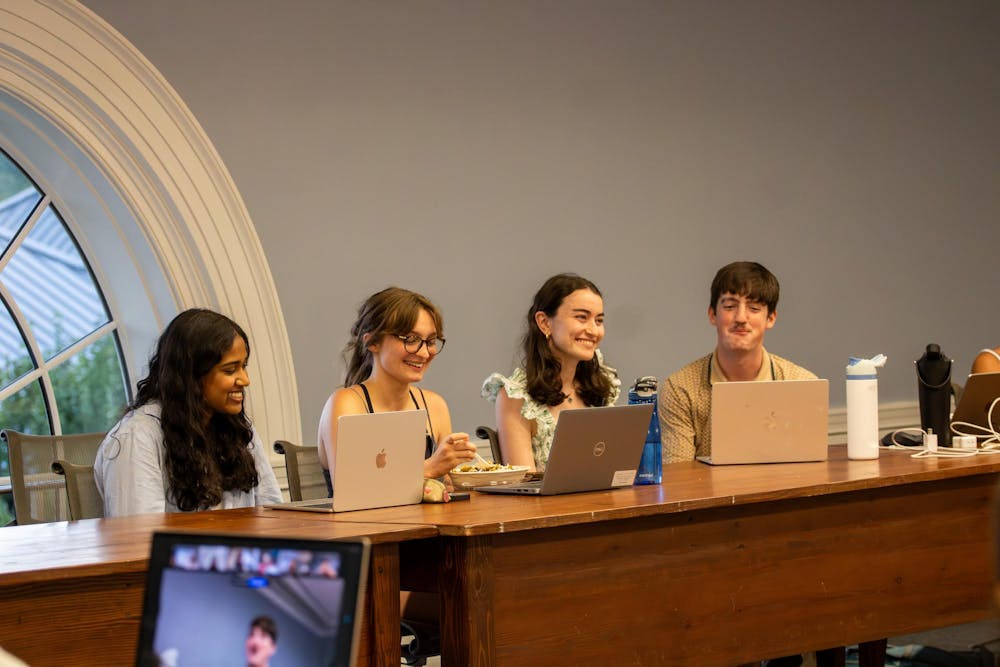
During their first meeting of the academic year, the Honor Committee introduced a new proposal to change the appeals process for students. The proposal includes the addition of a governing body that would oversee the appeals process and decide if a student's appeal is deemed legitimate.
The proposal was introduced by Walter Blessing, chair of the policies and procedures sub-committee and fourth-year College representative. The Policies and Procedures Sub-committee exists to examine the procedures and bylaws of the Committee and recommend changes when necessary. Blessing explained at the meeting how the current appeals process, as stated in the bylaws, exists to ensure that if the Committee fails to comply with their bylaws, the decision may get appealed by the student to the Committee.
“A lot of people have ended up submitting appeals [where] they just want to change their sanctions or they’re unhappy with the results of the case,” Walter said. “Rather than [a] legitimate appeal as it’s defined in our bylaws.”
According to Genny Freed, committee Chair and fourth-year College student, the current proposal has not been drafted into a bylaw amendment at this time — which would be the required next step for any change to be fully implemented.
According to the Committee’s bylaws, the purpose of an appeal is to allow a student to present their claims, if any, regarding the timeliness or fairness of the Honor proceedings that led to the student’s conviction, sanctioning or determination of non-compliance.
An appeal that is presented to the Committee will only be considered if it is submitted in writing to the Vice Chair for Hearings, the appeal contains the student’s name and their conviction/sanctioning and the appeal brief describes the grounds on which the appeal is filed. The appeal must also contain supporting documents that prove claims and support the students' reason for their appeal.
Blessing explained that such an amendment would also include the establishment of a preliminary governing body that oversees appeals and decides if they are legitimate in conjunction with the Committees bylaws.
According to Blessing, appeals currently sent through the Committee are usually sent to a full investigation, which includes interviews of witnesses, the reported student and investigated student. From there, it is sent to an Appeals Review Panel, composed of five members of the Committee not affiliated with the case to review formal requests for appeals after an honor hearing has occurred. Prior to an appeal being presented to an ARP, Blessing proposed the position of the Appeals Coordinator — a random Committee member chosen to work alongside the Chair to determine if the appeal is valid.
Blessing explained that the Appeals Coordinator and Committee chair would intervene before the appeal goes to an investigation. The Chair and Appeals Coordinator would vote together to either drop the appeal and continue with the case like normal or continue with an investigation if the appeal is upheld. According to Blessing, if the vote was split, the appeal would continue to be investigated.
With the new process, the Committee and the Appeals Coordinator, along with the Committee chair, would go through every claim made in an appeal brief and evaluate it against 11 criteria. The two would then decide to either drop or continue with an investigation that would be sent to an ARP.
The 11 criteria for dismissing an appeal include submitting an appeal before a panel for sanction has concluded, failing to submit the appeal in a timely manner as outlined in the Committee's bylaws, the Committee's inability to fulfill the appeal as requested, failure to state an appealable claim, lack of evidence of an infringement on a student's rights, lack of evidence of an infringement on a patient's rights, a prior waiver of the student's rights, attempting to appeal a requested procedure, insufficient new evidence, cumulative or repetitive evidence and lack of evidence that would change the sanction panel's decision.
Along with the proposal of the new appeals process, the Committee also discussed their outreach initiatives for their fall recruitment cycle. During the fall, the Selections and Recruitment Sub-committee holds events across Grounds to engage students from every school to join the Committee.
Cody Scarce, vice chair for the undergraduate community and fourth-year College student, shared that the Committee held their ice cream social on Observatory Hill Friday, where they gathered over 100 emails for students interested in joining the Committee. Along with their ice cream social, the Committee gathered emails from interested students at the Student Activities Fair.
Scarce also shared an ongoing project with the Committee, where they will have a basket of blankets outside of Lawn room 37 — the endowed room to the Honor Committee — for students to borrow and use while sitting on the Lawn.
Students interested in applying to join the Honor Committee for the academic year may submit an application for the support office pool until Sunday. The Committee is seeking applications from students of all years and schools across Grounds.
The next Committee meeting will be held Sunday in New Cabell Hall. Meetings are open to the public and if students are interested in joining virtually, a link may be requested by the Committee chair.

Isabela Delgado is a staff writer on the news desk who enjoys writing longer form pieces. Most of her work is focused on U.Va. Health and the Honor Committee, although she enjoys writing all types of articles for the paper. Outside of writing, Isabela is also a part of the Photo desk. Isabela is from New Jersey and currently plans to major in Government.
Read More
From the Archives: 2000s
By Peyton Franz and Alayjah Gillus | 16 hours agoCavalier Daily writer, John Adams, pranks students with a column stating that a newly installed “no TJ” policy will go into effect, preventing graduates from Thomas Jefferson High School for Science and Technology from attending the University and expelling all current students who graduated from TJHSST.

The School of Data Science announces first-of-its-kind Assured Enrollment program
By Ruby Budetti | 16 hours agoThe new Assured Enrollment Program allows first-year students interested in Data Science to secure a spot in the Bachelor of Science in Data Science major without having to participate in the traditional admissions that previous classes have undergone.

Summer construction — what’s changed on Grounds while students were away?
By Edward Christopher | YesterdayAs the student bustle on Grounds slowed in the summer months, the University made progress on construction projects.