
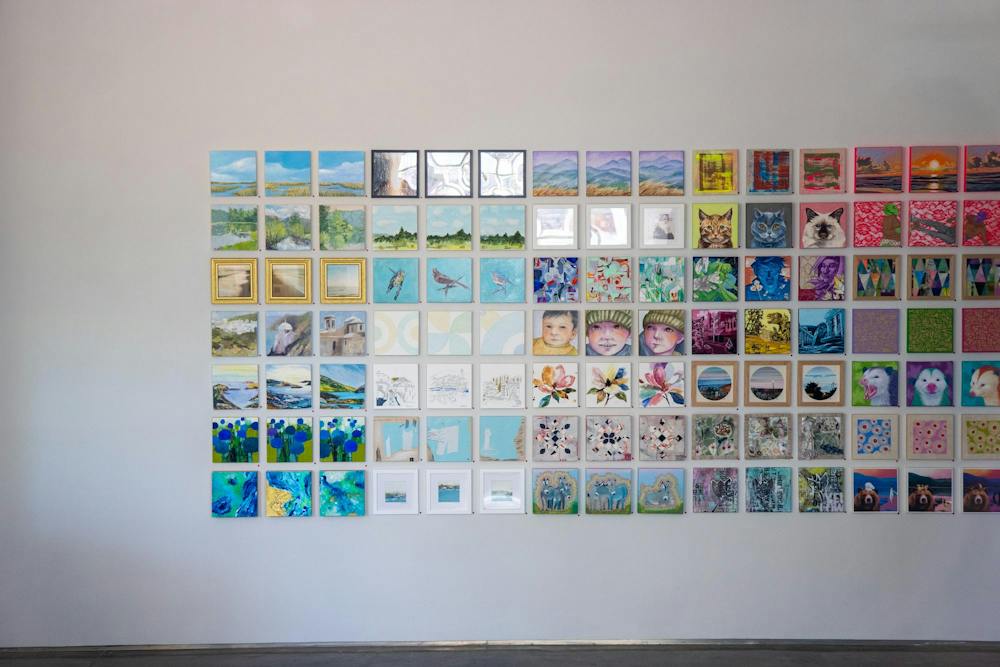
As fall settles on the University, outside observers might be deceived by the outwardly subtle, quiet nature of Charlottesville. The Second Street Gallery’s ongoing exhibit, “Teeny Tiny Trifecta 9,” challenges that notion by showcasing the wealth of creativity prominent in the local art scene. Featuring 609 artworks by 203 artists primarily based in Charlottesville and Central Virginia, the local contemporary art nonprofit’s exhibition offers an introduction to the diversity of thought and experience to be found in the City.
The exhibition, on display from Sept. 4 to Sept. 25, is now in its ninth annual iteration — introduced in 2017 by Kristen Chiacchia, Second Street Gallery’s chief curator. Chiacchia said she wanted to find a way to raise funds as a nonprofit without relying on the practice of auctioning expensive art every three years, as the New York City gallery she formerly worked at did.
“I felt that auctions only included a certain demographic of people. Only so many people could be in the room and be able to afford to purchase the work,” Chiacchia said. “I was like, ‘What could I do to not only include more artists in this fundraiser exhibition, but also make work accessible to a much larger group of people?’”
Chiacchia’s solution was simple and twofold. First, instead of pricing out all but the most seasoned collectors, every single piece at “Teeny Tina Trifecta” is up for sale at exactly $125. This affordability opens the hobby of purchasing gallery art — perhaps traditionally steered toward the wealthy — to a broader audience, even including college students. This wider appeal is central to the Second Street Gallery’s mission of “enliven[ing] Virginia through access to the best in contemporary art,” and is also significant for the gallery’s longevity.
Secondly, the exhibition’s “Trifecta” and sizing requirements lend an opportunity to a wider variety of local artists. The gallery requires artists to each submit three pieces of art, with the notable twist being that each of the trio must be exactly eight by eight inches in dimension. The works are then ordered in a sequential manner that keeps each artist’s work in its set of three within a larger rectangular arrangement. From afar, each wall at the gallery resembles a mosaic of evenly placed columns organized by common color palettes. Yet, far from imposing a sense of uniformity, the precision of the presentation makes the variety of artistic styles all the more noticeable.
Furthermore, the thematic elements of the show lend themselves to a dialogue between the work of different artists. Natural themes are especially prevalent in exhibiting artists' minds, with pieces ranging from clay sculptures of birds to a three-dimensional recreation of a sea floor. Throughout the exhibit, these similarities create pockets of association among the submissions of artists that otherwise have little in common stylistically.
A striking example is a set of three paintings of a white bird on a black background positioned close to another set of more surreal paintings of birds, as if to inspire a conversation on the different expressions drawn from a common inspiration. This exhibition’s earthy subjects lend it a calmer undertone that belies its connection with Charlottesville.
More than artists and onlookers simply sharing creative themes however, Chiacchia noted that the exhibition generates a certain communal excitement given the scale and interactivity of the showcase.
“I think part of it is just all the interactions with the artists, whether through seeing everyone getting really excited prior to the show on social media, or at the First Friday opening last year [where] we had over 700 people come,” Chiacchia said.
The communal energy of the exhibition was not felt by Chiacchia alone. Artist Liam Cavanaugh, a first time participant in “Teeny Tiny Trifecta,” noted the artistic connections the event helped foster.
“I think the importance here, at least for artists, is not only to learn about other artists who may be local, who are working in a way that the curator of the exhibition feels is similar enough to group them together, but also just community,” Cavanaugh said.
Anyone is able to submit work for consideration, meaning for many artists it is a first taste of a formal exhibition and can be a path to further opportunities. Notably, one participant is chosen to conduct a solo show at Second Street Gallery every year. Beyond its obvious impact on creating new relationships for artists, Chiacchia also opined that the lower stakes involved helps artists experiment and develop their style with the challenge of putting their expression within the dimensional constraints.
The assortment of styles and unique approaches to utilizing space found in the exhibition are proof of that exploration. A set of three clay-fired birds hung in circular frames sitting just a few meters away from three portraits of Charlottesville landmarks made of Lego pieces is just one example of this eclectic nature of the show.
Having been a part of the local art scene for nine years now, the exhibition’s growth from just 72 artists in its first edition to 203 now is a testament to the creativity bubbling beneath the surface in Charlottesville, as well as its importance as a safe haven for artists. According to Chiacchia, “Teeny Tiny Trifecta” has become a momentous event for Second Street Gallery each year, playing a role in financially supporting further artistic programming.
“This is our biggest show. It's the show with the biggest budget throughout the year,” Chiacchia said. “Some artists donate either part of their commission or the full commission to the gallery, and it really helps jumpstart our season so that we raise a bunch of money from this show and then we're able to do the other shows for the rest of the year.”
As creatives across disciplines grapple with the persisting challenge of gaining recognition and sharing a message, “Teeny Tiny Trifecta” stands as a beacon, and potential launchpad, for artists hidden in Charlottesville.
Read More

On Repeat: Songs to transport listeners back to the classroom
By Carly Smith | 12 hours agoEven though themes of love and loss are extremely present in pop culture today, over time artists have also been inspired by the classroom while writing their pieces.
Professor Emily Ogden peers into Edgar Allan Poe’s legacy in her upcoming book
By Carter Horner | 2 days agoIn addition to teaching poetry at the University, Ogden researches literature, and her Sept. 29 release will dive into Poe’s history — examining exactly how he changed lives with his writing.

Upcoming fall concerts in Charlottesville to add to the calendar
By Darya Bartol | 4 days agoWith a varied arrangement of artists, Charlottesville’s fall concert lineup boasts both large, iconic artists and smaller, promising indie acts.


