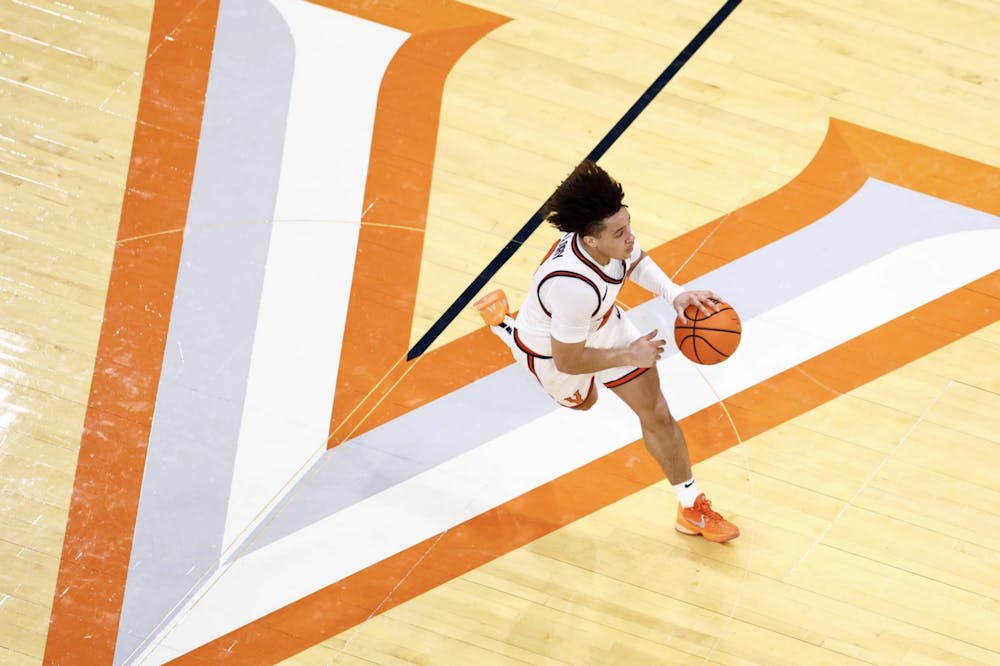
Every game of the Ryan Odom era so far has started with graduate point guard Dallin Hall on the court — and that, so far, has been the correct decision. Hall’s leadership, experience and poise are too important to forego for a roster this green. But the Cavaliers also have a freshman who isn’t interested in waiting politely in the background.
Coach Ryan Odom sat at the press podium after their win over Northwestern, nodding to freshman point guard Chance Mallory.
“He obviously could easily be a starter.”
Obviously.
Dubbed “The Prince” by his teammates, Mallory doesn’t move like a typical first-year guard at point. There is no extra half-second of doubt before a shot, no tentative probing that so often betrays freshmen in their first big games. He is the first to sub in and often the last point guard left on the court.
Hall came in Nov. 1 as the undisputed quarterback, with Mallory slated as more of a bonus off the bench. But seven games later, it’s clear that the freshman is something else entirely. Mallory is doing everything a starting guard does — except start.
For a program that once seemed perfectly content winning a rock fight scoring in the fifties, Odom now has the Cavaliers pressing full court, letting it rip from behind the arc and pushing towards first-half scores that used to be final ones for Virginia. This shift in style starts in the backcourt, where Odom has empowered his guards, the ones bringing the ball up the floor, to set the pace.
The dilemma is that his two point guards are almost perfect opposites. Hall is a veteran floor general who slows the game down. Mallory speeds things up. He picks up full court, attacks closeouts and forces opponents to play just a little bit faster than they’d like.
So, a month into Odom’s tenure, the debate over who should start at point guard is the wrong question to be asking. The answer isn’t Dallin Hall or Chance Mallory. It’s both — and Virginia’s first loss against Butler shows why.
The game against the Bulldogs diagnosed one of the team’s potential weaknesses that the low-majors were not strong enough to reveal — a need for aggression from the outset.
The Cavaliers were, in the words of graduate shooting guard Malik Thomas, “shocked” by Butler’s physicality. Thomas’s post-game comments painted a clear picture of a team that was reactive, not proactive against the Bulldogs. This hesitancy was an unusual sight for a team that is forming their identity around their toughness and physicality.
The very hesitancy Thomas described is a trait that simply does not exist in Mallory’s game. And to the end of faltering defense in the backcourt, the answer is also unequivocally Mallory.
Mallory is Virginia’s best perimeter defender — the “nail guy” in Odom’s scheme. He is an efficient perimeter shooter averaging 43.5 percent from behind the arc. And 25 minutes per game is not really a bench player’s load — especially when those minutes produce 11.3 points, 5.4 rebounds, 2.9 assists and 2.3 steals per game, the latter a mark that has him ranked fifth in the ACC.
These numbers further prove that Mallory’s role needs to transcend that of a spark-plug off the bench. As Odom has said, he provides a "massive lift" when the offense is already sputtering. But the Butler loss proves that, against high-major opponents, Virginia can’t afford to sputter in the first place.
This change — starting Mallory and Hall — would, of course, mean a tough decision for Odom in foregoing one of his current starters. But already, the two-guard look is quickly becoming one of Odom’s favored, and most effective, tools. When the two share the floor, their complementary styles often make this new Virginia team look like its best version.
Odom himself has all but endorsed it.
“Just the ball handling and passing,” Odom said. “They both can shoot. They're both point guards, and understand what to do out there … I do like that lineup. It's fast and we take care of the ball.”
Odom has also said that the two-point-guard look takes some pressure off of Hall, and Hall himself has said he is open to sliding between the one and the two.
“I actually really enjoy being able to get off the ball too, because it allows me to be a spacer and find easier opportunities to score,” Hall said at media day in early October. “I'm excited to share the backcourt with those guys, Chance even, a lot of big time players.”
The true tests of the backcourt will come as the schedule ramps up — a high-profile ACC-SEC Challenge against Texas Wednesday, high-majors in Dayton and Maryland, then the grind of conference play. Early season blowouts can hide a lot of rotation choices. Tight games against these sorts of teams do not.
Fortunately for Odom and Virginia, this problem of choice is a luxury to have. He doesn’t have to choose between Hall’s steady hand and the spark plug that is Mallory — he can, and should, have both.
Read More
Back home at JPJ, women’s basketball comfortably dismantles UMES
By Xander Tilock | 2 hours ago“I think our team is at our best when we’re confident, and I think that we just regained our confidence,” Coach Amaka Agugua-Hamilton said.
With ACC title hopes at stake, Maddox Marcellus and Virginia’s defense led the way
By Xander Tilock | 15 hours ago“[Marcellus’ performance] just shows the type of young men that we have in that locker room,” Elliott said.

In a bounce-back performance, Cavaliers dominate Bloomsburg in road shutout
By Joby Jung | 17 hours ago“Score first, get time and not get ridden,” Garland said. “They hit all those goals.”