What do blimps, Wheaties and Soulja Boy’s “Crank That (Soulja Boy)” have in common? They are all part of the deliberately unhinged marketing campaign behind A24’s upcoming “Marty Supreme.”
Released in select theaters this past weekend in advance of a nationwide opening Christmas Day, the film stars Timothée Chalamet as Marty Mauser, an up-and-coming ping-pong player in pursuit of greatness. In early October, the film premiered with a surprise screening at the New York Film Festival that took the audience by storm and kicked off a wave of discourse about the film that continues to dominate the media cycle.
“Marty Supreme” is A24’s most expensive film to date, and the studio — known for producing modern arthouse films and cult classics such as 2017’s “Lady Bird” and 2022’s “Everything, Everywhere, All At Once” — has leaned wholeheartedly into its marketing, going well beyond the traditional trailer drops and billboard advertising. What that means is embracing the Gen Z demographic, both of the film’s star and of its target audience.
Chalamet is already a public figure with a distinct propensity for virality, from his “Lil Timmy Tim” rap videos to his pink Glossier hoodie to, most recently, his role as an unofficial cheerleader for the New York Knicks during their 2025 playoff run. With that in mind, “Marty Supreme” is being promoted, not as a film starring Timothée Chalamet, but as Timothée Chalamet starring in a film — his star power and singular personality as the driving force behind its success.
The guerrilla media onslaught began in early October, when Chalamet debuted his newly bald head — shaved for his role in the upcoming “Dune: Part Three” — in a bizarre five-minute hype video, set in a field and surrounded by men sporting ping-pong balls as helmets. A few days later, the actor appeared in Times Square, flanked by the same ping-pong ball-headed posse, to debut the first 30 minutes of the film at the local Regal Cinema.
A24 dropped an 18-minute Zoom recording Nov. 17 in which Chalamet meets with the “Marty Supreme” marketing team and pitches them his vision for the film’s rollout. In a brilliantly-executed bit of meta comedy, Chalamet plays a narcissistic, egomaniac version of himself, somehow managing to keep a straight face — even while emphasizing every sentence with “schwap!” — as he pitches increasingly insane promotional tactics.
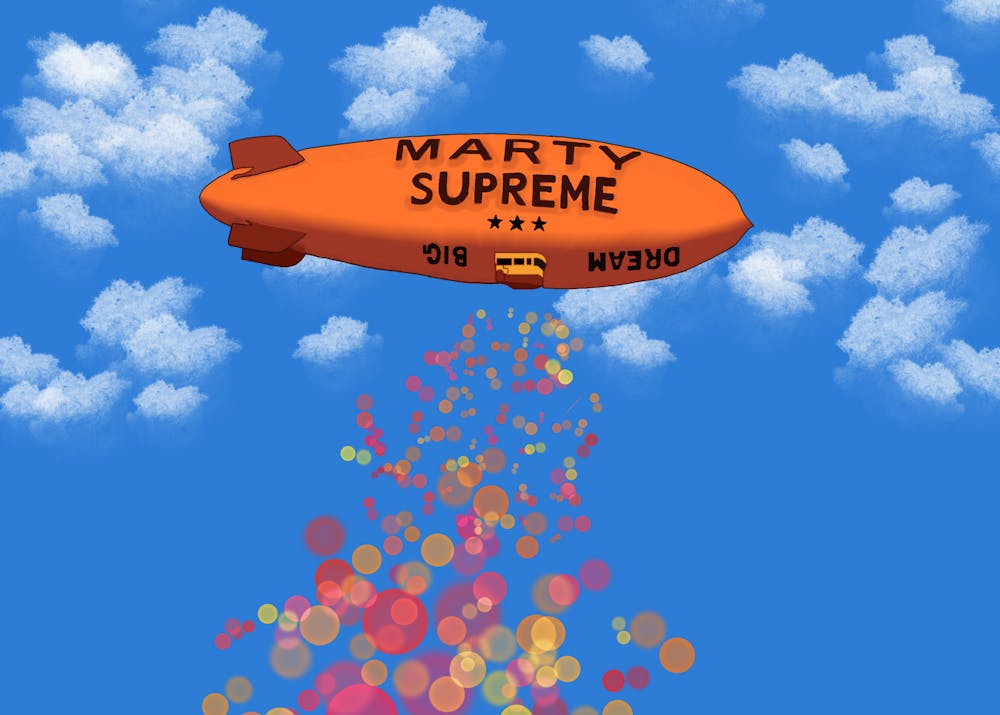
The entire production is satirical, self-aware and altogether spectacular, as the other participants on the Zoom are forced to indulge Chalamet throwing out ideas like painting the Statue of Liberty and Eiffel Tower orange or sending up a “Marty Supreme” blimp to rain down branded ping pong balls.
“If it’s the difference between someone losing an arm putting out the movie, but someone gaining an arm intellectually when they see it, I’m a fan of the latter,” Chalamet said, when warned of the safety risks such an event would cause.
Some other highlights include Chalamet’s proposal of printing his face on Wheaties boxes — which he believes would “inception” people to go see the film — and his concluding the meeting with a guided meditation, in which the marketing team is forced to partake while he sits and watches.
But the best part about the skit is that its ideas are legitimately, to quote Chalamet, “fruitionizing.” There are actually limited edition Wheaties boxes with Marty Mauser’s face on them, available for purchase on the A24 and Wheaties websites. There are actually orange “Marty Supreme” branded blimps flying over Los Angeles — though they unfortunately are not raining down ping pong balls.
A24’s limited edition “Marty Supreme” windbreaker, sported by celebrities like Kid Cudi and Kendall Jenner, drew lines around the block when offered at a pop up in SoHo one night in November. Many have argued that the jacket may be the defining sartorial relic of 2025 culture — just as the Loewe “I Told Ya” shirt of “Challengers” fame was for 2024.
Chalamet attended Brazil’s version of Comic Con Dec. 5, where, onstage with director Josh Safdie, he cranked that Soulja Boy and volleyed ping-pong balls into the audience. That same day, he was nominated for a Critics Choice Award — a major predictor for the Academy Awards — for his performance in “Marty Supreme.” Which feat is more impressive is debatable, but the takeaway is the same, that Chalamet’s impact is undeniable.
Certainly the actor’s aspirations for greatness have been a topic of conversation since his bold and unapologetic speech at the 2025 SAG Awards. Accepting the best leading actor trophy for his performance as Bob Dylan in “A Complete Unknown,” he acknowledged industry legends such as Viola Davis and Daniel Day-Lewis as some of his sources of inspiration.
“I know we’re in a subjective business, but the truth is, I’m really in pursuit of greatness,” Chalamet said.
More broadly, though, Chalamet’s place at the helm of the “Marty Supreme” marketing madness speaks to a broader cultural shift, a world where people are almost more important than product. Now more than ever, culture functions within a creator economy — look at Rhode, or SKIMS, or any of the myriad other celebrity brands that have skyrocketed to the spotlight in the past half decade.
Society is not unoriginal so much as overwhelmed. Faced with an endless onslaught of content, audiences increasingly look for guidance on what pursuits are worthwhile — and few guides are more compelling than those already in the spotlight, already culturally vetted. In the modern era, the floor is higher for what is out there, meaning that talent becomes the true driver of a brand’s competitive edge.
True, not many people could pull this spectacle off to the extent that Chalamet has. But that is also why it works. Authenticity is a rare thing in 2025, and certainly no one would expect it from the skinny French theater kid from Hell’s Kitchen with the accent aigu on his name. Certainly no one would expect him to strap himself to the top of the Las Vegas Sphere and proclaim that “‘Marty Supreme’ is an American film that comes out Christmas Day, 2025!” as he hoots and hollers and caws like a bird. Maybe he really is the Kwisatz Haderach.
Or maybe “Marty Supreme” is not the exception. Maybe it shouldn’t have to be. Maybe, rather than an anomaly, the film’s marketing is a blueprint — an instruction manual for how to be original at a time when almost nothing is. After all, even though it remains to be seen whether the box office numbers will match the engagement ones, in many ways, “Marty Supreme” has already won.
Read More

beabadoobee shines on her electrifying album ‘Pylon’
By Kelsey McIntyre | 0 minutes agoEven though beabadoobee began writing rock music as a teenager, this is certainly her most adventurous project in terms of genre.

Lizzy McAlpine soars to new heights on ‘Angel’
By Alena Touve | 1 hours agoLizzy McAlpine’s “Angel” is a triumph of sonic experimentation and lyrical ability, channeling both folk and musical theater into one harmonious product.

Girls in pearls, guys in … jerseys
By Zoe McFarland | 20 hours agoAs University tradition continues to coexist with changing trends and tastes, game day fashion will likely continue to resist simple characterization.