Since the Violet Crown’s opening in 2015, the theater was shown to have a different mission than the other commercial theaters in Charlottesville. While the Violet Crown’s program included some of the requisite studio blockbusters shown at Alamo Drafthouse and Regal Stonefield, it also screened independent, arthouse and international films — films which are not often screened at larger cinemas.
This commitment to a more unique catalogue gave the Violet Crown what seemed like a stable niche in the city of Charlottesville. That is, until threats of demolition came crashing down in the fall of 2024.
Heirloom Development, led by Charlottesville resident Jeffrey Levien, proposed a sale of the Violet Crown’s real estate, which would allow the building to be razed and turned into a housing complex. In November 2024, Violet Crown management stated publicly that they had no plans to close, but in February 2025, the building’s demolition was approved by the city. And while Levien eventually walked away from the demolition contract in May 2025, there were still questions as to whether the parent company of the Violet Crown, Es Vedra Cinemas, would be able to extend their lease with the current real estate owner, Violet Crown Cinemas, LLC.
As a result, the fate of the Violet Crown remained a mystery — until three local women appeared from behind the scenes.
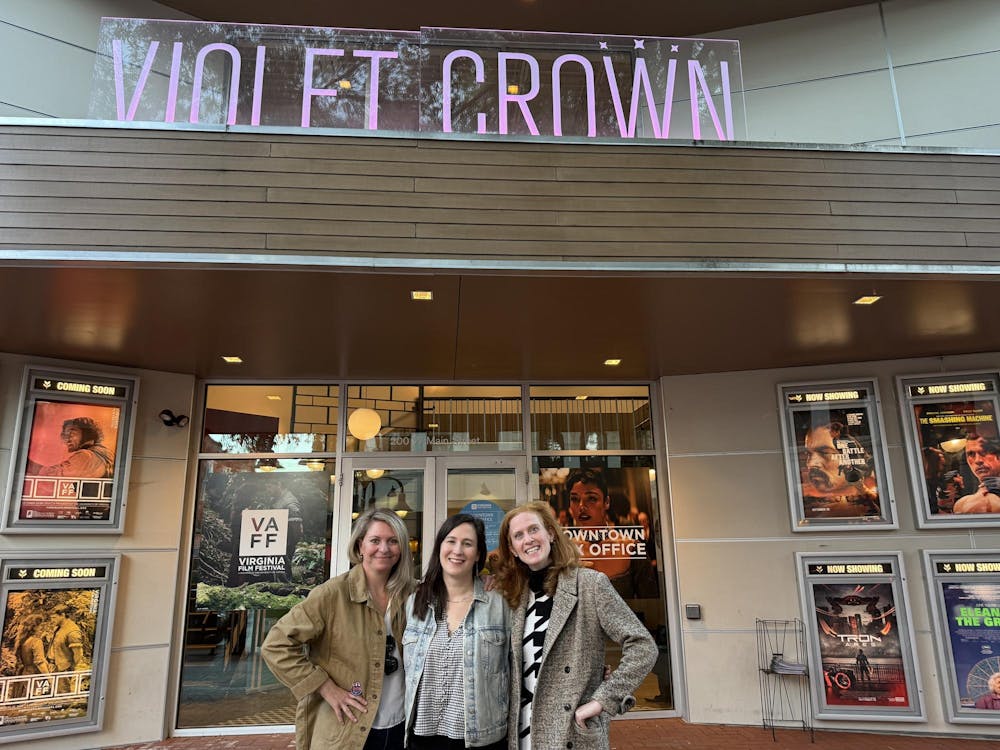
Rachel Baker, co-author of the Spread newsletter and freelance magazine editor, Annie Galvin, audio producer for the New York Times, and Lindsay Meck, executive producer of content and experiences at IEEE, facilitated the sale of the land containing the Violet Crown to an LLC. Because of this, its operations as a theater will continue for the foreseeable future.
Their actions may have come as a surprise to the general public, but actually the trio had been thinking about how they could help the Violet Crown since the first report of its possible demise.
“Rachel and I … had been discussing the potential demolition for a long time, contemplating what we’d lose if the downtown theater ceased to exist,” Galvin said in a written statement to the Cavalier Daily. “So we started almost jokingly talking about saving it.”
All three women had long histories with the Violet Crown, from seeing films while on maternity leave to attending events as part of the Virginia Film Festival. In addition, Meck had already witnessed the devastating effects of losing a central artistic space.
“Something similar happened in my hometown … when our much loved independent movie theater shuttered," Meck said in a written statement to the Cavalier Daily. “The closure was really a blow to supporting businesses nearby … Moreover, it killed an affordable and accessible entertainment option for teens, families and adults locally. I didn’t want that to happen here.”
Brought together by their love of the movie theater, Baker, Galvin and Meck formed a kind of cinema-loving "triumvirate." They began conducting research into the land beneath the theater, speaking to local representatives in a variety of industries to understand if a cinema was truly the best use of the plot. And though Galvin recognized that the city does need additional housing, she said it became clear during the research process that there were other locations for new developments which would not jeopardize a space they considered so culturally important.
Their outreach expanded to include cinemas across the country, as they found there were many instances of locals fighting to save their resident independent theater. Galvin cited Boston’s West Newton Cinema, Des Moines, Iowa’s Varsity Cinema and New York City’s Metro Theater, to name a few.
“This is a very common story: a small-ish movie theater goes up for sale, and community members band together to save it … Every model is different, but those conversations reminded me that in-person movie-going is an experience cherished by many people across America,” Galvin said.
Luckily, Galvin, Baker and Meck were able to follow in those locals’ footsteps. They organized the sale of 200 West Main Street to a limited liability company called Lissadell, which is publicly managed by Galvin herself. Because the women had also negotiated an extended lease of the physical building by Es Vedra Cinemas, the sale of land was the last step in ensuring the theater’s operational future.
Cameron Polson, the Violet Crown’s general manager and programmer, was relieved to hear the Violet Crown was officially safe.
“We were thrilled. And not just for our jobs, but … because Charlottesville can have this independent arthouse theater experience,” Polson said. “And that Charlottesville just has people in it who care enough to involve themselves in the community to that point.”
Not only would the loss of the Violet Crown have negatively impacted the Charlottesville arts community, it would have also been missed by ordinary Charlottesville citizens. Chuki Druknya, Charlottesville native and sophomore American University student, was saddened by the possible demolition, as the Violet Crown has been her theater of choice for nearly 10 years.
Druknya cited the specific business models at Regal Stonefield and Alamo Drafthouse, noting how she felt they were not always conducive to the best movie-watching experience. The Alamo Drafthouse is centered around serving meals during screenings, while the Regal Cinema features arcade games and traditional concessions. In contrast, Druknya felt the Violet Crown’s subdued decor and simplistic design created the perfect conditions for immersing oneself in a film, without any external distractions.
By offering not only a more curated experience, but a more specific program, the Violet Crown’s commitment to the independent niche could be seen as a financial liability. However, Druknya maintained its importance.
“The indie scene [in Charlottesville] is already really small, and then to dedicate thousands of dollars into something that’s really small — it’s a risk,” Druknya said. “But when you do have it there, it is really appreciated, even if it’s from a small group of people.”
It is not a lack of interest in its program that places cinemas like the Violet Crown in developmental jeopardy. Galvin herself told stories of going to unassuming screenings only to find a full house. Rather, it is the financial expectations of film and the theatrical model which can invite questions as to whether small cinemas like the Violet Crown are the best use of local real estate.
Often, independent films like those shown at the Violet Crown operate on lower production and distribution budgets than studio blockbusters, making it difficult for them to appear in theaters or turn a large profit when they are given program space. But Polson’s Violet Crown believes that money should not dictate a film’s success or outreach.
“We always want to have an art film in our roster, or an independent film or a documentary, and those aren’t always the movies that make the most money,” Polson said. “It’s important that these smaller films, and quite often socially important films, can get shown on a big screen to wider audiences, the way they were meant to be seen.”
Polson also noted the effect that streaming platforms have had on the theatrical model and the film industry as a whole, as streaming’s popularity has put movie theaters at financial risk. While that evolution will never be reversed, Galvin and her associates do not believe that physical cinema should fade away as a result.
“I believe there’s something really unique about seeing a movie in a dark theater with other people … I just wouldn’t have had that communal experience while streaming the film at home,” Galvin said.
Galvin, Baker and Meck’s personal love of film has ultimately let the Violet Crown stay standing. Similar breakthroughs have been made around Charlottesville in recent years, such as local artist Morgan Ashcom’s conversion of the industrial Data Visible warehouse into the artistic coworking space of Visible Records. Meck spoke to the importance of these singular actions.
“I think we all wish we could have a little more impact and make the world a little bit better,” Meck said. “For me, it starts by getting involved in my own backyard. I have learned so much through this adventure, and feel very optimistic about this city. Hopefully, that optimism can inspire others.”
Read More

The Virginia Dance Company trades competition for community
By Eloise Diffley | 9 hours agoThe Virginia Dance Company is composed of a tight-knit group of dancers, most of whom have danced competitively and consistently throughout childhood and high school.

U.Va. experts warn against emerging substances kratom, cychlorphine
By Michael Racz | 9 hours agoIn the wake of recent deaths at the University of Mississippi, as well as suspicions surrounding the presence of the potent synthetic opioid cychlorphine in the drug supply, University officials, medical leaders and student organizations across the country have begun urging students to exercise increased caution around controlled substances.

An overview of available resources for victims of sexual assault at U.Va.
By Luca Bailey | YesterdayAccording to research from the American Association of Universities, more than one in 10 college students are victims of sexual assault at some point when attending their university.