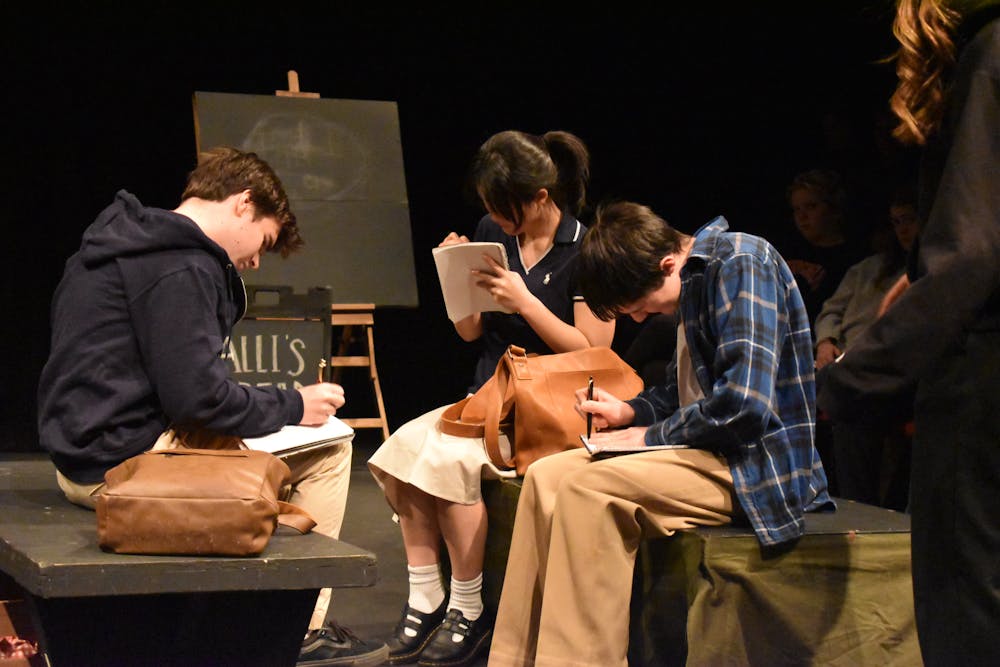
This Wednesday, DRAM 3652 “Producing Theatre” put on their semester-long culminating performance of “Where Words Once Were.” Free to all, the play was performed in the Helms Theatre. With audience members seated on three sides of the stage — a configuration known as black box theatre — and a stripped down set, viewers were able to immerse themselves within the dystopian universe.
This pioneering class aims to help young drama students produce their own play. Prior to the performance, Assoc. Prof. Caitlin McLeod stepped in front of the audience to explain that the students were given freedom to choose what play they wanted to perform and how. From the set design to the costuming to even directing, the students were able to have creative control.
Originally written in 2016 by Finegan Kruckemeyer, “Where Words Once Were” is set in a dystopian world where vocabulary is limited to a list of 1000 words and the rules strictly enforced. Orhan, the main character played by third-year College student Jack Wolff, defies these rules in search of new words. He forms a friendship with Angela, played by second-year College student Gabby Everett, one of the citizens who has been silenced due to breaking the rules of word usage. As the play progresses, Orhan pushes the boundaries of words, culminating in a societal disruption.
While the play was produced by students of the drama class, non-students were encouraged to try out as well. Everett, who was one of those non-enrolled members, said that she was aware that every choice was made by the class.
“There were four people working on the directing team,” Everett said. “We would work through small details and four people could have a conversation with you about that.”
The set design was simple, featuring a table that transformed into school benches and three chalk boards used to articulate words that were not allowed. Audience members nearly surrounded the performers, with the front row of seating being level with the stage itself. Third-year College student Isabella Fazio was in the audience Wednesday and explained that this set up allowed her to feel more connected with the performers.
“Rather than seeing everything that could happen, I thought it was cool the way I had to move my head and move with the actors as they were experiencing the plot or experiencing their own emotions and their own journey,” Fazio said.
As the play progressed, actors would occasionally interact with the crowd. In one scene, upon discovering that a pen — which has been banned in the city to curb writing forbidden words — has not been returned to the school, the head teacher begins searching through audience members.
Laughter was infectious when Orhan’s best friend and town jokestor, Kieran, was on stage, and gasps filled the crowd as Isaac, a stern guard who enforces the rules of the town dances around his crush on Orhan’s mother, Alli. Everett explained that this is one of her favorite aspects of black box theater.
“You really feel everyone’s breath, and that’s one of the reasons that I love live theater so much is that everyone is a part of the show,” Everett said. “The audience is such a big character in the show.”
More than just the intimate experience, the play’s message of taking back words was especially poignant. A large portion of the play consisted of spoken monologues by Angela that slowly got shorter until they fully ceased as Angela lost more words. Arianna Lawton, audience member and third-year Education student, was inspired by both the small room and the play’s message of restricted speech.
“There’s just a way deeper message, and that really came across to me,” Lawton said. “It was just so fun, such a small room and so many people that I think can be empowered by that.”
Afterwards the audience was invited to partake in light refreshments as they talked with audience and cast members about the performance. The dedication from each student was palpable as they eagerly discussed their involvement. Everett noted that the creative freedom that came with students taking the reigns on the play was especially motivating.
“It’s very special that this was an entirely student-run production … they did everything,” Everett said. “And just getting to be surrounded by those people and every rehearsal, being driven to do the things that we want to do because of our own wants and desires instead of someone telling us to is really cool.”
Read More
‘Tony’ sincerely builds an unlikable Anthony Bourdain worth rooting for
By Cecilia Sherman | Yesterday“Tony” is a tasteful standout that gracefully foreshadows Bourdain’s complicated life of adventure and discovery.

On Repeat: Nostalgic songs to celebrate the waning of summer
By Kelsey McIntyre | 5 days agoWith less than a month until students return to Grounds, this soundtrack can be used to rest and relax before the stressful semester by reminiscing on familiar times.
Virginia Theatre Festival unites Charlottesville and Broadway talent
By Carter Horner | August 8, 2026The Virginia Theatre Festival began in 1974 as a University semi-professional drama program and recently returned to Charlottesville for its 52nd iteration.