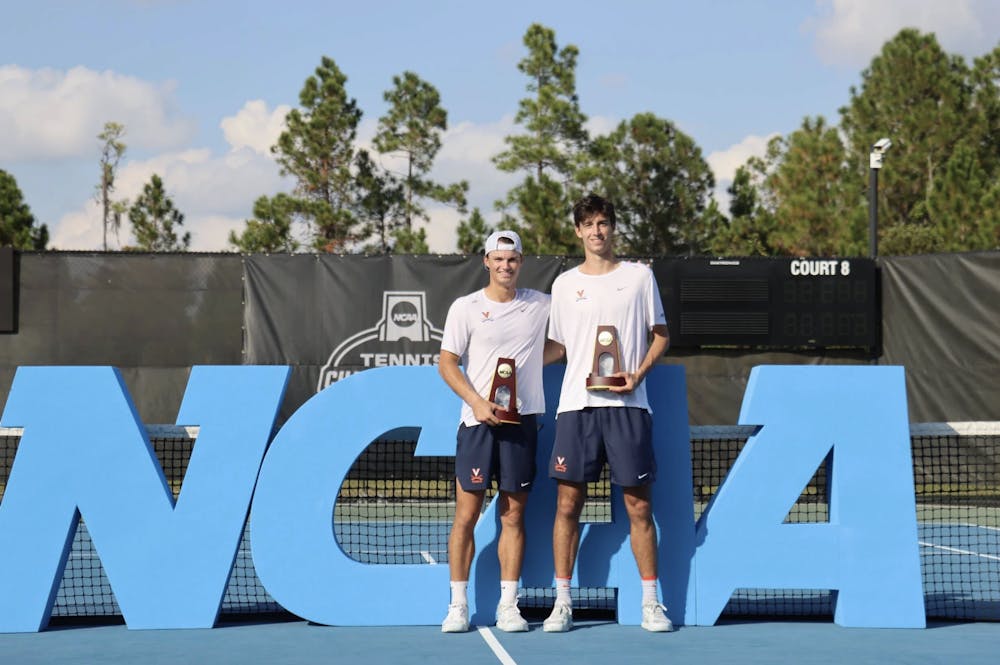
Junior Dylan Dietrich and senior Måns Dahlberg did not arrive in Orlando, Fla. in mid-November expecting to leave such a distinct mark on Virginia men’s tennis history. They believed they could compete. They hoped they could make a run. But like most players stepping into an NCAA championship draw stacked with other nationally ranked opponents, the reality of winning it all felt distant.
Two weeks later, they returned to Charlottesville as national doubles champions.
Dietrich and Dahlberg are now the fourth doubles team in the history of the Virginia men's tennis program to be honored as NCAA champions. Their names will hang permanently on the banners inside the Boar’s Head Sports Club, a visible reminder of a fall run that reshaped expectations for both players and the program as a whole.
But on paper, the pairing was not a conventional one for Virginia tennis.
Interestingly, the success of this pairing was not solely the result of a lineup decision by coaches, but also a result of the close friendship between the two.
While many doubles partners' compatibility is developed through pairing of skills on and off the tennis court, Dietrich and Dahlberg’s partnership extends beyond the traditional traits.
They lived together in dorms, later in the same off-Grounds apartment building and eventually in the tennis house. They even gained a popular nickname on the team — “the pookie bears.” They joke now about “hearing each other through the walls,” but that constant proximity shaped how they naturally communicate both on and off the court.
In their first year in the program, the two did not play doubles together — in fact, Dahlberg was not even competing in doubles much at the time. But by the time they officially paired up during Dietrich’s sophomore season and Dahlberg’s junior year, the foundation was already set.
“They’re not the traditional doubles team, big serves, constant net pressure, textbook patterns,” coach Treat Huey said. “But we’ve tried to get them to believe that you can win by playing a different style, by playing the tennis that they are good at.”
Evidently, this belief was embodied in Orlando, Fla.
After an opening-round match that allowed them to settle in, Dietrich and Dahlberg faced the No. 1 seed in the country in the Round of 16, Benito Sanchez Martinez and Petar Jovanovic of Mississippi State — who also started as No.1 in the preseason rankings. The Virginia duo earned a spectacular 6-3, 7-6 (3) win.
In the quarterfinals, the pair played 5-8 seed Aidan Kim and Bryce Nakashima of Ohio State. That morning, Huey said he was joking around with the two, hoping to push Dietrich and Dahlberg’s buttons.
"[I said] ‘Ah, you guys have no chance today,’" Huey said. "And somehow it worked, they were really motivated that day, locked in, and played exceptionally well.”
According to Huey, the gap between competing and contending disappeared as the matches progressed in Orlando, Fla. Each subsequent match reinforced that their game style and their trust in each other could withstand any moment, trust built not only through minutes on the court, but also through moments as roommates.
“They started believing they could beat the best teams in the country, not just once, but day after day,” Huey said. “That was really fun to watch.”
The deeper in the draw they went, the more visible the chemistry between Dietrich and Dahlberg became. When nerves crept in, humor broke the tension. Huey observed that the two played their best tennis when they were relaxed, cracking small jokes and trusting that all of their hard work would hold.
“Their bond. They have such a great friendship,” Huey said. “Our whole team is close, but especially those two. They can always rely on each other. If one of them has a terrible stretch or messes up badly, it’s not the end of the world, they’re going to be best friends whether they win or lose.”
That comfort level mattered most in tight moments. On championship point, though ending with a double fault from the opposing team, Dietrich and Dahlberg sprinted toward each other, embracing at the net, the moment finally real.
“Their names will be on the board forever,” Huey said. “10 or 15 years from now, at each other’s weddings, their teammates will still point and say, ‘Yeah, those are the guys who won the national championship in doubles.’ Pretty cool moment.”
With these two, the balance is just as significant off the court. After taking a class together their first year, the pair often joke that they “switch roles” in the classroom, balancing each other out just as they do on the doubles court.
As the spring dual-match season approaches, the partnership will carry an added layer of meaning. Dahlberg will graduate at the end of the year, closing the chapter on one of Virginia’s most iconic doubles runs and unique doubles pairings. Dietrich said that he is unsure if they will remain paired throughout the spring, but their impact on the program is already undeniable.
“Our big goal is to win a team national championship. Winning an individual one is great, but May is where we want to peak,” Dietrich said.
For the program, the run has injected renewed belief into the doubles event and sets a new example for future pairings. More than anything, their championship win serves as a reminder that success does not always come from forcing chemistry or following a conventional formula. Sometimes friendship itself can become the competitive edge, and on the national stage, that trust proved decisive.
Years from now, when former teammates return to Charlottesville and look up at the banners, the story behind Dietrich and Dahlberg’s names will remain the same — a national title built not just on tennis, but on friendship.

Margaret Jane Piatos is a senior associate on the sports desk. She is a fourth-year College student, majoring in Political Philosophy, Policy and Law. Margaret is from San Marino, Calif., and she enjoys covering men's and women's tennis.
Read More

A chance meeting led field hockey assistant coach Brendan Creed to Charlottesville
By Adair Reid | 4 hours ago“Ultimately we haven't won this thing here, so that kind of is a big attraction for me in terms of let's do something for the first time,” Creed said. “There's something to chase, which I think is also really exciting.”

On the recruiting trail, Virginia baseball finds future Cavaliers
By Drew Dillman | 4 hours agoWhether it be in Virginia or across state lines, incoming first-years or experienced veterans, Coach Chris Pollard has found a way to recruit talent for the 2027 season and beyond.

Sloan, ‘Mr. Reliable,’ scores first career goal as Virginia trounces Gardner-Webb
By Michael Liebermann | 12 hours ago“I thought I was going to be scoring goals from the minute I got here,” Sloan said.