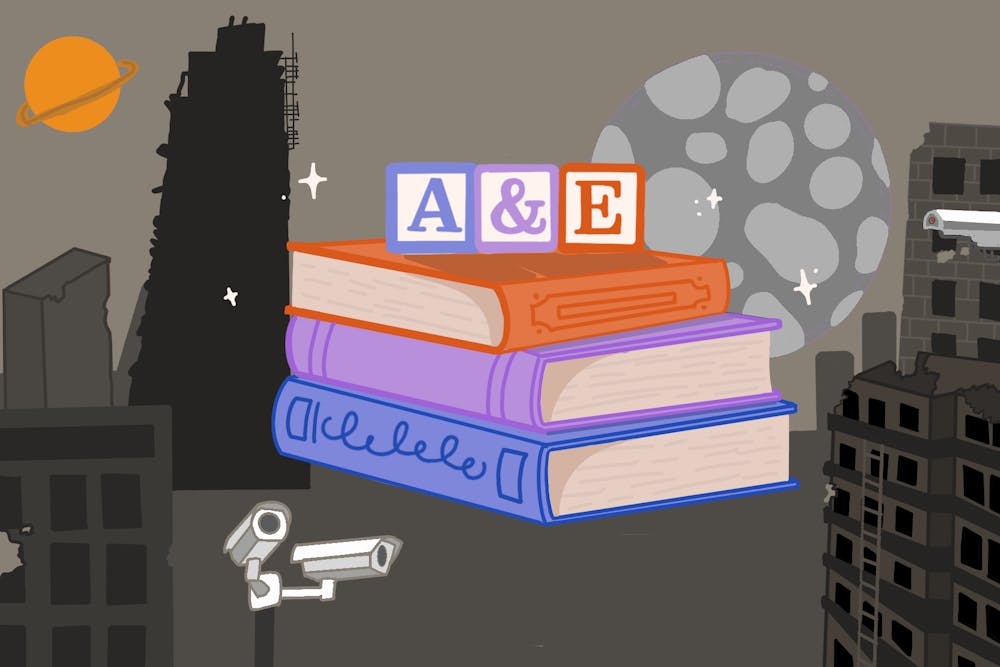
With the arrival of the new year comes reflection on the past one, and 2025 was a year ripe for reflection. While it is impossible to condense a year into one defining moment or cultural trend, 2025 felt marked by an explosion of advances in artificial intelligence technology. The increased presence of AI technologies in everyday life — from enabling pervasive surveillance and data collection to spreading political misinformation and stoking partisan division — have resulted in people labeling 2025 as “dystopian” online.
While the idea that 2026 may take the world deeper into dystopian territory is up for debate, there is a plethora of literature featuring off-kilter futuristic worlds to stoke your imagination regardless. Whether you’re interested in seeing how present times line up to Orwellian-like societies or simply looking for some literary escapism, this list features three of the most subversive and unique dystopia-adjacent books that contemporary fiction has to offer, ranging from science fiction to philosophical character-driven tales.
“Annihilation” by Jeff VanderMeer
Published in 2014, “Annihilation” is the first — and commonly regarded as the best — installment in Jeff VanderMeer’s “Southern Reach” trilogy. The series focuses on a morally compromised and desperate government agency named Southern Reach and its exploration of Area X, a quarantined wilderness marked by unexplainable natural features like human-animal hybrids and otherworldly fungal structures. This entry provides a more postmodern take on the dystopian genre — the government’s institutional power is ineffective and human values are rendered meaningless by the indifferent alien power of Area X.
“Annihilation” focuses on a team of four women – referred to only as the Biologist, the Anthropologist, the Surveyor and the Psychologist – who have been sent by Southern Reach to explore Area X. The story is narrated through the Biologist’s journal entries, detailing her inner thoughts as she realizes that nothing in this wilderness is as it seems.
The Biologist’s narration is purposefully emotionally detached, reflecting the alien uncanniness of Area X and the Biologist’s own murky motivations, but also beautifully illustrative, describing the abundant nature with the appreciative detail of a scientist. Where “Annihilation” excels is in its ability to blend science-fiction and horror as well as stream-of-thought and suspense to create a viscerally unique story, one drenched in dread but impossible to put down.
“I Who Have Never Known Men” by Jaqueline Harpman
The 1995 French novel “I Who Have Never Known Men” recently became a hot topic among literary communities after a new English translation released in 2022, introducing the book to a new generation and mainstream popularity. “I Who Have Never Known Men” details the life of a nameless young girl mysteriously trapped in a cage with 39 adult women under constant observation by silent guards. Unlike the others, the protagonist has never lived outside of the cage and her inexperience shapes her as a metaphorical blank slate for humanity. Her flat, empathetic narration as she questions her purpose gives the book a philosophical tone, posing existential questions through the detailed experiences of these 40 women.
As the novel progresses, revealing its world as more bleak and dystopian than initially presented, the women are forced to lean on each other, persevering despite an increasingly fruitless future. Harpman’s prose is sharp in its simplicity, detailing disturbing images and bleak settings with impactful precision. Despite its emptiness, the world Harpman creates is rich in description and easily imagined as she draws readers in with carefully crafted plot reveals.
“I Who Have Never Known Men” practices slow and deliberate storytelling while exploring existentialism in a group of women who slowly realize their existence’s futility. Its combination of dystopian elements and primal human experiences create a powerful book — one guaranteed to sit with readers long after they finish it.
“Liberation Day” by George Saunders
Comprising nine short stories, which range from mind-controlled human puppet rebellion to the surveilled life of an underground amusement-park worker, “Liberation Day” may be acclaimed surrealist author George Saunder’s most idiosyncratic collection yet — but also his most brilliant. The collection, published in 2022, has narratively separate stories that, together, tackle a handful of broader political and socioeconomic themes including love, oppression and class in dystopian settings with authoritarian technology systems. The story titled “Elliott Spencer,” for example, explores the fragmented mental state of an elderly homeless man whose brain has been reprogrammed to spew political propaganda.
Saunders is a master wordsmith and he radically pushes the limits of his experimental style in “Liberation Day,” utilizing unconventional, attention-grabbing grammatical choices that challenge readers. The stories are often filled with high emotional stakes, creating very sympathetic characters. Saunders imbues these nine stories with humorous observations, scathing satire and clear compassion, a combination that works surprisingly well. “Liberation Day” is a beautiful collection, one that is as likely to make readers laugh as it is to make them cry.
While these books are united through both their unconventionality and their inclusion of dystopian elements, they also share a more hopeful theme — an emphasis on human resilience in seemingly unwinnable scenarios. Through these picks, readers concerned with an impending dystopian future may glean a sense of optimism in the face of uncertainty.
Read More

The Virginia Dance Company trades competition for community
By Eloise Diffley | YesterdayThe Virginia Dance Company is composed of a tight-knit group of dancers, most of whom have danced competitively and consistently throughout childhood and high school.

Hoo’s Watching: Anatomy of a teen TV show
By Caroline Lee | 3 days ago“Crew Girl” is not reinventing the wheel, nor is it particularly interested in doing so.

‘Verity’ falls short on its psychologically thrilling promise
By Julia Prevost | 4 days ago“Verity” is entertaining in moments, particularly when its dialogue becomes so outrageous that disbelief gives way to amusement.