The newest body of work from Karina A. Monroy, a Charlottesville-based artist and art therapist, is a careful, patient meditation on her own heritage and the role of maternal figures in the Chicana culture. Monroy, who was born in California to two Mexican immigrant parents, crafts a detailed and introspective display of her own mixed-media art — ranging from crochet to paint to film — in an exhibition titled “Sueños Florecientes/Flowering Dreams: Portals to Self,” which opened to the public Jan. 9 at New City Arts.
The title takes its name from the ancestral Mexican practice of lucid dreaming as a form of medicine, a theme that Monroy carries throughout an array of pieces. In the artist statement attached to the exhibit, Monroy describes the experience of these lucid dreams as “the conscious and unconscious interacting with one another, dancing with one another, breathing life into one another.” It is this shared relationship within works that provides a clear sense of purpose and unity throughout the display.
In particular, this throughline of personal relationships is notable for the other artists with whom Monroy shares the display. Alongside works from Monroy herself are ones created by her mother, Carmen Monroy, and her maternal grandmother, Andrea Agredano. This grounds the display, cherishing the significance of the maternal figures in her life. The resulting composition is personal while remaining widely relatable.
Motifs in family and motherhood are a common component of Monroy’s work as an artist, but were not a factor in her original composition, which began more than a year ago. Rather, Monroy said that they naturally influenced her project as it took shape.
“I wasn't necessarily looking at the matrilineal component or aspect when I was first making the body of work, but that kind of just organically comes up in a lot of my work,” Monroy said. “So I decided to kind of focus on that a little bit more carefully.”
Nonetheless, each piece in the gallery carries the weight of interpersonal relationships and generational legacy in its composition. A painting titled “el nacimiento/the birth” depicts three stages of a deer’s early life from conception to fawn, each of which emerge from the mouth of a woman in a cloud of her breath. The stylistic acrylic artwork grapples with the origin of life itself and the precious, careful relationship between creatures and their mothers.
A similarly striking work using the same materials is positioned near the back of the gallery. Named “el floreciento/the blooming,” this tremendously detailed rendering is of a woman adorned with natural symbols such as flowers and branches across her upper body and in her hair, drawing comparisons to the concept of “Mother Nature.”
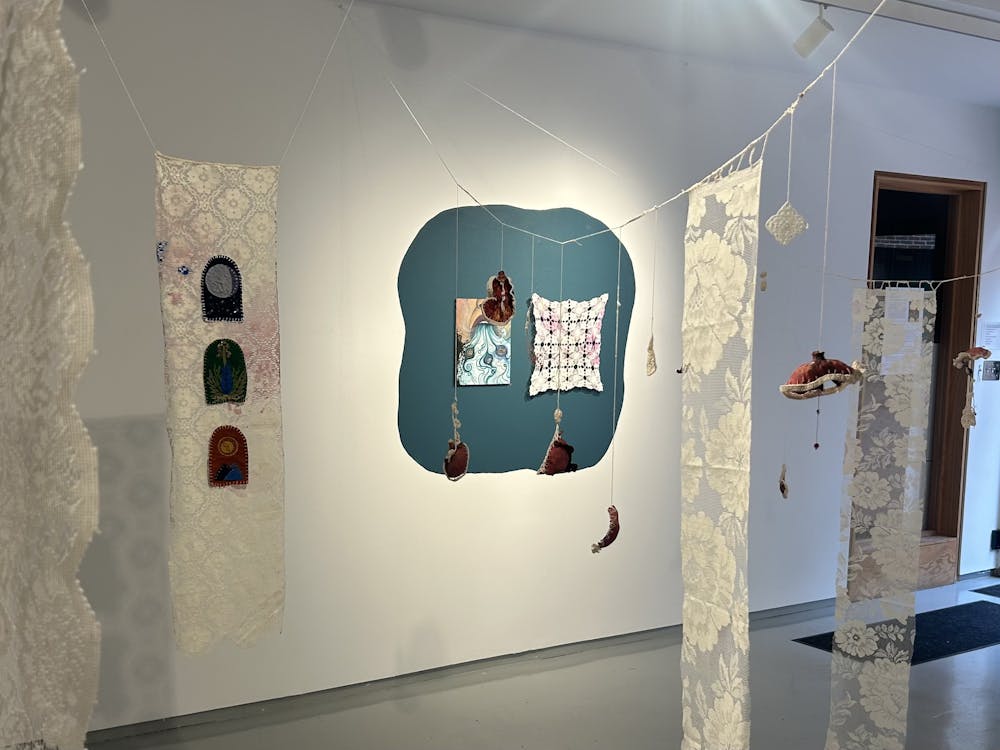
Monroy also varies her styles, media and subjects in a surreal manner throughout the display. In her multimedia exhibit, the artist explored new creative avenues that recalled memories of her matrilineal heritage. Monroy said that this was the first time she had incorporated crochet into her pieces, an art form that holds immense significance for her family and her culture. In addition to her own, her mother’s and grandmother’s crochet works were included in the exhibition.
“[Crochet] is a big part of the exhibition itself because my mother and my grandmother and most of the women in my family on my mother's side have crocheted quite a bit,” Monroy said. “My mother’s and my grandmother's crochet pieces are also included in the exhibition in conversation with my paintings. So when I was looking at crochet, I was thinking a lot about the component of matrilineal healing or intergenerational healing.”
This concept of intergenerational healing is particularly present in the exhibit’s most elaborate and expansive piece, called “mollera.” The work gets its name from a colloquial, anatomical word for the head, but also has linguistic connotations to the brain and to the soft spot on a baby’s skull. In drawing inspiration from these fundamental, impressionable components of childhood, Monroy focuses “mollera” around the formative role that maternal figures have on infants.
The piece itself is a magnificent blend of a variety of media, and entices spectators to examine its ornate details and personal storytelling. The work is made of found objects, embroidery floss, crochet cotton thread and recycled fabrics. Underneath the table, Monroy placed a projector that displays a video against the nearby wall, interrupted in positioning by a stitched white dress. The accompanying audio track plays clips of candid dialogue and spoken-word poetry while the video plays footage of Monroy’s relatives superimposed on footage of washing and breaking down parts of a pomegranate. Much like the video itself, this piece of art is a deeply layered, carefully constructed stroke of creativity and artistic prowess, deftly creating a complete audio-visual experience.
Beyond the footage, pomegranates play a crucial role in the overall composition of the exhibition. The pomegranate is a fruit traditionally associated with fertility and therapeutic significance, and Monroy weaves these traits across several of her pieces. Hanging throughout the gallery are deconstructed, hollowed-out pomegranates without their edible seeds, revealing a husk of the fruit that once was. This creates a powerful, lasting symbol of motherhood with a striking purple color that stands out against the crocheted white fabric.
The pomegranates, too, have a familial significance for Monroy herself, as evidenced by the piece “manos de Nina #1/Nina’s hands #1,” a white crochet pattern created by her grandmother that is stained with pomegranate and prickly pear juices. Monroy said that the incorporation of the fruit further ties her artwork to her grandmother and her home.
“My grandmother had a huge pomegranate tree in her home growing up, so they're very much symbols of home for me and symbols of motherhood for me in lots of different ways,” Monroy said.
Overall, “Sueños Florecientes” is an invitation to contemplate one’s own heritage and place in the world through the story of matrilineal connection. It is a beautifully-constructed exhibition that makes full use of its space, resulting in a deeply moving, thought-provoking experience. Monroy said that she hopes her own personal story can be reflected in those who engage with the art and resonate within the exhibit itself.
“It is my personal story, but as the saying goes, the personal is always political,” Monroy said. “So I think that that can also be felt within the work as a woman and daughter of immigrants…I hope that people can hold that as well as they’re looking through the space.”
The exhibition is on display downtown in the Welcome Gallery at New City Arts until Feb. 18. Admission is free, and the gallery is open Wednesday through Saturday from 10 a.m. to 5 p.m..
Read More

Lizzy McAlpine soars to new heights on ‘Angel’
By Alena Touve | 6 minutes agoLizzy McAlpine’s “Angel” is a triumph of sonic experimentation and lyrical ability, channeling both folk and musical theater into one harmonious product.

Girls in pearls, guys in … jerseys
By Zoe McFarland | 19 hours agoAs University tradition continues to coexist with changing trends and tastes, game day fashion will likely continue to resist simple characterization.

From a rooftop to the stage — ‘Third Floor Window’ finds its place in the student music scene
By Sofia Hahn | 2 days agoThe band leans heavily into this communal enthusiasm, with high-octance sets often dependent on their performances being able to invigorate crowds.