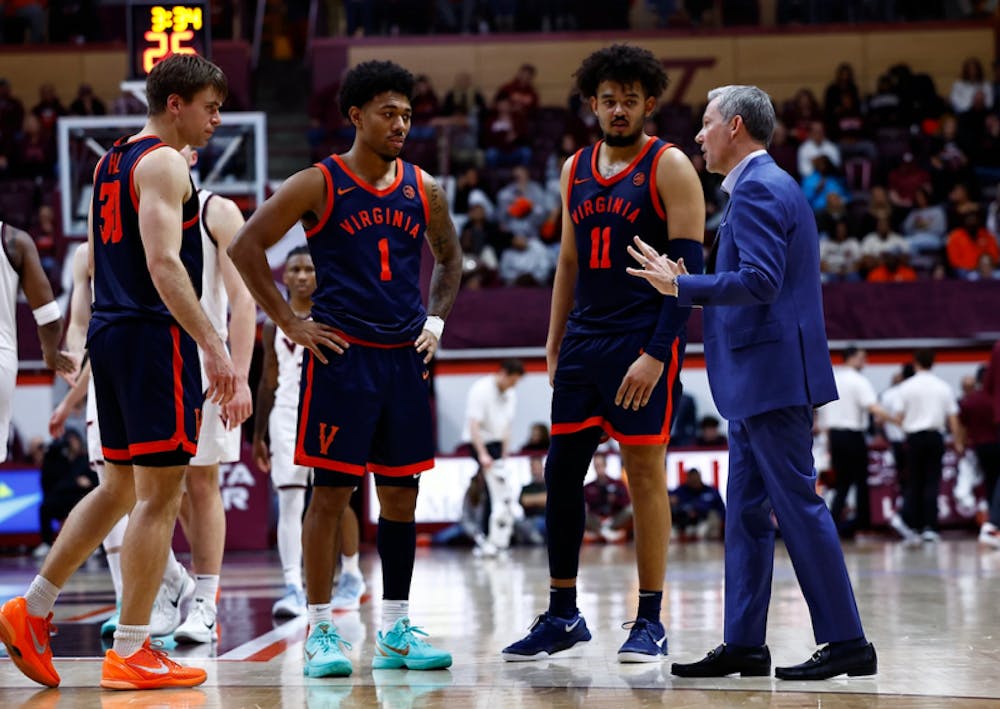
For No. 21 Virginia, conference play started on New Year’s Eve with a game destined to take Coach Ryan Odom and his team out of their comfort zones.
A rivalry matchup away against a physical Virginia Tech team is a context that immediately puts teams on the back foot, making scoring difficult and consistent runs near impossible. Add in that it would become the first overtime game of the season, and the game turned into a different beast altogether.
The Cavaliers (11-2, 0-1 ACC) put up a real fight, falling to the Hokies (11-2, 1-0 ACC) 95-85 in triple overtime. The game was a physical affair in which both teams shot well below 40 percent from the field, but Virginia Tech’s experience in overtime settings and clutch performance from sophomore guard Ben Hammond carried them over the hump that is Virginia.
The game showed itself from the beginning, with both teams struggling to score through regulation. Virginia Tech built its lead off the backs of three players — junior forward Amani Hansberry, freshman center Christian Gurdak and freshman guard Neoklis Avdalas — who combined for 18 of the Hokies’ 23 first half points. Gurdak and Hansberry, especially, were menaces on the boards and were the first and second leading rebounders throughout the game, with 19 and 15 respectively.
“Here’s Christian Gurdak, here’s a kid playing his 13th college game,” Hokies Coach Mike Young said. “And this guy comes in here and corrals 19 rebounds, are you kidding me? Hansberry was awesome [too].”
The second half was neck-and-neck for the full 20 minutes, with both teams narrowly missing rim attempts that would have secured a two-point lead in the final seconds. The rivals entered the first overtime tied at a mere 55 points.
Virginia Tech had already played three overtime games this season, winning all of them. Gurdak hit several under-basket shots off of offensive rebounds, while the lightning quick Hammond found himself at the line with regularity and hit several tough floaters down the stretch.
For the Cavaliers, a bulk of the offense down the stretch came from the usual sources. Freshman forward Thijs De Ridder continued to muscle his way to the rim, scoring eight points in the three overtimes and five rebounds. After sitting for most of the first two overtime periods, graduate guard Malik Thomas was instrumental in keeping Virginia in the game — in 5 minutes, he scored 11 of his 26 points. Thomas’ deep two-pointer to tie the game in second overtime — after a full court pass from graduate forward Devin Tillis — was caught and laid in by freshman guard Chance Mallory with less than a second on the clock, forcing the third overtime.
“For our guys to execute that was really cool,” Odom said. “But you can’t be in that position where you’re relying on that. And Chance made a heck of a play, he just followed the ball, did what he was supposed to do and chased it and was there just in the nick of time.”
The Hokies, a more physical team than the Cavaliers, had a bit of a friendly whistle at times throughout the game. They shot 41 free throws to Virginia’s 15 — with free throws ultimately being the difference in the third overtime.
Hammond, who came alive in overtime with 20 points, went 10-12 from the charity stripe, outscoring the Cavaliers 10-7 in the third overtime period. Playing all 15 minutes of extra time, his overtime performance was ultimately what pushed the tired Hokies to a comfortable lead in the dwindling seconds.
“He was awesome,” Young said. “He’s cramping unlike any young man I’ve coached in the locker room right now. He was exceptional … He created havoc for the Cavaliers down there with a couple of things … Arguably he was the best player on the floor today.”
While a few important calls — including a goaltending on Grünloh in the final minutes of the second half and a couple of light off-ball whistles — allowed the Hokies to keep the game even. Their size and physicality throughout, particularly from Gurdak and Hansberry, ultimately allowed them so many additional possessions that provided those two, Hammond, Avdalas and others to score even when only shooting a team 35 percent from the field.
“I think [Virginia Tech] did a great job of attacking the rim and some of those are on offensive rebounds,” Odom said. “There’s two areas for us that we’re constantly working on — defensive rebounding and certainly playing physically without fouling. And it all comes back to discipline and getting to the next play.”
Physicality, and Virginia’s ability to handle it, has been a recurring theme against top opponents and will continue to be one as conference play progresses. The Cavaliers only shot 22 percent from three-point range on the day, making a couple in the clutch but failing to convert with any consistency.
In that regard, graduate guard Jacari White and his microwave scoring ability was greatly missed, though the Hokies were also missing two starters and a backup big. The two rivals will reconvene in Charlottesville March 7 to close out conference play, with all four of those injured players currently expected to be back by then.
First though, the Cavaliers will continue conference play Saturday, Jan. 3 with another road matchup at NC State, which will be livestreamed on ESPN2. The Wolfpack (10-4, 1-0 ACC) had a similar offseason to Virginia, bringing in a proven tournament coach in Will Wade and completely revamping their roster. Led by a bruising big in senior forward Ven-Allen Lubin, a pair of productive guards in senior Quadir Copeland and sophomore Paul McNeil and a proven wing in senior forward Darrion Williams, NC State is an offensive force with solid presence on the boards, and are coming off a 23-point win over Wake Forest to open conference play.
Read More
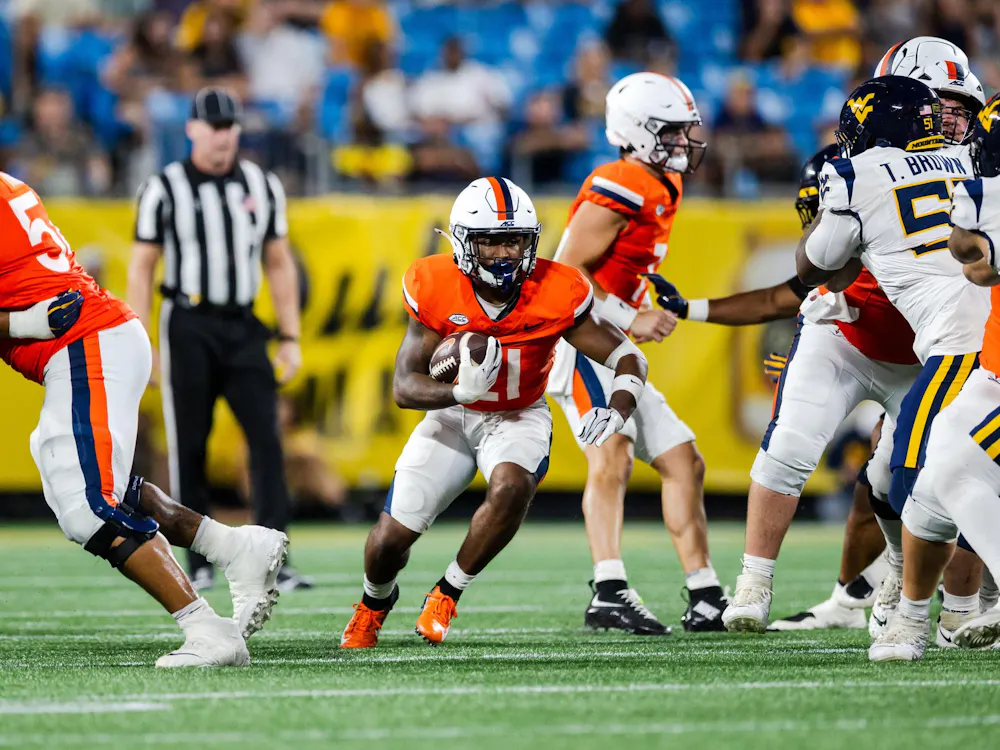
After loss, Virginia looks to ‘feed the monster’ — the Blue Hens are the first course
By Ben McNiff | 6 hours agoVirginia faces Delaware Saturday — the kickoff is slated for 6 p.m. at Scott Stadium. It will be their final non-conference matchup of the season, with a road trip against Florida State looming.

Cavaliers keep cards clean, cruise to victory at Canadian Collegiate Invitational
By Joby Jung | YesterdayWith three finishers in the top five and the overall individual and team win, the Cavaliers cleaned up on their trip up north.

SAAC aims to promote connection, advocacy and citizen-athlete development
By Adair Reid | YesterdayPresident Noah Dyer will represent Virginia on the ACC SAAC, interacting with the NCAA on policies and regulations that impact student-athletes.