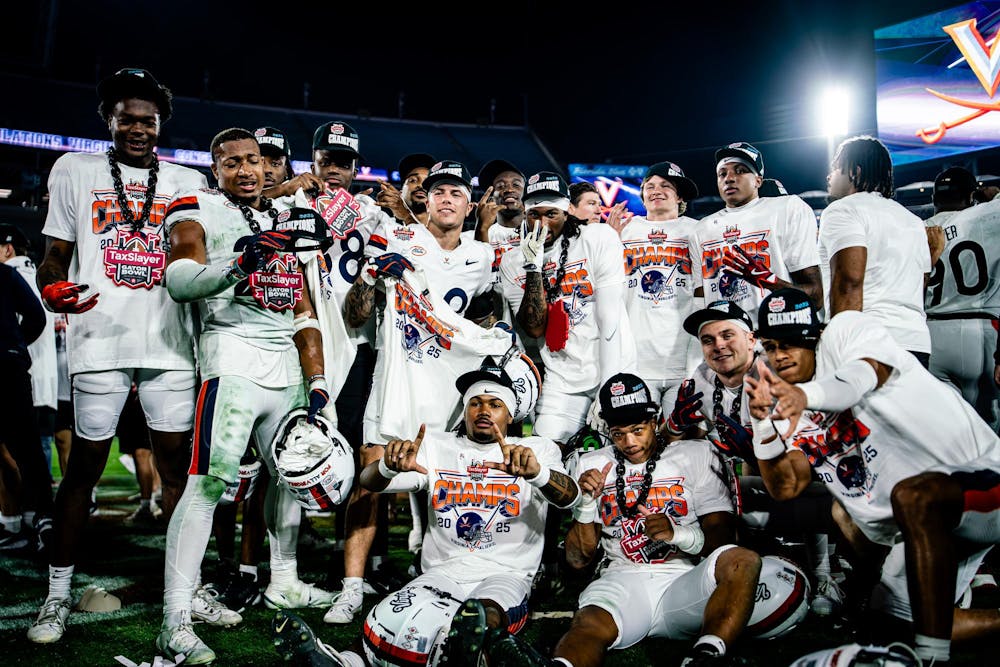
The Cavaliers’ 2025 season ended Dec. 27 with a victory over Missouri in the Gator Bowl to achieve the highest win total in school history. With multiple players declaring for the NFL draft and entering the transfer portal, Virginia has already hit the ground running this offseason and looks to acquire more talent for 2026.
The future is approaching fast, but the Cavaliers’ greatest season ever deserves a more retrospective look. Two beat writers examine lingering questions from this historic year.
Which players surprised you the most with their contributions this season?
Ben McNiff, Senior Writer: Senior receiver and former walk-on Eli Wood had a career year as a consistent contributor after three seasons buried on the depth chart. In a Gator Bowl victory, he set new career highs in receptions and yards. Wood also made a crucial play on the ball to avoid a touchback on a trick play punt by graduate quarterback Chandler Morris. Wood had three career catches prior to this season. Yet, he led all receivers in catches and yards for the final game — capping off the season with a 16-catch campaign complete with a touchdown in the conference championship. It doesn’t get more unexpected than that.
On the other side of the ball, graduate defensive end Daniel Rickert joined a front with transfers hailing from powerhouses like Ohio State and Alabama. Before the season, it was unclear how much playing time he would earn given his FCS experience at Tennessee Tech. Despite pedigree working against him, he led the team in sacks and sack yards. Like Wood, he made plays when it mattered most, as 6 of his 6.5 sacks came against conference opponents.
I’d also like to give junior punter Elijah Slibeck his flowers. The preferred walk-on from Fishers, Ind. has sat behind All-ACC graduate punter Daniel Sparks since 2023. In Sparks’ brief injury absence this season, Slibeck excelled, becoming the 11th player in school history to record a punt over 70 yards in the win over Louisville. He also earned ACC Specialist of the Week honors for his efforts.
Theo Moll, Staff Writer: Few faces made a greater impact for the Cavalier offense than graduate running back and First-Team All-ACC selection J’Mari Taylor. In December 2024, Taylor transferred into a crowded Virginia running back room after a career year at the FCS level. The rusher quickly put to rest any doubts about whether his numbers would translate to Power Four competition. Despite sitting out the Gator Bowl shortly before declaring for the NFL Draft, Taylor broke 1,000 yards on the ground — becoming the first Cavalier rusher to do so since Jordan Ellis in 2018.
Also making a difference out of Virginia’s 30-plus member transfer class was graduate safety Devin Neal. Following the 2024 campaign, the Cavalier secondary had to somehow compensate for the loss of third-round NFL draft pick Jonas Sanker. Neal did as good a job as anyone, leading Virginia in tackles and finishing second in pass break-ups — none more impressive than the last, in which he took flight to knock the football free from a Missouri receiver and secure a Cavalier Gator Bowl victory. Most importantly, Neal anchored a secondary that transformed into one of Virginia’s more dependable positional units by year-end.
Lastly, it’s worth mentioning the leap taken by junior linebacker Kam Robinson this year. Though injuries at both the beginning and end of his campaign limited Robinson to less than eight full games, the junior was a force every time he touched the field. Two interceptions returned for touchdowns, a sack, a fumble recovery and a game-winning safety were enough to net Robinson a second-place finish in ACC Defensive Player of the Year votes, despite limited playing time.
What could’ve really brought this team to the next level?
Ben McNiff, Senior Writer: This was the best season in program history. Virginia football won 11 games, something that Virginia has never done before, with victories in the Commonwealth Clash and the Gator Bowl. The one achievement this team left on the table was an ACC Championship, and the Cavaliers’ defeat by Duke was entirely avoidable. Ultimately, stronger, more commanding starts on offense — to games and to drives — could have placed Virginia in a position to control games all four quarters, rather than just in fourth quarters.
Faultlines in Virginia’s magical run foreshadowed the disaster in Charlotte, N.C. — the Cavaliers’ third down attempts per game rose throughout the season, indicating lower success on first and second down. Additionally, their turnover margin across their last six games dipped into the negatives. An offense facing challenges like these is going to struggle with consistency in their possessions, as the Cavaliers did in the conference championship. In this game, Duke possessed the ball nine minutes longer, and managed to score on all five of their red zone possessions. The Cavaliers, meanwhile, only reached the red zone four times, scoring three times from within the twenty.
There are four teams in CFB history who played four overtime games in one season. Virginia’s loss extended the curse — none of the teams who share this record have gone undefeated in their overtime clashes. An aptitude for close wins is admirable, but not sustainable.
Theo Moll, Staff Writer: It is difficult to imagine this season going any better for the Cavaliers. Months ago, playing for an ACC Championship would have sounded unfathomable to many outside the program — Virginia was picked to finish 14 out of 17 teams in the ACC preseason poll. But what could have made a Cavalier conference title just a little less elusive?
Put simply, both sides of the ball did not get hot at the same time. As Virginia’s defense slowly came into its own, the Cavaliers’ high-powered offense began to stall. With those opposing trends, Virginia was able to eke out regular season wins even when one side of the ball underperformed. But it also meant that by the ACC Championship, the Cavalier defense was playing some of its best football of the season while the offense struggled.
Early in the season, Virginia was lighting up the scoreboard day in and day out — it was not until game seven of the campaign that the Cavaliers would score fewer than 30 points. Four of the team’s first five games would have constituted Virginia's highest point total since 2021. Unfortunately for defensive coordinator John Rudzinski, some of the Cavaliers’ opponents were scoring at will, too.
But as Morris played through injuries in the middle of the season and beyond, the defense began to find its rhythm. The secondary was no longer allowing big plays over the top, as it had a few times early in the season. The front seven, too, was clearly gaining comfortability. Look no further than its shutdowns of the California and Duke rushing attacks in the regular season matchups.
Pair Virginia’s electric, early-season offense with that stubborn, late-season defense and Virginia’s trip back from N.C. might have been a more exciting one.
Read More

Why — and why not — to overreact after a Week Zero win
By Drew Dillman | 10 minutes agoWhile there is some evidence to believe the hype may be warranted, there are also reasons to cool one’s jets in favor of a more measured response.

Virginia men’s soccer claws back for draw against No. 23 Oregon State
By Noah Cinel | 4 hours ago“It’s progress,” Virginia Coach George Gelnovatch said.

To start 1-0, Virginia leaned into the identity they advertised all spring and summer
By Ben McNiff | YesterdayThe Cavaliers, with perhaps the most covered victory of Week Zero, appear to have launched into ACC contender status.