
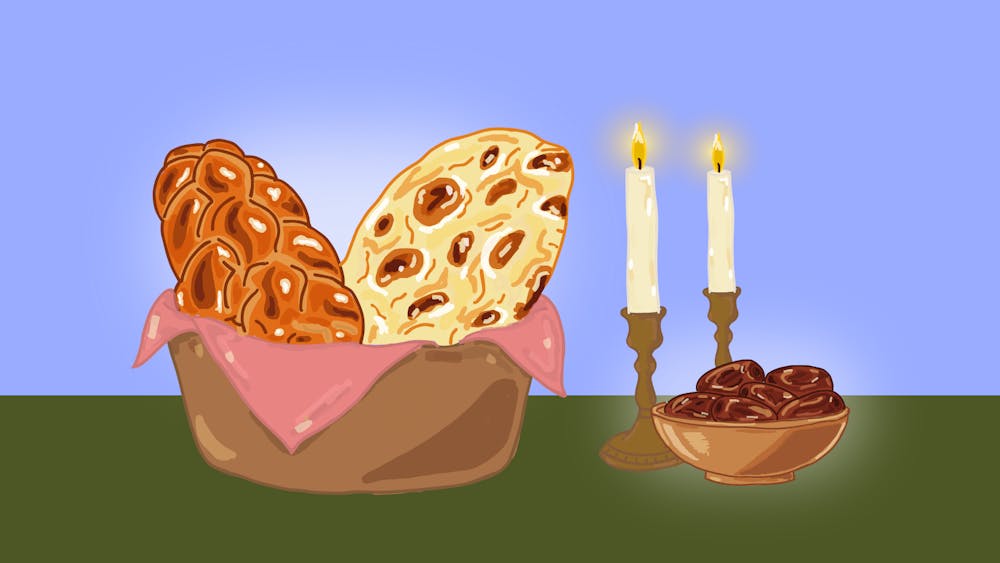
Soft conversation and the clatter of dinner prep filled the Asian American Student Center Friday evening as students gathered for a joint Iftar and Shabbat event. Hosted by Students for Justice in Palestine and Jewish Voices for Peace for the third consecutive year, the event brought together two sacred rituals — the nightly breaking of the Ramadan fast and the start of Shabbat, Judaism’s weekly day of rest — inviting students to share a meal, learn about one another’s traditions and build community across faith lines. Organizers of the event hoped the evening would serve as a reminder of how shared ritual can build connection in moments when communities often feel divided.
For Medical student Josh Rosenberg, who has helped run the event since its inception, the gathering represented an effort to move towards a deliberate sharing of ritual, beyond simply attending each other’s events.
“We’ve all been sharing space at each others’ events and engaging and organizing with one another,” Rosenberg said. “We thought it’s just a really cool opportunity to overlap one of the most important Muslim holidays and one of the most important Jewish holidays.”
Before the meal — catered from Afghan Kabob with halal dishes like kabobs, rice, naan and eggplant — organizers led a presentation explaining the meaning of each tradition and the roles these rituals play in their respective faiths. Ramadan, they noted, marks the month in which the Qur’an, the holy book of Islam, was revealed. During this month, Muslims fast for 30 days as an act of devotion and discipline.
Shabbat, observed weekly from Friday nightfall to Saturday nightfall, is Judaism’s day of rest — a time set aside for reflection, community and stepping back from the pace of the week. Alongside the meal, organizers also set out challah bread, which is traditionally eaten to welcome Shabbat, giving attendees a tangible way to participate in the ritual. The presentation highlighted how both practices center intention and connection, offering attendees a window into the shared rhythms of the two faiths.
First-year College student Zainab Soofi said the evening’s presentation revealed parallels she had not expected, especially in how Shabbat mirrors elements like Jum’ah, the weekly Islamic congregational prayer.
“I didn’t know that [Shabbat] was from sunset to sunset, similar to how the Islamic days go,” Soofi said. “It was just a really good form of exposure to learn just what they do on Shabbat, why it’s such an important day for them … and how much it aligned with how I feel like [Muslims] treat Jum’ah.”
Soofi noted that the chance to hear about Shabbat from Jewish peers added a personal layer to the evening.
“My best friend is Jewish,” Soofi said. “So I always think that conversations between Muslims and Jewish people are really important.”
Building on the introduction to shared ritual, the latter half of the presentation turned towards the realities of observing Ramadan in Gaza — a shift that grounded the evening’s learning in the humanitarian stakes of the moment. Presenters shared figures illustrating the scale of ongoing violence, including a statistic that Israel had broken the ceasefire in Gaza at least 1,602 times.
For third-year College student Najibah Rushmila, hearing those figures in a quiet, intentional setting cut through the background noise of constant online updates she had grown desensitized to.
“Today’s media is so saturated, especially in terms of social media,” Rushmila said. “There’s so much influx of information at one point, like, you can’t process all of it, so you just kind of become numb to it.”
Rushmila added that sitting in a room where people were listening with full intention was not only grounding, but also reminded her of the deeper purpose behind Ramadan.
“The whole month is for us to practice self restraint, and realize the abundance of the things that we have and start appreciating them more,” Rushmila said. “I think them combining everything in that presentation was a very good way of making people think about [that].”
Paired with descriptions of widespread food scarcity and displacement, the presentation underscored the stark contrast between the comfort of sharing a communal meal on Grounds and the daily struggle for survival faced by families in Gaza. For Rosenberg, that awareness felt present especially during the event, as the ease of gathering with friends reminded him of how easily such comfort can be taken for granted.
“There are well over millions of people in Gaza who don’t have access to food,” Rosenberg said. “And so I think it’s incredibly important for us to be conscious of the fact that we are lucky to be able to share this space.”
For Rushmila, the presentation cut through the feeling of helplessness that often surrounds these issues, leaving her with concrete ways to contribute.
“They told us a bunch of [charities] like the World Central Kitchen, and how, even though I’m so far away and I can’t be directly involved, I can help [through] aid and [donations],” Rushmila said.
Even as the presentation confronted attendees with sobering realities, presenters emphasized that learning should not end in despair. The final moments of the presentation shifted toward concrete ways to stay engaged — from supporting humanitarian aid efforts, donating to charities and initiating conversations that are often avoided in public spaces.
For Soofi, that forward-looking message was one of the most meaningful parts of the night, offering a sense of agency amid a topic that often feels overwhelming.
“These issues can become so divisive, and they don’t need to be, especially when it’s, you know, it’s about humanity,” Soofi said. “Just to see that people were able to talk about it in a really open space, it was a very comforting thing to me.”
As conversations stretched on over a shared meal, the room took on the feeling of a community knitted together through small, shared moments — students trying new food, comparing the rituals they grew up with or simply sitting beside someone they may not have otherwise met. Those quiet exchanges captured the heart of the evening, a reminder that connection is built through the willingness to understand each other.
“I feel like, once things become, like less alien to you, you’re able to connect with people more,” Soofi said. “And I really think if more people did that, we would definitely have, like very much less disagreements, and it would be easy to hear people out, because you see something more human in them, because you understand them.”
Read More

My affliction of cougar-ism
By Madigan Wirkus | 17 hours agoAlthough a fourth-year dating a third-year may seem like a minor discrepancy to most, I find myself subconsciously justifying the age gap constantly.

From soccer to startup, Emiliano Mercenari is doing it all
By Malone Morchower and Abby Snowdon | 5 days agoMercenari is a first-year College student, an attacker and midfielder for the Virginia men’s soccer team and the founder and current operator of four startups.

Conmole cooks up the perfect evening out
By Ingrid Gay | 6 days agoAs much as I loved many of the dishes we had that night, the best part of Conmole was not the flavors, it was the service.


