
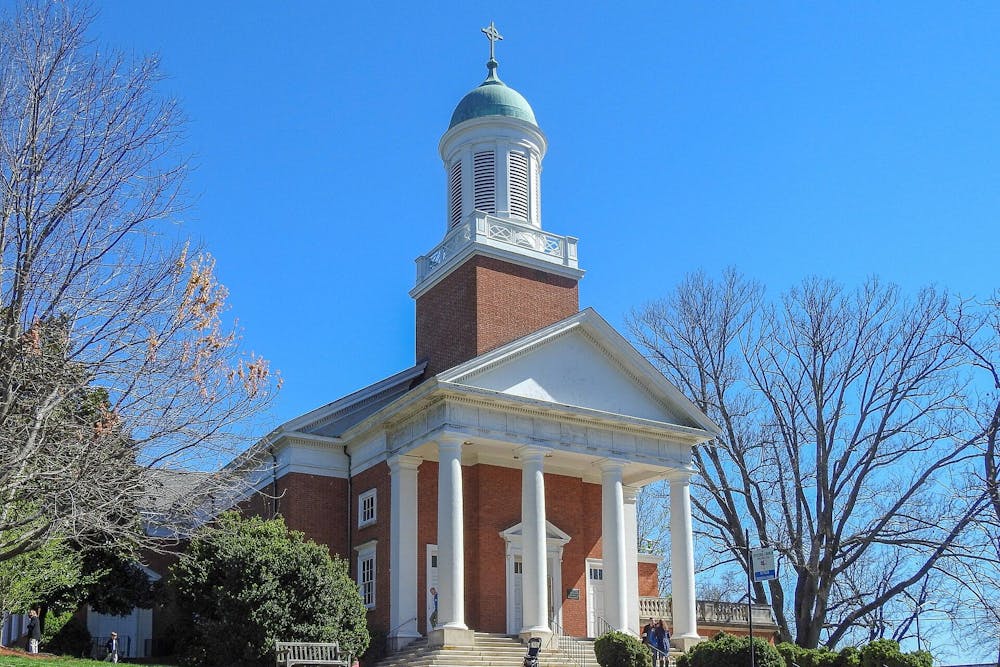
During the season of Lent, St. Paul’s Memorial Church is giving students and the greater Charlottesville community the space to engage in reflection and conversation about some of life’s biggest questions. Every weekday at 8 a.m., St. Paul’s — located at 1701 University Ave. — offers a traditional morning prayer service in the chapel followed by a Bible study. Friday mornings, that Bible study is uniquely focused on some of the Bible’s unnamed female figures.
Lent is a season in the Christian faith which lasts 40 days, starting on Ash Wednesday and culminating on Holy Thursday — although many people continue their Lenten sacrifices through Good Friday and often until Easter Sunday. During this time, Christians practice penitence and sacrifice in the pursuit of greater closeness with God. Many Christians choose to temporarily give up “worldly” things during Lent — such as social media or sweets — to represent their commitment to God and His greater fulfillment.
According to Dr. Peter Kang, senior associate director and campus minister at St. Paul’s, the Lenten Morning Prayer program was established in 2023 as a seasonal addition to the church’s existing fellowship opportunities. Following the morning prayer service, every Friday, many students opt to stay and engage more deeply with women in scripture over quiche from MarieBette.
The “Women of the Bible: Nameless Women” Bible study at St. Paul’s explores how the roles of women shape scripture. In the Bible, there are over 600 nameless women, and many of them played notable roles. This Bible study does more than merely analyze absence — it aims to give a name to those who have for so long been denied one.
Fionn French, third-year College student and student vestry member, guides the study based on a different story in the scripture every week. French explained that they became interested in the Bible’s unnamed women after taking a Sunday school class about female characters in scripture.
“I think it's an interesting lens to approach the Bible from, because it guides you towards stories that aren't highlighted in the lectionary,” French said. “[It] can give you a lot of insight on what [the] scripture [says] ... and practice disentangling that from dogma and church politics. Like, what does the book actually say? There's women everywhere in the Bible.”
The “Women of the Bible: Nameless Women” study has completed two out of six total sessions leading up to Lent’s end, with each week focused on a different biblical woman. While the majority of the participants are women, all are welcome to join the small group discussion, with attendance typically around three to five people.
French said that they usually begin each session by reading a selected passage, and then letting participants share their thoughts and feelings about the scripture, paying special attention to the woman’s role in the story. In addition to the reading and discussion, French also shares historical context and insights with participants that can better place them into the pages of the passage.
“Everybody has their own perspective on the story,” French said. “Even a story that I've read a million times, and feel like I have a pretty good grasp on, people are bringing up new angles and new interpretive lenses and like, I feel like I learn something with every meeting, even though I'm the one with notes and historical context.”
These evolving interpretations also inform the study’s broader purpose. For French, examining the stories of nameless women is not only about recovering overlooked figures in scripture, but also about highlighting uniquely “feminine” forms of strength and leadership.
“I do think it's a worthwhile agenda to have feminine stories and role models that are not women in men's roles, but just women doing their thing, who are also worth, you know, looking for lessons and teaching to our children,” French said.
For fourth-year College student Mary Edith Plunkett, the morning prayer service has provided a new way for her to engage with scripture. She said that she has been making a habit to come to morning prayer every day it is offered, and believes that the new routine has added a new layer to her spirituality and broadened her understanding of Christian womanhood.
“My religious upbringing didn't involve as much Bible school, [or] learning or reading about the Bible, so this is all kind of new to me,” Plunkett said. “I think it's so neat to have these kind of role models, or just people that you can relate to in the Bible … but mostly I just enjoy learning more stories and stuff that I didn’t know about before.”
Besides the unnamed women series, St. Paul’s offers other opportunities for students to engage in active conversation. “Press Pause,” a bi-weekly discussion that transpires every-other Monday evening, centers around slowing down and focusing on identifying participants’ greatest strengths and weaknesses. Amidst the fast-paced University culture, the church aims to be a place of serenity and contemplation for students to take a break and ponder in Christian fellowship. All are welcome to the Lent events at St. Paul’s.
“I hope that throughout the season of Lent into Easter, it can be a season of refocusing and also just remembering joy and hope and love and the support that we can offer one another… and being grateful for that,” Kang said.

Claire McGinn is a staff writer on the life desk. She is a third-year College student majoring in history and minoring in Data Science. Claire is from Centreville, Va., and she enjoys writing about University events, programs and student organizations. Outside of The Cavalier Daily, Claire is involved in University Programs Council, Women in National Security, Kappa Delta sorority and Catholic Hoos.
Read More

From soccer to startup, Emiliano Mercenari is doing it all
By Malone Morchower and Abby Snowdon | 4 days agoMercenari is a first-year College student, an attacker and midfielder for the Virginia men’s soccer team and the founder and current operator of four startups.

Conmole cooks up the perfect evening out
By Ingrid Gay | 5 days agoAs much as I loved many of the dishes we had that night, the best part of Conmole was not the flavors, it was the service.

The Ozempidemic — is social media telling the full story?
By Dana Douglas | September 9, 2026To strain the surplus of information about GLP-1 medication circulating on social media, The Cavalier Daily spoke to those on the frontlines of the phenomenon — University medical professionals and a student prescribed GLP-1 — to uncover what this development actually looks like for the future of weight management, diabetes treatment and American healthcare as a whole.


