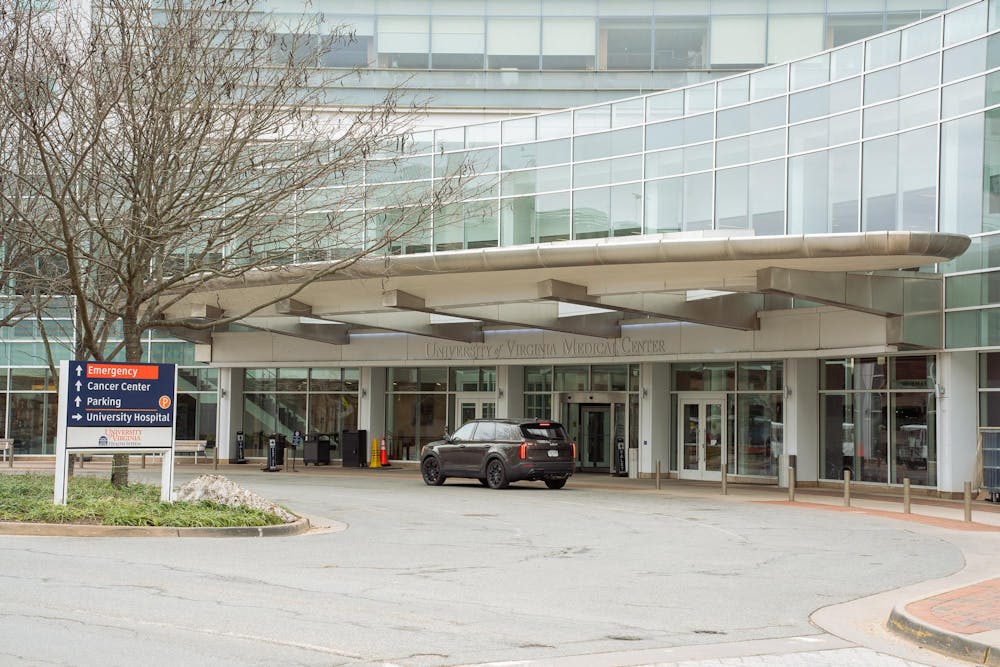
Over the past year, I have had the privilege — and the responsibility — of leading U.Va. Health during a period of significant change.
Like many academic health systems across the country, we are navigating real pressures — uncertainty in research funding, constraints on reimbursement, rising costs and continued workforce strain. They are shaping decisions we make every day — about how we invest, how we support our teams and how we sustain our missions.
But what has struck me most in this first year as CEO is not the weight of those pressures. It is how we respond to them.
After more than three decades at U.Va. as a physician, colleague, patient and now CEO, my confidence in U.Va. Health comes from what I see every day.
I see doctors pushing the boundaries of science even as funding becomes more uncertain. I see nurses and care teams delivering extraordinary care under intense demands. I see students learning with urgency and purpose. And I see collaboration across disciplines that allows us to solve problems no single department could solve alone.
The strength of U.Va. is not in any one office or individual. It is in the caliber of the people who choose to learn and serve here — and the shared sense of purpose that connects all of us.
Mission matters. At U.Va., the health system is not adjacent to the University’s mission — it is one of its primary expressions. Here, discovery, education and patient care converge. Discoveries move from lab bench to bedside. Students learn from textbooks, yes, but also from patients, from clinical teams. Innovation unfolds in real time. That is what academic medicine makes possible. That flywheel is visible across Virginia and beyond.
Some examples — we were the first in Virginia to earn the National Cancer Institute Comprehensive Cancer Center designation, reflecting the groundbreaking cancer research and treatment available here. The Paul and Diane Manning Institute of Biotechnology will accelerate the path from discovery to treatments and cures. U.Va. Health Children’s has been ranked the top children’s hospital in Virginia for five consecutive years because of the care our teams provide for children with the most complex needs. And at the U.Va. Brain Institute, clinicians, engineers and data scientists work across disciplines to take on complex neurological diseases.
Our medical and nursing students train at the bedside in an environment where innovation is not theoretical — it is operational.
These are only a few examples, but they make the point — without the academic infrastructure of the University, these advances would be diminished. And without U.Va. Health, many advances would never reach the patients who need them.
These achievements are evidence of a model that works — research informs care, care generates new questions and education sustains both. As a public institution entrusted with state resources, we have an obligation to contribute materially to the Commonwealth’s prosperity. Today, U.Va. Health generates $8 billion of the University’s nearly $12 billion in annual statewide economic impact and nearly 60 percent of U.Va.’s operating revenue. It employs or supports more than 40,000 jobs, drives billions in direct expenditures and contributes hundreds of millions in tax revenue to communities across Virginia.
Behind those numbers are the precious lives entrusted to our care. Each year, U.Va. Health handles more than 170,000 emergency visits across four emergency departments, more than 1.2 million outpatient visits and more than 50,000 surgical cases. As a Level I Trauma Center and home to specialized programs unavailable elsewhere in the state, U.Va. Health carries responsibilities few institutions can. As demand continues to grow, we must continue our work to improve access for all who live and work in the communities we serve.
Here, scale reflects responsibility, not ambition. As the needs of Virginians have grown more complex, U.Va. Health has extended its reach to meet them because it is our imperative to do so. A broader clinical and research footprint strengthens referral networks, sustains advanced specialty programs and reinforces the teaching and discovery environment that distinguishes academic medicine. It also helps ensure that patients do not have to leave Virginia for highly specialized care.
The work of a health system can look humble up close — healing, lessening suffering and making an impact on people’s lives, one patient at a time. But its impact is also far-reaching. It strengthens communities, advances the University’s public mission and expands what is possible for Virginians, and for patients everywhere who benefit from new knowledge, better treatments and the progress academic medicine makes possible.
U.Va. has a health system because advancing health is inseparable from advancing knowledge and serving society. When those missions are joined at scale, they create lasting public value for Virginia and drive medical progress far beyond our own state borders. At this moment when academic medicine faces real external pressure, that unity of purpose is not just what steadies us. It is what makes this work worth defending and advancing well beyond our time serving.
It is why, after a year at the helm, I remain as hopeful as ever about the future of U.Va.’s health system.
Dr. Mitch Rosner is the CEO of U.Va. Health and Executive Vice President of Health Affairs at the University. He can be reached at opinion@cavalierdaily.com.
The opinions expressed in this guest column are not necessarily those of The Cavalier Daily. The guest column represents the views of the authors alone.
Read More
EDITORIAL: Prevent drug overdose tragedy from repeating itself
By Editorial Board | 15 hours agoThe combination of these realities at Ole Miss — unsafe drug use leading to overdose and death, coupled with specious social media speculation — represents a microcosm that we must be cognizant of at our University, where drug use is common and drug education is not sufficiently provided.

OPINIONS: How U.Va. should respond to the changing artificial intelligence landscape
By Ishaan Satija , Miles Dyckoff , Scarlett Sullivan and Zehra Hasnain | 3 days agoFour opinion columnists write about how students, departments and the University administration could transform their relationship with AI

DUTTENHOFER: A case for 287(g) agreements
By Lucy Duttenhofer | 5 days agoICE is not going away. 287(g) agreements are not, either. Understanding and using them effectively must be a priority.